











![[FA] SIT One SITizen Alumni Initiative_Web banner_1244px x 688px.jpg](/sites/default/files/2024-12/%5BFA%5D%20%20SIT%20One%20SITizen%20Alumni%20Initiative_Web%20banner_1244px%20x%20688px.jpg)
Why are buses never cold when you need them to be, and vice versa? Two teams of first-year SIT students sought practical solutions for everyday commuting conundrums and walked away as top winners in SBS Transit’s recent hackathon.
For most commuters, putting up with a stuffy bus ride is just one of the many minor inconveniences that come with taking public transport.
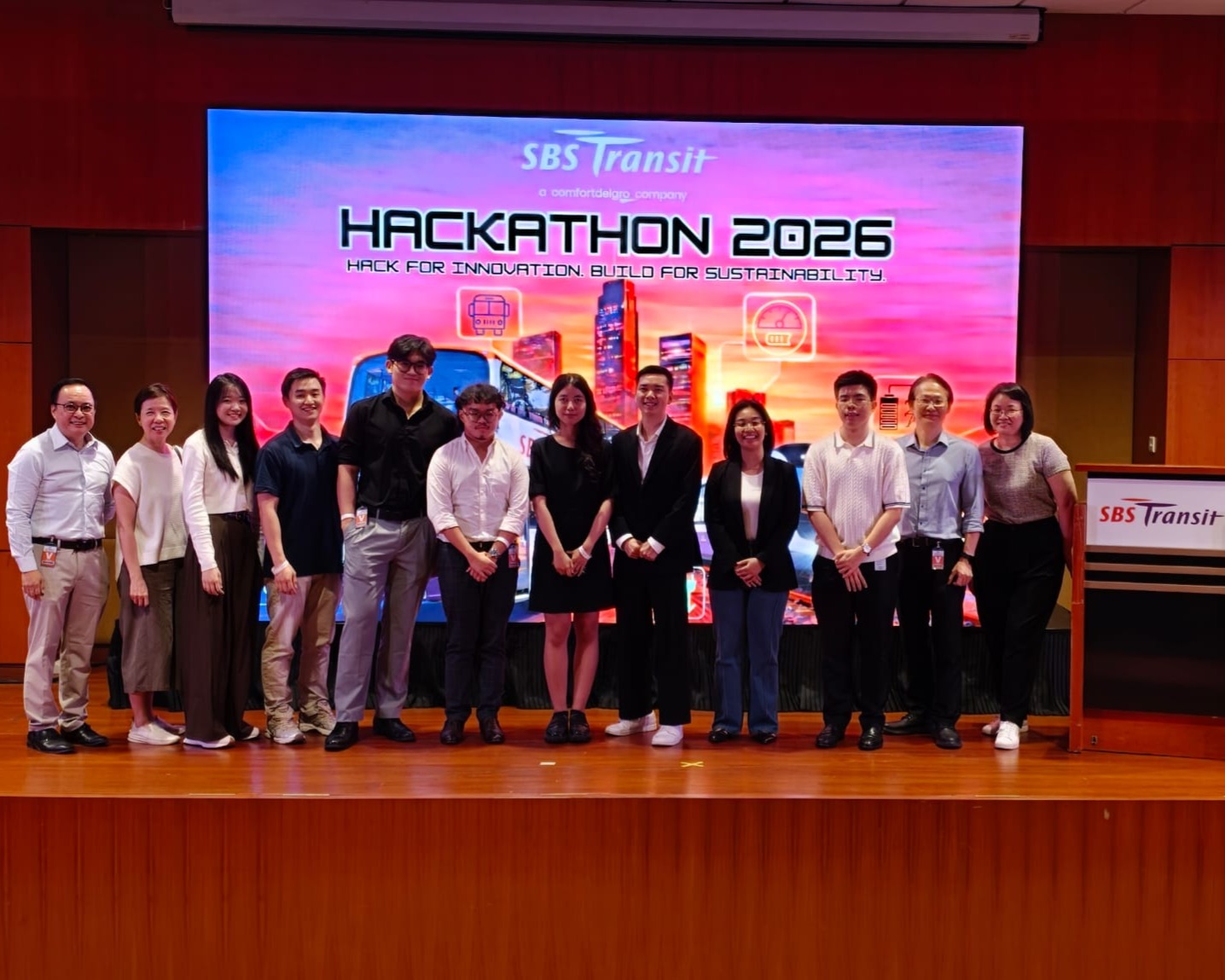
But at SBS Transit’s (SBST) recent hackathon, that was exactly the challenge. Teams tackled real industry problems to design smarter, greener, and more efficient solutions for commuters.
Two teams of first-year SIT students took it all on – from smarter energy consumption to locating parked buses in a multi-storey depot – to take top spots in their respective challenge tracks.
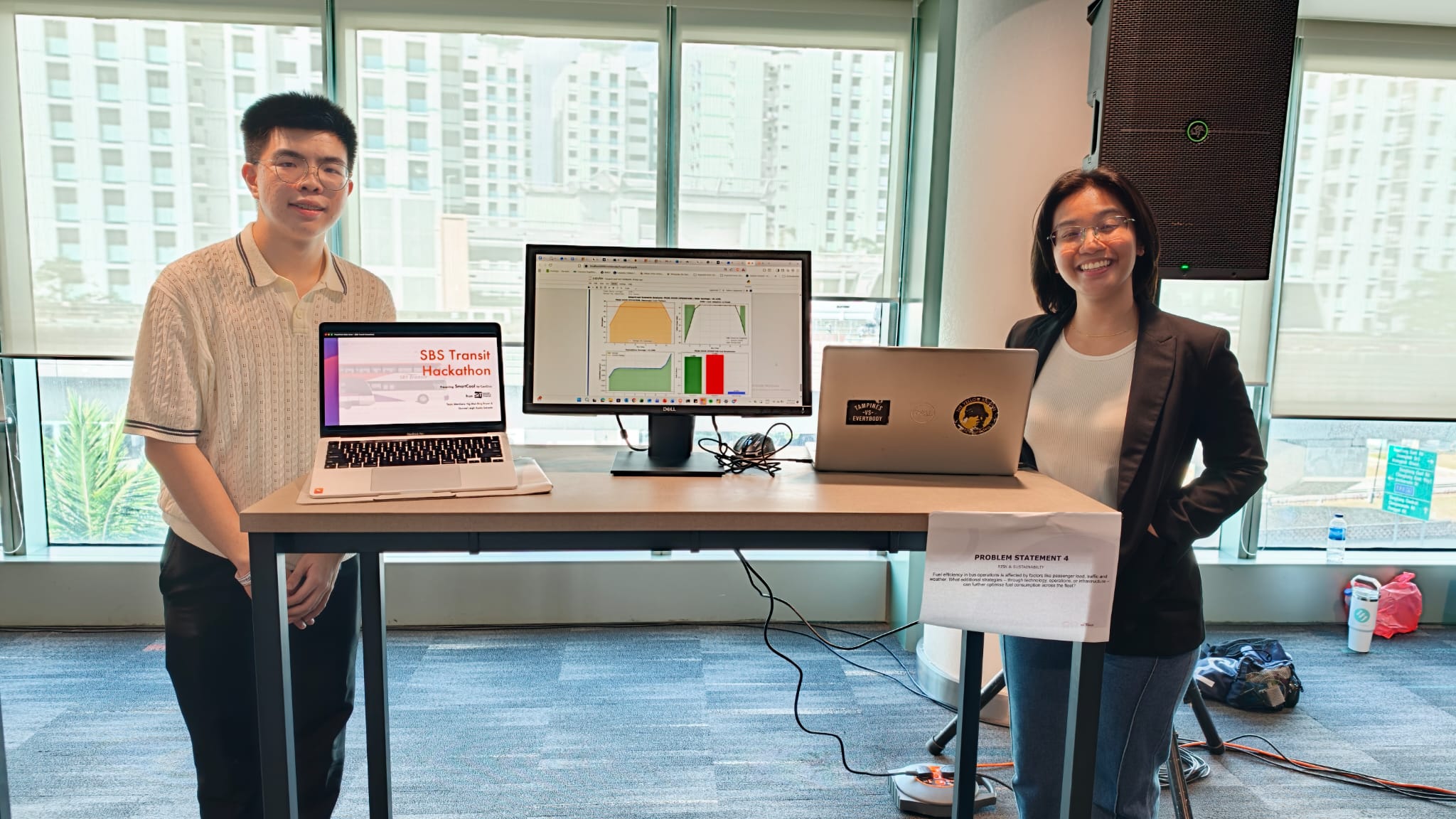
Team CoolDuo, comprising students Quinzel Leigh Ayala Salcedo from the Business and Infocomm Technology degree programme and Bryan Ng from the Aviation Management degree programme devised a system that improved energy efficiency and cut fuel costs by adjusting bus air-conditioning temperatures based on real-time passenger load.
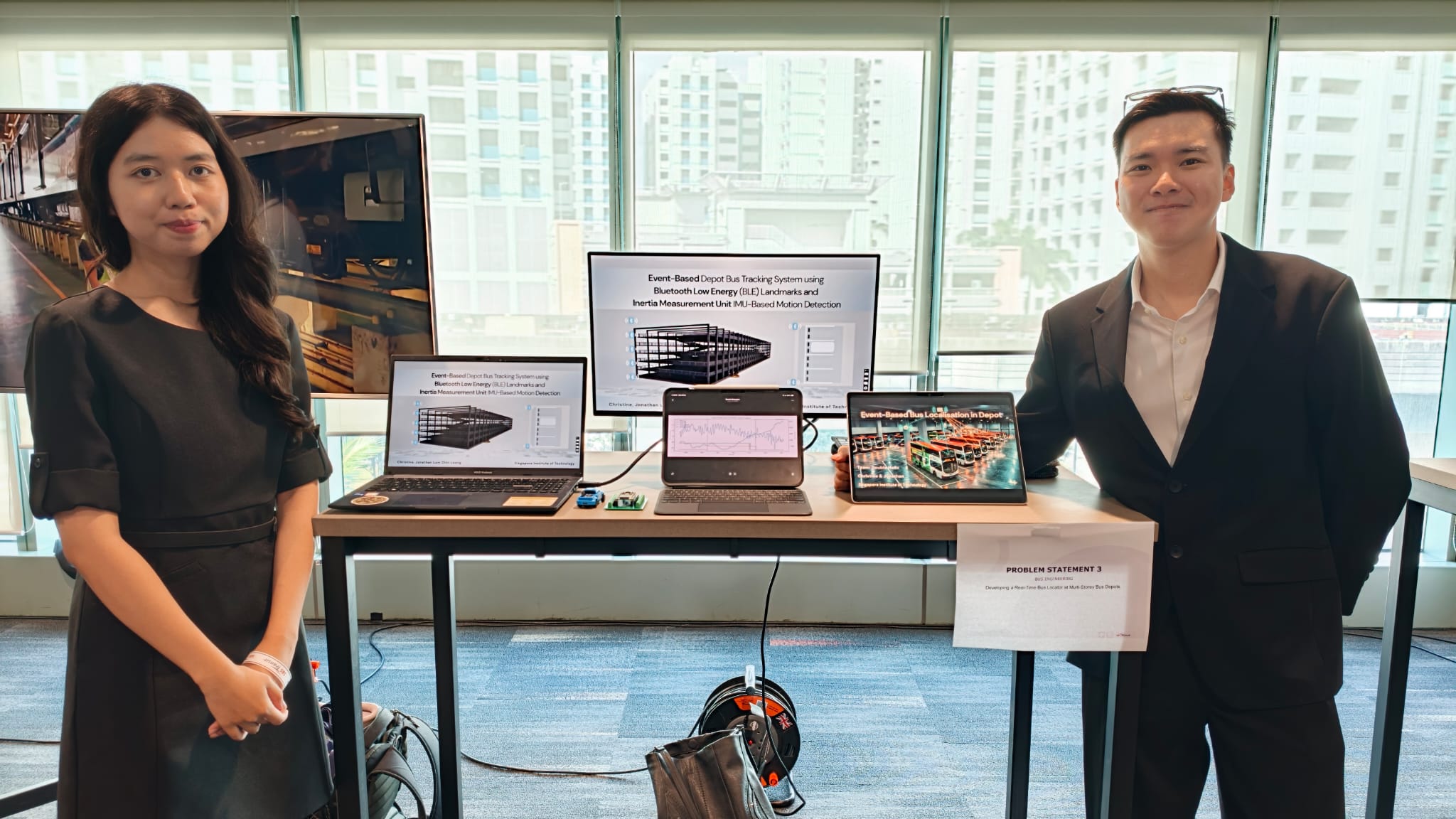
As for Team Double Helix, made up of students Jonathan Lum and Christine from the Engineering Systems degree programme, they developed a solution to improve operational efficiency even before a bus commences its journey: helping bus captains locate a parked bus using inertia measurement unit (IMU) and low-energy Bluetooth beacons in multi-storey depots where wifi is spotty.
Under Pressure to Design Real-World Solutions
The teams had just one week after the brief to prepare their proposal slides for their first submission.
For Team CoolDuo, they had to quickly get up to speed with how bus air-conditioning systems worked and how these could be optimised based on passenger load to save on fuel costs.
“It was tough as neither of us has a background in engineering. We just had to try our best to understand the technicalities of the system,” Quinzel said. But her teammate, Bryan was optimistic.
“The Heating, Ventilation, and Air Conditioning (HVAC) system can account for up to 25% of fuel consumption; we felt that a solution targeting this would be an interesting one to propose.”
With limited access to national passenger and HVAC data, the duo turned to case studies of overseas transport providers and worked closely with their assigned SBS Transit mentor.
For Double Helix, it often felt like they were taking one step forward and two steps back. Christine recounted how they had to rework their prototype as it did not meet cost requirements.
“It was frustrating, but that experience reflected real engineering constraints,” Christine said. “Instead of chasing technically perfect solutions, we learned to balance cost, feasibility, and practicality.”
As the competition progressed, so did the stakes and the pressure. The final stretch coincided with academic deadlines, forcing both teams to work through the night to juggle project submissions while refining prototypes and sharpening their pitches.
The realisation that pitch day meant presenting to the Group CEO, board members and senior executives of SBS Transit added another layer of intensity.
“We felt the pressure, but we were also excited by this valuable opportunity to pitch in a professional setting,” Bryan said.
Applied Learning in the Real World
For both teams, the hackathon offered an opportunity to apply lessons gleaned in a real-world context.
Modules like Engineering Graphics and even skills taught in the first trimester such as C-programming, came in handy in the development of Double Helix’s solution. “It was interesting to see how the foundational skills from just one and a half trimesters of ESE could come together in a single prototype,” Christine said.
For Team CoolDuo, their training offered a different, but equally powerful, edge. “In our coursework, we are taught to challenge the process and think critically. I believe that helped us in the hackathon by taking on a user-centric perspective,” Bryan said. Skills such as presentation and public speaking also gave them confidence to articulate their proposal with clarity on pitch day.
From Prototype to Practice
News of their first-place wins in their respective challenge tracks came as a welcome surprise, with both members of Team Double Helix receiving offers of an advanced IWSP attachment with SBS Transit.
Christine and Jonathan are looking forward to their upcoming IWSP attachment with SBS Transit in May next year, which they see as an opportunity to move beyond their prototype and bring their solution into real-world application. “It’s exciting that we will be working on the real-time bus locator further with the engineering team,” said Christine.
“Ultimately, I hope to use this experience to develop scalable transport solutions that successfully bridge the gap between engineering innovation and business reality.” Jonathan added.