














![[FA] SIT One SITizen Alumni Initiative_Web banner_1244px x 688px.jpg](/sites/default/files/2024-12/%5BFA%5D%20%20SIT%20One%20SITizen%20Alumni%20Initiative_Web%20banner_1244px%20x%20688px.jpg)
In collaboration with arts group The TENG Company, Associate Professor Peter Tay investigated how monaural beats — the rhythmic pulsing created by playing two different tones together, can affect emotional and cognitive symptoms of grief. His study found that these beats may potentially serve as an adjunctive therapeutic tool, particularly for alleviating emotional symptoms such as anxiety.
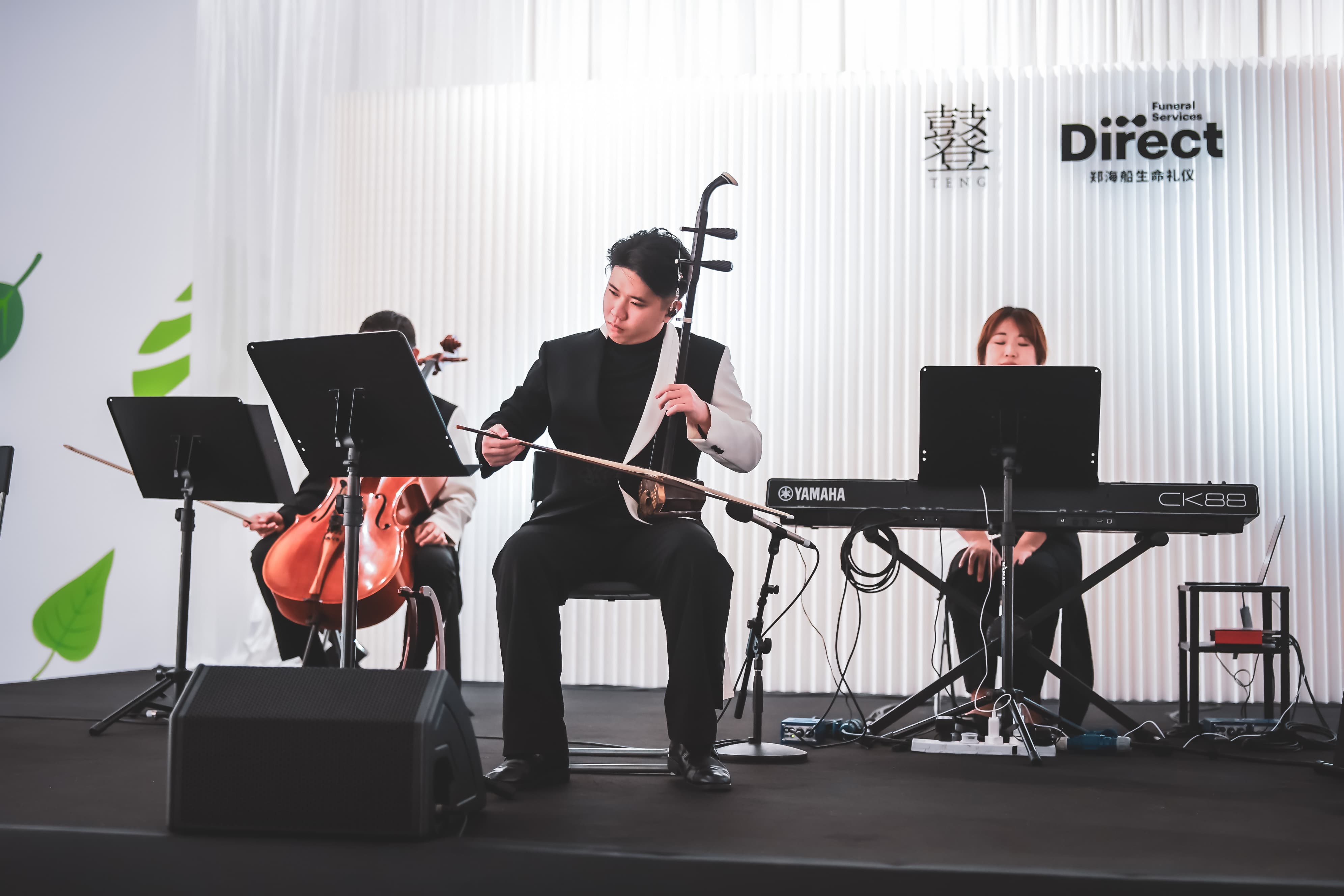
In collaboration with The TENG Company, A/Prof Peter Tay explores how rhythmic sound pulses known as monaural beats could help people manage anxiety and grief. (Photo: Direct Funeral Services and The TENG Company)
The 'Lofi Girl'—an animated figure synonymous with focus and study— is the face of a popular music genre known as lofi hip-hop. The chill, low-tempo beats have become the go-to soundtrack for anyone looking to find their 'flow' while working or learning.
On YouTube, similar playlists abound, designed for a range of purposes from promoting concentration, to relaxation, to sounder sleep. Their widespread popularity points to a shared understanding that sound and music possess an uncanny ability to shape people’s emotional states and even cognitive abilities.
At the Singapore Institute of Technology (SIT), this phenomenon was investigated at a deeper level. In collaboration with a Singaporean arts organisation The TENG Company (TENG), SIT Associate Professor Peter Tay from the Health and Social Sciences cluster studied how monaural beats overlaid with TENG’s music can alter the way individuals respond to grief. Because grief often comes with lingering sadness and heightened anxiety, it can make emotional regulation difficult, which is why it provides a meaningful context for investigating sound-based interventions. To create monaural beats, two pure tones of different frequencies are played to both ears, producing a rhythmic pulsing effect.
This builds on a previous joint study in 2022 on the effect of binaural beats — when two pure tones of different frequencies are played separately to each ear to produce an illusory third tone, it was found that such auditory stimuli can relieve anxiety.
“For binaural beats, while there’s been quite a lot of studies done, research on the impact of monaural beats on well-being only gained traction about five years ago,” A/Prof Tay said.

A/Prof Peter Tay leads SIT’s study on how monaural beats may help alleviate grief-related anxiety. (Photo: SIT)
Bringing the Beat Back
SIT’s partnership with TENG began in 2022 with the company’s Creative Director, Dr Samuel Wong. Inspired to incorporate binaural beats into TENG’s original music for sound therapy, Dr Wong wanted to work with an applied psychology expert to ascertain its impact on well-being.
As a research psychologist with over 15 years of experience and a musical background to boot, this was right up A/Prof Tay’s alley. “I have a personal interest in music too. I picked up the clarinet in secondary school and ended up joining the SAF (Singapore Armed Forces) band during my National Service,” he said.
This time, however, the collaboration focused on exploring whether monaural beats had the same therapeutic effect, particularly in the affective (emotional) and cognitive (thinking) processing of grief.
In the experiment, 249 participants were recruited through convenience sampling based on their accessibility and proximity to the researcher, and were gathered in a room. Each person was first asked to recount details of an experience with grief, such as the death of a loved one, in up to two paragraphs in an online survey. This methodology was adapted from a prior study. The current study on monaural beats has also received ethics approval and includes a post-experiment debrief. The researchers also offer a helpline for the participants as a precaution.
The participants were randomly assigned to one of two groups: a control group that listened only to TENG’s “Music for Mindfulness” instrumental track, and a stimulation group which listened to the same music overlaid with a monaural beat at a 40 Hz frequency. This frequency was observed to increase positive mood and arousal in EEG (electroencephalography) studies. Then, their emotions were assessed through a self-report and a series of cognitive tasks.
The results supported their hypothesis. “Simply put, listening to music with monaural beats lowered anxiety, especially for people with high anxiety profiles. It also helped participants inhibit sad emotions, suggesting that it might help people regulate their emotions better,” said A/Prof Tay.

The TENG Ensemble performing their latest release, Music for Comfort, live at the launch event. (Photo: Direct Funeral Services and The TENG Company)
Getting the Note Right
While this study represents an exciting first step in the emerging field of monaural beat research, there is potential for further exploration to build on the findings and test them on a more representative sample.
A/Prof Tay noted some unexpected findings, such as a reported increase in anxiety among participants who had a comparatively lower baseline anxiety. These variations suggest that individuals may respond differently to sound stimulation, opening avenues to tailor interventions to personal needs. He posited that the frequency of the beat could have different effects, depending on one’s natural anxiety profile, offering a rich area for future investigation.
For now, a group of A/Prof Tay’s students is conducting a follow-up study comparing 40 Hz and 5 Hz monaural beats to ascertain their effects on cognitive performance, such as attention. 40 Hz frequencies may enhance concentration by assisting in the production of gamma brainwaves, while 5 Hz frequencies are more commonly associated with theta brainwaves, which are linked to deep relaxation.
Said A/Prof Tay: “There is some potential in using monaural beats as a practical tool for emotion regulation. It’s accessible as you can easily share this music on public domains like YouTube and SoundCloud; you don’t have to go to a clinic. It is also non-invasive and just like listening to normal music.”
Monaural beats may not yet be a mainstream tool to relieve stress and anxiety, but for some, they offer a way to find some harmony in the chaos of life.