











![[FA] SIT One SITizen Alumni Initiative_Web banner_1244px x 688px.jpg](/sites/default/files/2024-12/%5BFA%5D%20%20SIT%20One%20SITizen%20Alumni%20Initiative_Web%20banner_1244px%20x%20688px.jpg)
- Launch of Singapore’s first Maritime Engineering Doctoral Training Centre (MEDTC) to train the next generation of industry-ready maritime engineering leaders.
- Introduction of a new Master of Science in Vessel Management, co-developed with DNV in partnership with the Maritime and Port Authority–Singapore Maritime Foundation (MPA-SMF) Joint Office for Talent and Skills to equip professionals with practical, industry-relevant skills for modern vessel operations.
- Strategic partnerships and MOUs with MPA and key industry stakeholders to strengthen maritime cybersecurity, drive innovation, and build a future-ready workforce for Singapore’s maritime sector.
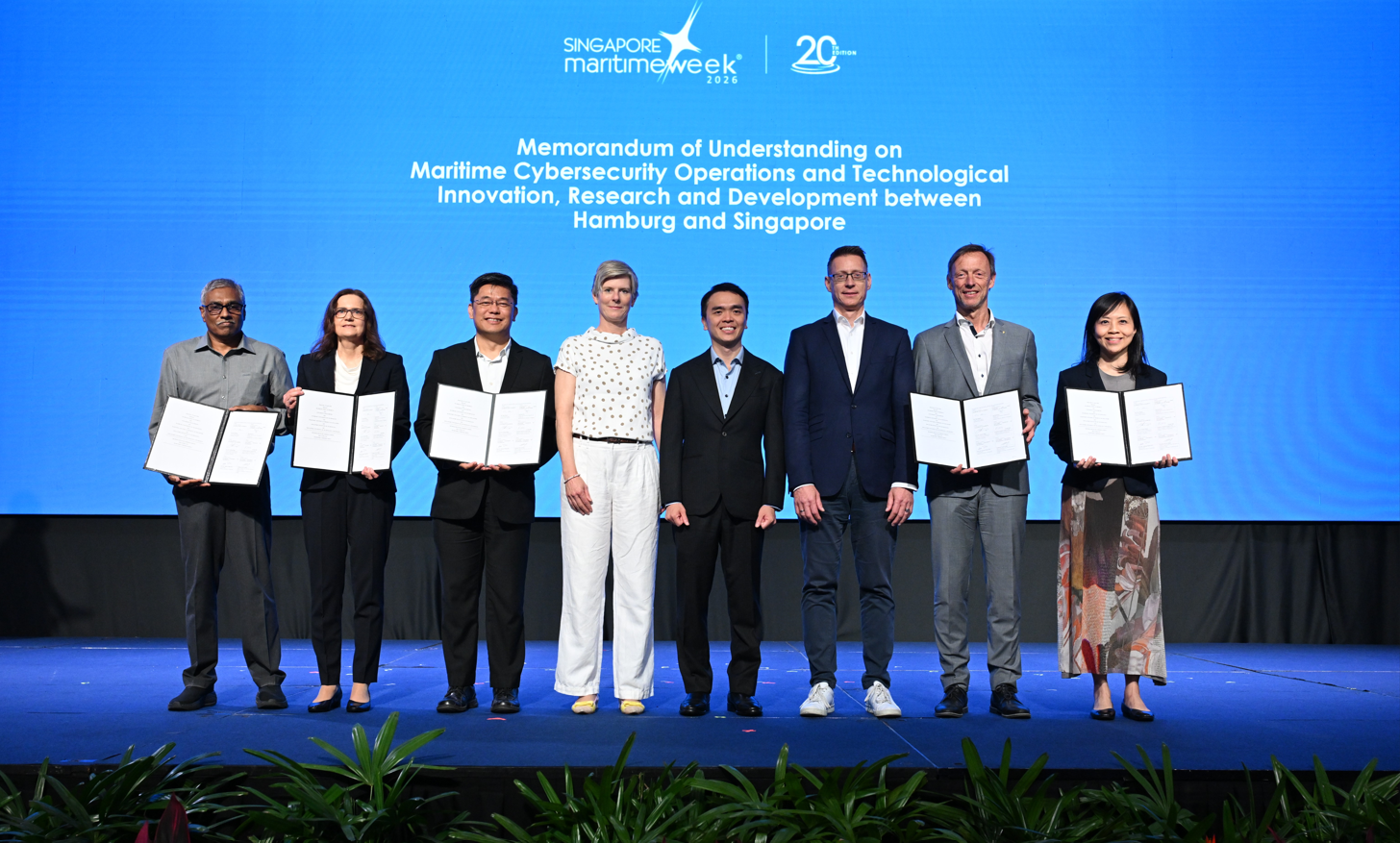
Singapore Maritime Week 2026. (Photo Credit: MPA)
In conjunction with the Singapore Maritime Week (SMW) 2026, the Singapore Institute of Technology (SIT) today announced a suite of new initiatives to strengthen Singapore’s maritime talent pipeline and support the sector’s transformation towards decarbonisation, electrification, and digitalisation. These initiatives include the launches of Singapore’s first Maritime Engineering Doctoral Training Centre (MEDTC), as well as a new Master of Science in Vessel Management co-developed with DNV, and in partnership with the Maritime and Port Authority-Singapore Maritime Foundation (MPA-SMF) Joint Office for Talent and Skills. SIT also inked several strategic partnerships with MPA and key industry partners.
Doctoral Training Centre Advancing Maritime Talent Development
Supporting Singapore’s maritime sector’s rapid transformation is SIT’s MEDTC, Singapore’s first doctoral training centre dedicated to deepening maritime engineering capabilities. It aims to equip specialists with advanced technical expertise and operational insight, preparing the next generation of maritime engineers to tackle complex challenges and lead Singapore’s maritime sector into the future.
As an industry-integrated platform that enables applied, real-world research, the centre supports Industrial Doctorate and Industrial Master’s (ID/IM) projects co-developed with industry partners and embedded in operational environments, ensuring research outcomes are directly relevant and implementable to industry needs and Singapore’s maritime transformation. Unlike traditional, academically driven doctoral programmes, SIT’s ID/IM programmes are distinguished by a student profile made up predominantly of working professionals from partner companies. This model enables companies to upskill and retain talent through research, while ensuring that projects are grounded in real operational challenges. SIT’s ID/IM programmes that leverage MEDTC benefit from the real-world industry projects that aim to address critical challenges. These include electric harbour craft design, battery safety, vessel systems integration, and operational optimisation. Through SIT’s role as the lead of the Future Ship & System Design[1] programme, research done through MEDTC contributes to sustainable ship design, operational efficiency, and Singapore’s ambition for a greener port ecosystem.
Among the MEDTC doctoral candidates is Ong Wen Qi, whose work focuses on battery fire safety for electric harbour craft—an emerging concern as the industry transitions to electrification. She shares, “Addressing real-world challenges such as battery fire safety has been both daunting and fulfilling. Through MEDTC, I have been able to work closely with industry partners across the maritime value chain, which has helped me better understand how my research contributes to making marine electrification safer and more viable for Singapore.”
Another doctoral candidate, Arvin Singh, will focus on developing a quantitative modelling framework to support maritime decarbonisation infrastructure planning. Drawing on his professional experience at DNV’s Maritime Decarbonisation & Smart Shipping Centre of Excellence, Arvin’s research will link real vessel activity data with future fuel transition scenarios to help ports and maritime operators make more informed, data-driven decisions about alternative fuel infrastructure and low-carbon technology pathways.
His work will address a key challenge faced by ports today. While the need to decarbonise is clear, there remains significant uncertainty around how quickly alternative fuels will scale, what infrastructure will be required, and how investments should be phased over time. By combining Automatic Identification System (AIS) vessel data with maritime fuel adoption forecasts, Arvin’s research aims to move infrastructure planning from broad assumptions to more realistic, evidence-based modelling.
“Through my work in maritime decarbonisation projects, I realised that many of the industry’s challenges cannot be solved through theoretical approaches alone. The industrial doctorate will allow me to bridge industry practice with structured research, so that the work is not only academically rigorous but also directly relevant to real-world maritime decision-making. I hope this research can contribute to helping Singapore and the wider industry plan more confidently for the decarbonisation transition.” Arvin Singh said.
New Master’s Programme in Vessel Management to Build Industry-Ready Talent
SIT is also introducing a new Master of Science (MSc) in Vessel Management targeted to commence in early 2027. Developed in collaboration with DNV, the programme responds to the maritime sector’s need for more industry‑ready vessel managers amid growing operational complexity, tighter regulatory requirements and the transition towards more sustainable vessel operations. The programme addresses the shortage of qualified technical and marine superintendents by equipping learners with the skills to manage safety, compliance and performance in real‑world maritime environments.
The MSc in Vessel Management adopts a flexible, competency-based, and practice-oriented pathway, combining SIT’s applied learning pedagogy with DNV’s global industry expertise. Learners will acquire both technical mastery and managerial competence, be prepared to lead vessel operations, ensure regulatory compliance, optimise performance, and drive innovation across the maritime value chain. By integrating classroom learning with advanced simulations, on‑the‑job training and industry projects, learners gain hands‑on exposure to digitalisation, decarbonisation, systems integration and operational risk management.
The programme comprises technical, management, and elective domains, designed on a competency-based model that allows learners to build practical skills, operational judgement, and leadership acumen needed to navigate evolving maritime challenges while tailoring their learning to their career stage and interests.
By providing an alternative pathway for engineering graduates and mid-career professionals, the programme strengthens Singapore’s pipeline of industry-ready maritime talent, empowering learners to translate applied knowledge into practical solutions and supporting companies in cultivating a resilient, skilled workforce that can meet the demands of a digitalised, sustainable, and future-ready maritime sector.
“Superintendent roles increasingly require not only technical expertise and operational judgement, but a deep understanding and effective application of today’s emerging technologies. Through this programme, DNV and SIT aim to equip the maritime workforce with the applied knowledge and practical competence needed as the industry transitions towards more digital and lower carbon operations, helping companies build long term resilience,” said Dr Shahrin Osman, Business Development Director at DNV Maritime Advisory in Singapore."
Deepening Collaboration Through Strategic Partnerships
At SMW 2026, SIT signed three Memoranda of Understanding (MOUs), as well as four Research Collaboration Agreements (RCAs) with DNV, Jurong Port, RINA and Zeabuz to advance maritime research, innovation, and workforce development. In particular, the RCA with DNV will support the development of remote and autonomous maritime capabilities through applied research and upskilling across technical, operational, and training domains. This includes work related to shore-based Remote Operations Centres (ROC) for selected bunker vessel functions, as well as the development of frameworks to support remote operations and strengthen operational readiness. The collaboration will also leverage SIT’s Future Ship and System Design (FSSD) Lab to explore operational concepts for remote and autonomous vessel functions, supporting industry readiness for more digitally enabled maritime operations. There will also be knowledge‑sharing between academia, research and industry, to help build the skills needed for new operating models.
An MOU was signed with the Maritime Cybersecurity Collaboration with the Maritime and Port Authority of Singapore (MPA), Hamburg Port Authority, University of Hamburg, Hamburg University of Technology and Singapore University of Technology and Design that aims to strengthen maritime cybersecurity capabilities through joint research, training and operational initiatives. A framework will be developed to enhance cyber resilience across maritime operations, including incident reporting, simulation‑based exercises and research into emerging technologies, with SIT contributing expertise in operational technology cybersecurity and supporting training and knowledge exchange.
An MOU was also signed with MPA-PSA Marine to support a hybrid internship programme, giving SIT students exposure to both industry practices and government policy in the decarbonisation of the harbour craft sector.
Another MOU was inked with Singapore Polytechnic Centre of Excellence in Maritime Safety (CEMS), Sea Forrest and Pyxis to develop practical training for electric harbour craft operators. The training will incorporate best practices including SIT’s research outcomes in battery thermal incidents and failures. It will feature realistic scenarios and decision-making exercises covering operations, maintenance and emergency response.
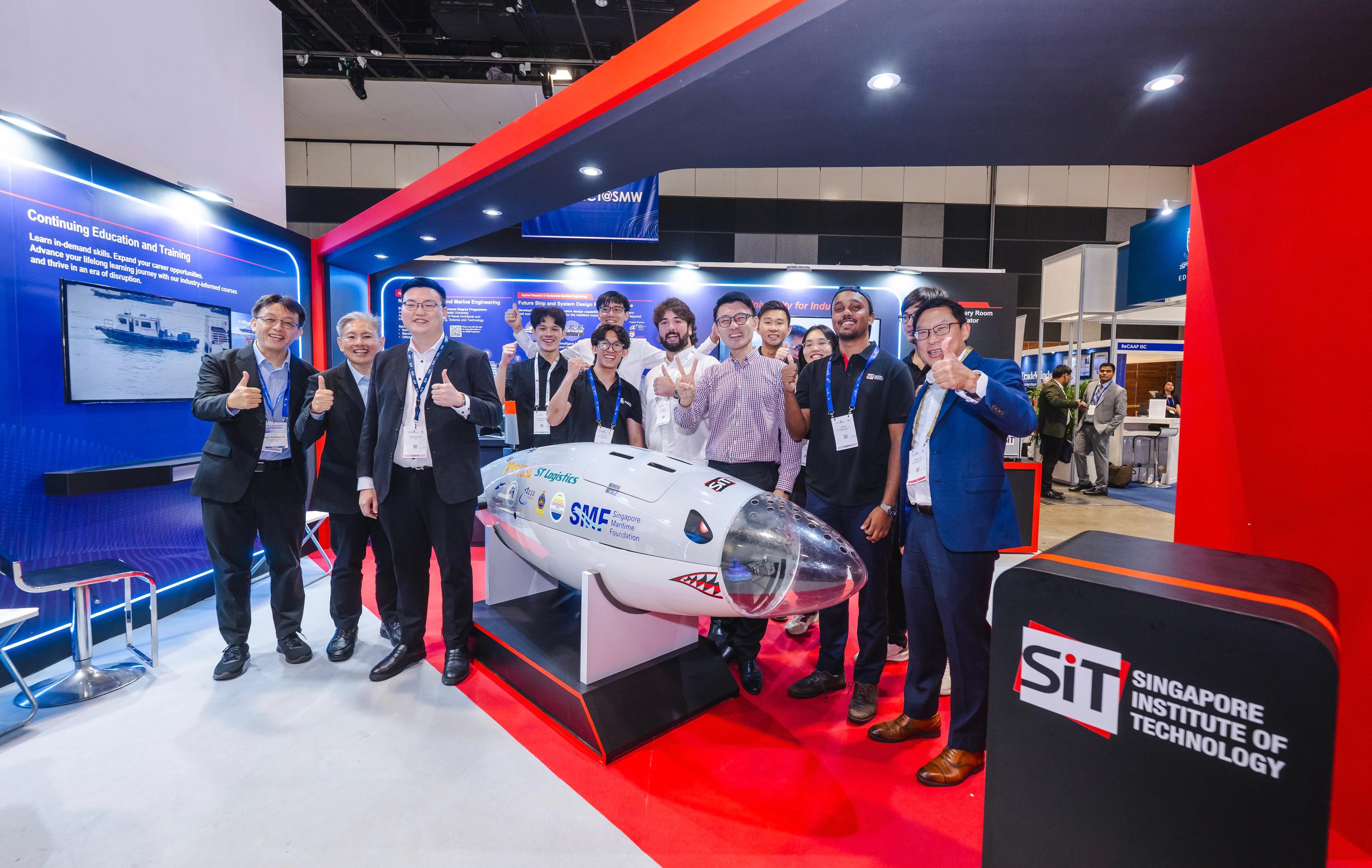
Welcoming Minister of State Baey Yam Keng to SIT’s booth at SMW 2026. (Photo Credit: Ministry of Transport)
“As Singapore’s maritime sector charts a future defined by digitalisation, decarbonisation, and global connectivity, SIT, as the University for Industry, is committed to developing the next generation of maritime leaders. Through applied learning and research embedded in real-world operations, we equip talent with the expertise, insight, and an innovative mindset needed to steer Singapore’s maritime sector into the future,” said Professor Susanna Leong, Deputy President (Academic) & Provost, SIT.
About Singapore Institute of Technology
As the university for industry and Singapore's first university of applied learning, the Singapore Institute of Technology (SIT) offers industry-relevant degree programmes that prepare its graduates to be work- and future-ready professionals. Its mission is to maximise the potential of its learners and to innovate with industry, through an integrated applied learning and research approach, so as to contribute to the economy and society.
The University’s unique pedagogy integrates work and study, embracing authentic learning in a real-world environment through collaborations with key strategic partners. Its focus on applied research with business impact is aimed at helping industry innovate and grow. SIT’s new centralised campus within the larger Punggol Digital District features a vibrant learning environment where academia and industry are tightly integrated with the community.
For more information, visit www.SingaporeTech.edu.sg
1] The Future Ship & System Design (FSSD) is a national programme led by SIT, initiated by MPA and Singapore Maritime Institute (SMI), to advance sustainable and energy‑efficient ship design. FSSD focuses on developing and validating technologies for electric harbour craft to support maritime decarbonisation, operational efficiency and talent development. For more information: https://www.singaporetech.edu.sg/news/sailing-towards-greener-horizon-together