











![[FA] SIT One SITizen Alumni Initiative_Web banner_1244px x 688px.jpg](/sites/default/files/2024-12/%5BFA%5D%20%20SIT%20One%20SITizen%20Alumni%20Initiative_Web%20banner_1244px%20x%20688px.jpg)
Learners from SIT’s inaugural run of its Graduate Certificate in Sustainability Principles and Practices share how the course has empowered them to make greener choices at work.
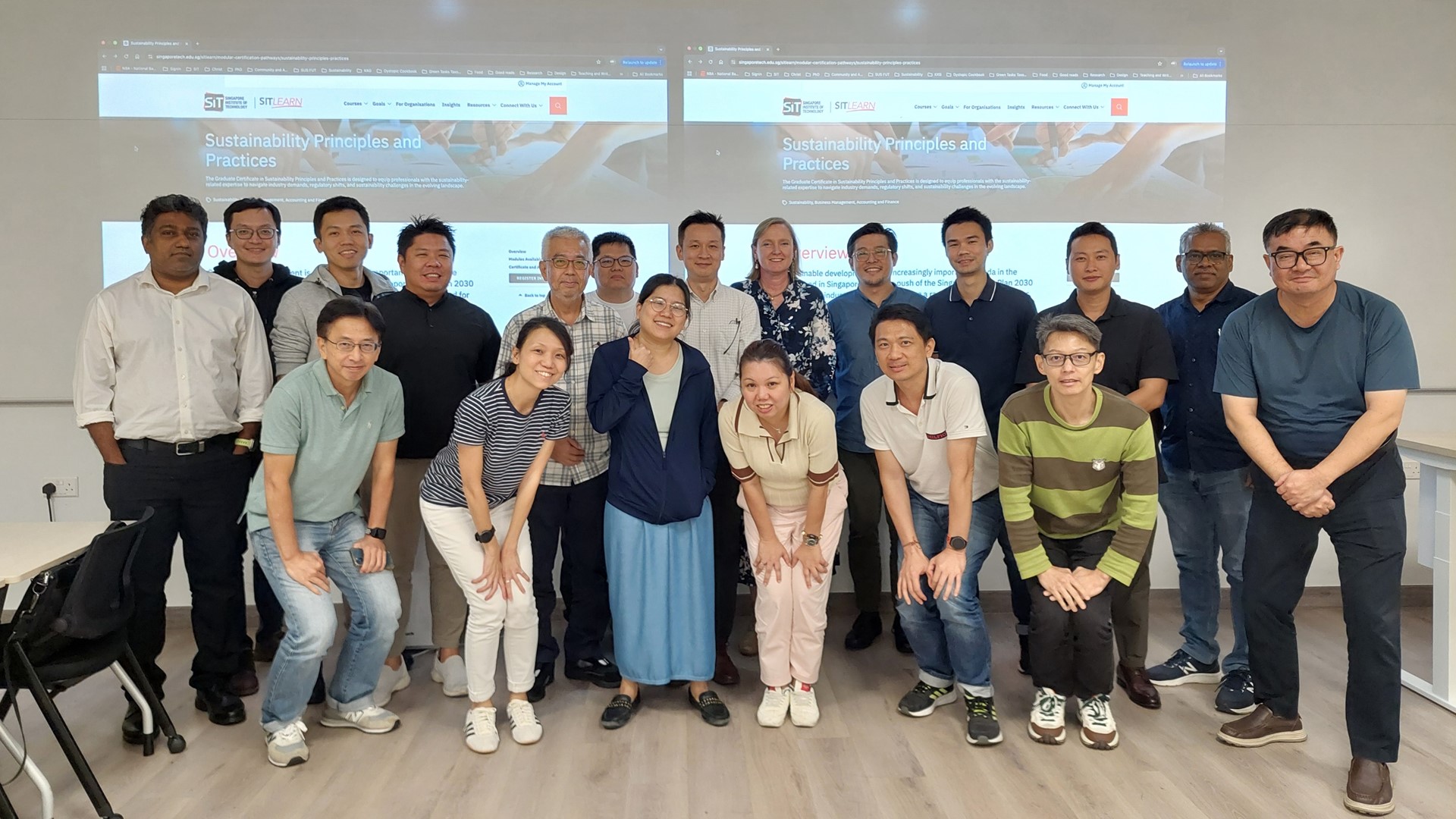
The class from the Graduate Certificate in Sustainability Principles and Practices course. (Photo: Mark Teo)
Ramesh Subramaniam was on vacation with his family in Sri Lanka when Cyclone Ditwah struck. Determined to make the best out of his holiday, they braved days of torrential rain, only staying indoors when absolutely necessary. When his sister-in-law’s van stalled during a flood, Ramesh got out of his vehicle to push the van through the water.
Although the family made it out relatively unscathed, the unexpected experience reinforced his belief in the importance of sustainability.
“It’s the only Earth we’ve got. We’re not going to get on a spaceship and fly to Mars,” said the 44-year-old project manager at engineering consultancy Jacobs International Consultants.
The situation is dire: seven of the nine planetary boundaries[1] that regulate the stability of Earth’s system have already been breached, with climate change being one of them. Beyond growing environmental consciousness, legal requirements are further underscoring the urgency of sustainability. To achieve Singapore’s goal of having 80 per cent of buildings be green by 2030, mandatory environmental sustainability standards have been raised[2]. These include higher minimum energy performance requirements for new and existing buildings that undergo major retrofitting, as well as a higher Green Mark standard for all Government Land Sales sites.
For Ramesh, signing up for the Graduate Certificate in Sustainability Principles and Practices course at the Singapore Institute of Technology (SIT) was a no-brainer. With the essential sustainability skills and practices he is gaining from the ongoing programme, he hopes to eventually apply for the Institution of Engineers Singapore’s (IES) Chartered Engineer in Sustainability certification.
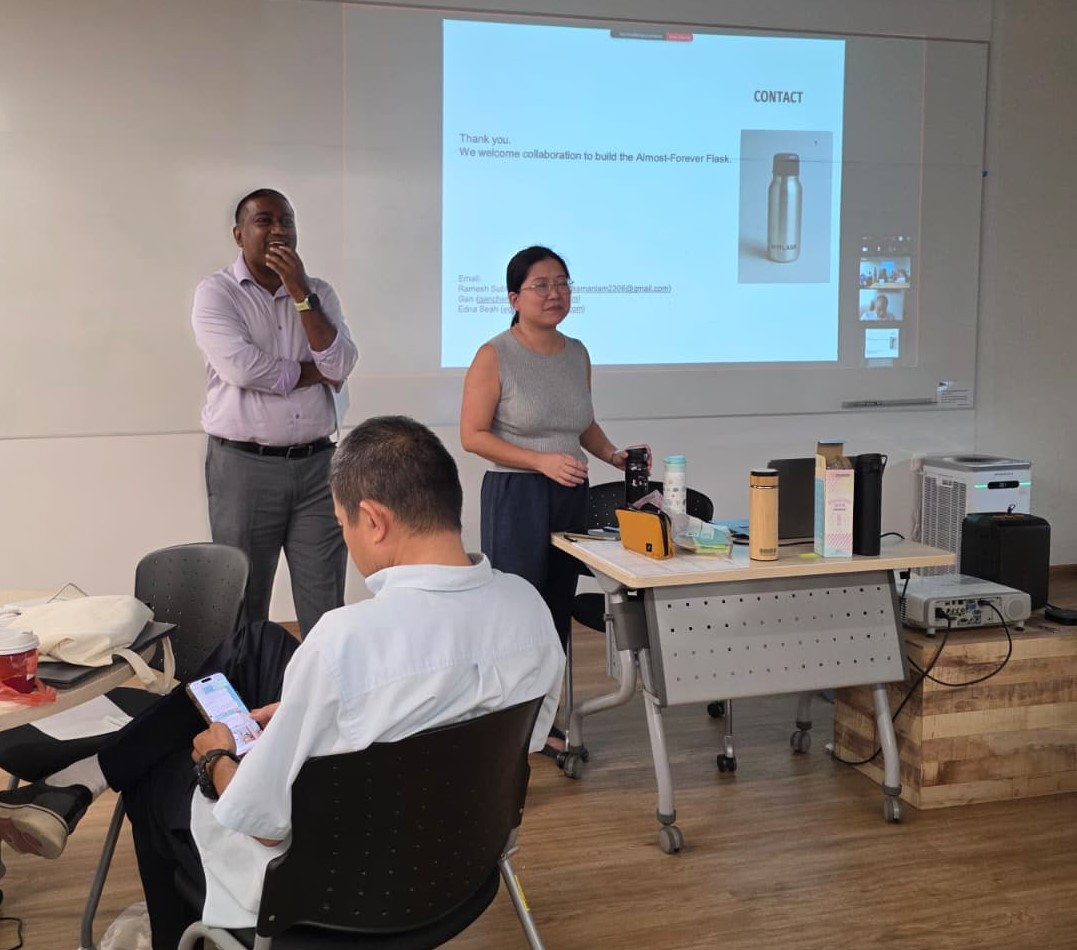
Learners Ramesh Subramaniam (left) and Edna Seah giving a presentation during a class at the Graduate Certificate in Sustainability Principles and Practices course. (Photo: Ramesh Subramaniam)
“Engineers are the backbone of everything. If you can capture sustainability in that basic building block, then it will trickle down to the rest of society,” he said.
Establishing Solid Foundations
Sustainability is more than a corporate buzzword in SIT’s Graduate Certificate programme. Its rigorous curriculum covers everything from specific hands-on skills like carbon accounting to higher-level topics, including sustainability legislation and the carbon market.
A distinctive strength of the Graduate Certificate is its roster of industry practitioners who co-develop and teach the modules. Learners gain firsthand insights into real-world sustainability implementation — from compliance requirements to technological innovations and sector-specific challenges. This practitioner-led approach ensures that graduates emerge not only with academic knowledge but with work-ready competencies that employers increasingly demand.
“Sustainability is actually very technical,” said Gan Cheng Chian, 60-year-old technical manager at Belgian steel wire transformation and coatings company Bekaert. “People often think of it as a broad ideal or a corporate initiative, but on the ground, it comes down to hard engineering decisions, precise calculations and an understanding of how materials behave throughout their entire lifecycle. Without that technical foundation, it’s impossible to make meaningful change.”
Having been in the construction industry for over 30 years, he noted that the cement industry accounts for 8 per cent of the world’s total carbon emissions, with cement being the second most consumed material in the world after water.
While Cheng Chian belongs to a generation of engineers for whom sustainability was not part of their formal training, he has made it a priority to equip himself with these critical skills. “If we have no clue how to replace certain materials to be greener, or how to calculate greenhouse gas emissions numbers, we are in trouble,” he said.
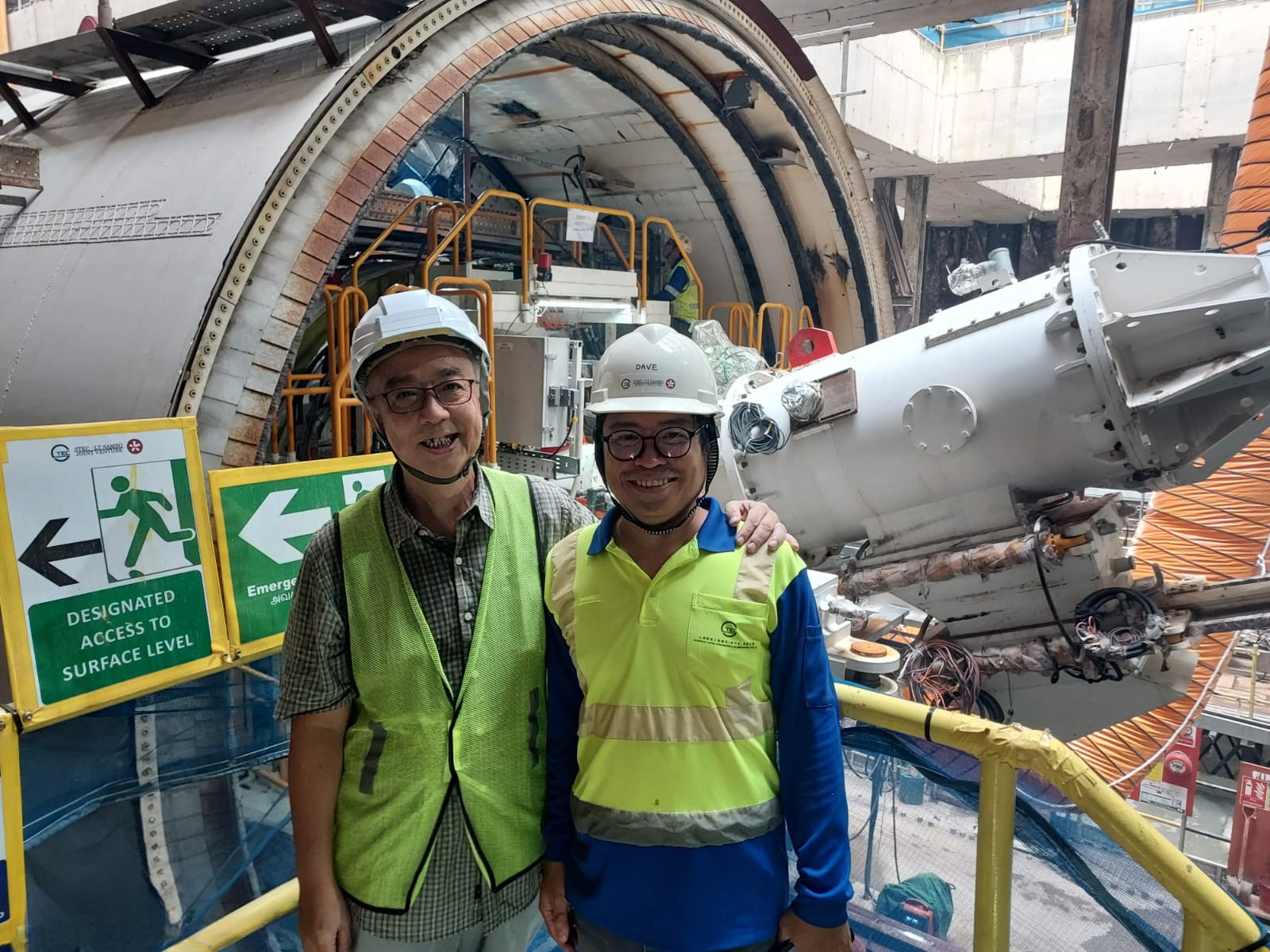
Gan Cheng Chian (left) with his co-worker at work. (Photo: Gan Cheng Chian)
Through the course, Cheng Chian was introduced to and acquired useful frameworks to calculate carbon emissions and conduct life cycle analyses. These came in useful for his low-cement concrete mix project at work, which aims to cut carbon emissions by 70 per cent by using slag, a byproduct of steel production.
Similarly, Ramesh has put sustainability into practice by working with his supplier to minimise fibreglass waste generated from repairing water and sewage pipes by potentially reusing it as strengthening material for concrete.
“Having the ability to zoom in and out of one’s scope of work is essential for addressing sustainability challenges that are complex and multi-faceted. The uniqueness of the Graduate Certificate lies in its practical orientation, giving learners the knowledge and skillset to start working,” said Associate Professor Ethan Chong, one of the course’s trainers.
Shifting Gears
For Edna Seah, 38, who works at a German engineering company and is concurrently pursuing a Master of Science in Electrical and Electronic Engineering at SIT, the course provided an entirely new framework for thinking. In particular, the module on circular economies opened her eyes to a different approach to resource use and design.
“The circular economy is more than recycling. In fact, recycling is the last resort because it is an energy-intensive process. That was very eye-opening for me,” she said, explaining that recycling reduces a product’s value to zero, while repairing it preserves most of that value.
In a group project with classmates Cheng Chian and Ramesh, Edna investigated how to extend the lifespan of a thermal bottle. They found that it would be far less wasteful to replace a mouldy rubber gasket with a new one than to replace the entire bottle itself — a practice that some companies are already adopting by offering spare parts or repair services.
The course goes beyond shifting its learners’ mindsets, enabling them to influence others towards a common goal at their workplace.
Edna said, “What’s usually lacking is alignment between all the different stakeholders. With sustainability knowledge, engineers are better able to advise ways to achieve sustainability outcomes.”
Ramesh added, “I want to use these credentials to get people to think about sustainability in their projects. Some mega projects are worth billions, so sustainability at such a big scale would definitely have substantial effects.”
The second run of the Graduate Certificate in Sustainability Principles and Practices will commence in March 2026. For more information, click here.
[1] https://www.pik-potsdam.de/en/news/latest-news/seven-of-nine-planetary-boundaries-now-breached-2013-ocean-acidification-joins-the-danger-zone