









![[FA] SIT One SITizen Alumni Initiative_Web banner_1244px x 688px.jpg](/sites/default/files/2024-12/%5BFA%5D%20%20SIT%20One%20SITizen%20Alumni%20Initiative_Web%20banner_1244px%20x%20688px.jpg)
We can only look in one direction at a time — but what if our roads could detect danger before we see it? At SIT, Associate Professor Dan Chia is leading a project that enables drivers and autonomous vehicles to anticipate danger before it happens.
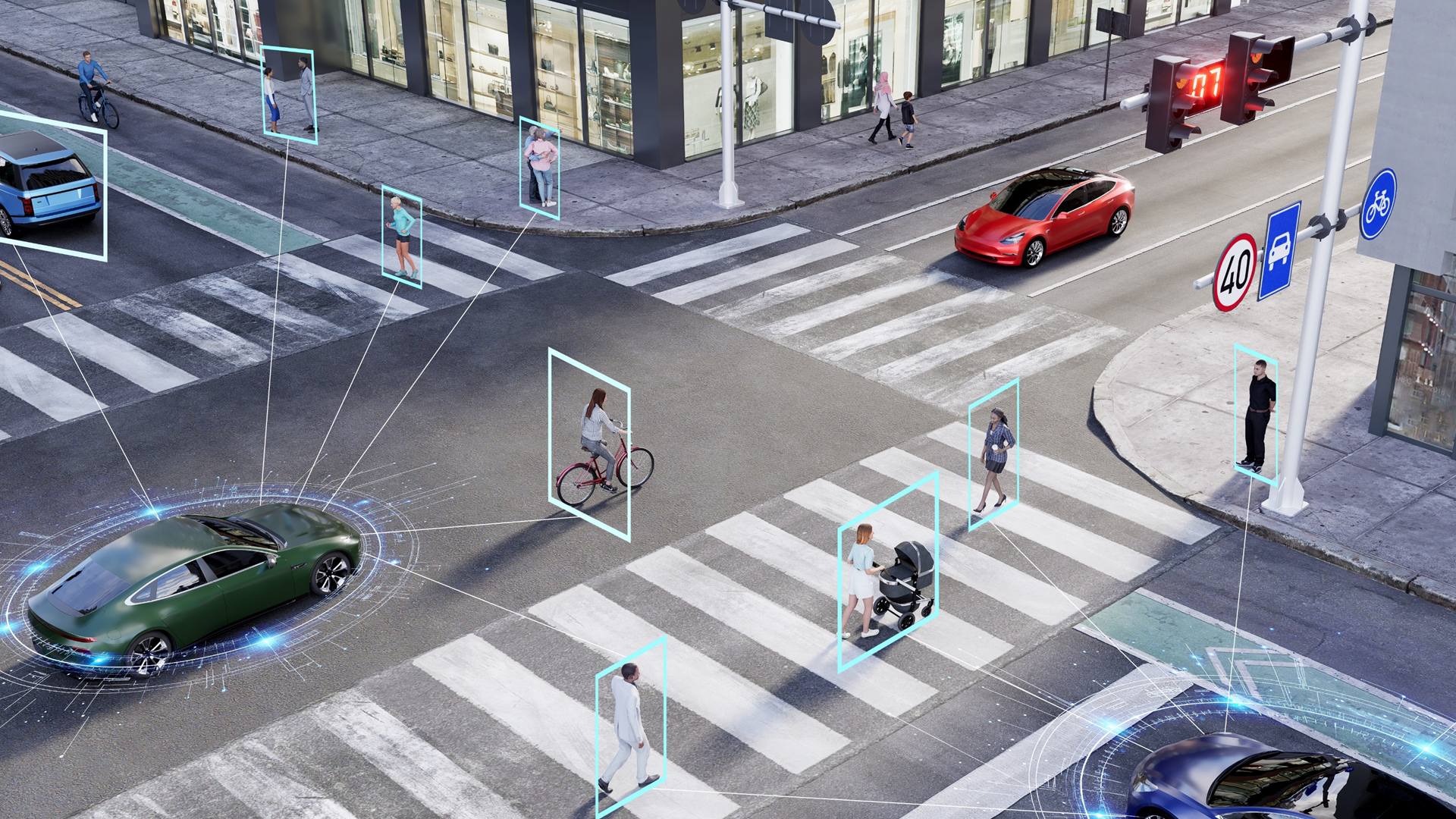
Safer roads start with seeing beyond the driver's line of sight. What if our roads could detect danger before we do? (Photo: Shutterstock Images)
Drivers are taught to first look ahead, glance left, then right, before moving. But at any given moment, a driver sees only a fraction of what is happening around them.
Hazards often emerge not because they are invisible, but because they fall outside a driver’s immediate field of view — a pedestrian stepping out from a blind spot, a vehicle stalled just beyond a corner, or a turning car obscured by traffic flow.
“Drivers can only focus on one area at a time,” said Singapore Institute of Technology (SIT) Associate Professor Dan Chia from the Infocomm Technology Cluster. “You could be looking out on the right, but something’s happening on the left.”
While local data is unavailable, findings from abroad offer some insights. In 2024, the Road Transport Department in Kuala Lumpur listed blind spots as one of the top five causes of accidents with heavy vehicles. In Singapore, traffic accidents have been rising. The total number of traffic accidents resulting in injuries and fatalities rose by 8.9 per cent to 3,818 in the first half of 2025, up from 3,507 in the same period a year earlier. Fatal accidents increased by 11.4 per cent, while overall casualties also continued to climb. Vulnerable road users, particularly motorcyclists and elderly pedestrians, remain disproportionately affected.
A/Prof Chia is leading the effort at SIT to address this critical gap in awareness. His work centres on a clear proposition: if drivers cannot access complete information, the road environment itself must help fill those gaps.
Moving from Reaction to Anticipation
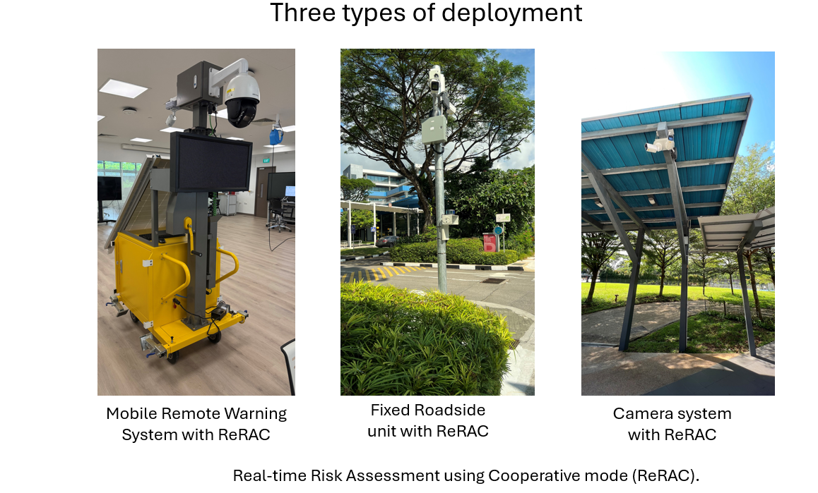
Three deployment modes of the ReRAC system: a mobile remote warning system, a fixed roadside unit, and a camera system integrated with ReRAC (SIT Photo: Dan Chia)
Known as the Real-time Risk Assessment Cooperative Mode (ReRAC), A/Prof Chia’s system is built on a shift in thinking: from reacting to hazards, to anticipating them.

A/Prof Dan Chia, whose Real-time Risk Assessment Cooperative Mode (ReRAC) system shifts road safety from reacting to hazards to anticipating them. (SIT Photo: Dan Chia)
Here is what that looks like in practice. A driver approaches an unregulated junction. Around the corner, hidden from the driver’s view, a pedestrian is stepping off the pavement. Before the driver notices the pedestrian, a roadside camera mounted nearby has already detected and calculated the risk of collision and triggered an audio alert to the driver’s phone or in-car display within milliseconds.
Instead of a distracting video feed, the system transmits a compact stream of data: a risk score on a scale of zero to ten, alongside a time-to-collision figure that tells the driver, in seconds, how long they have to respond.
This processing takes place entirely within the roadside unit itself, keeping the data lean and the transmission fast. With a wide enough deployment, hundreds of such units could feed simultaneous warnings to drivers and autonomous vehicles (AVs) without overwhelming the network.
From Research to Real-world Deployment
A/Prof Chia built ReRAC through a multi-partner collaboration spanning academia, industry and government agencies. Local AV technology firm MooVita, led AV testing and compared the performance of 5G communication against an older standard — dedicated short-range communication, or DSRC, which has a more limited transmission range.
The work was also supported by Strides Frontiers (a business arm of SMRT Corporation) and the University of Glasgow, along with the National Research Foundation and the Land Transport Authority (LTA) under the Urban Mobility Grand Challenge Programme.
Crucially, ReRAC has moved beyond conceptual development into real-world testing. The system was deployed at Ngee Ann Polytechnic from 2021 to 2025, where traffic conditions like unregulated junctions and high pedestrian activity provided a challenging and realistic environment — precisely the conditions the system is designed to address.
During the trials, the team observed a measurable behavioural impact. Between 57 and 60 per cent of drivers reduced their speed after receiving the alerts, while a majority found the audio warnings useful and effective.
Enabling Autonomous Mobility
While ReRAC enhances safety for human drivers, its long-term significance lies in its role within autonomous mobility systems.
Autonomous vehicles depend heavily on onboard sensors, which can detect objects up to 100 to 200 metres away. But they are just as blind as any human driver the moment its visibility is obscured. Infrastructure-based systems like ReRAC provide an additional layer of environmental awareness — one that extends beyond the vehicle itself.
“We are using past and present data to actually forecast and help you make your drive or the autonomous drive safer,” said A/Prof Chia.
This combination of real-time detection and predictive capability enables a more comprehensive understanding of road conditions — not just what is happening now, but also what is likely to happen next.
From Raw Data to Safer Streets
The system also incorporates longer-term learning. By aggregating data over time, ReRAC can identify patterns and forecast risk in specific locations, flagging congestion near school zones or pinpointing junctions where near-misses occur repeatedly but leave no trace.
“There are still many near misses that are not being reported that cause stress for drivers and traffic jams and things like that,” said A/Prof Chia. And what isn’t recorded can’t be acted upon. Every unreported incident is a data point lost — a warning the road could have issued but didn't. ReRAC is designed to close that gap, quietly building a more complete picture of where risk accumulates on Singapore's streets.
The team continues to refine the system, with a particular focus on reducing the delay — known as latency — in 5G communication between roadside units and vehicles. The lower the latency, the faster a warning reaches the driver. “Our algorithms and our approach are all being deployed in the real world,” said A/Prof Chia. He hopes that real-world deployment is the first step towards policy-making. “It’s only with a national safety standard that there is a chance that ReRAC becomes a policy.”
Looking Ahead
While the technology has proven effective in trials, wider deployment will take time. The key challenge is integration into Singapore’s broader infrastructure plans, which will require sustained collaboration across industry and government. In the meantime, the team is in discussions with AV operators in Punggol to expand real-world testing in new environments.
At its core, ReRAC addresses the simple truth that no driver, no matter how alert or experienced, can see everything, and that roads themselves can be made smarter to compensate. For A/Prof Chia, the measure of the work has always been simple: not what the system can do in controlled trials, but what it can prevent on the streets. “Our hope is to make the streets safer in the modern world.”