











![[FA] SIT One SITizen Alumni Initiative_Web banner_1244px x 688px.jpg](/sites/default/files/2024-12/%5BFA%5D%20%20SIT%20One%20SITizen%20Alumni%20Initiative_Web%20banner_1244px%20x%20688px.jpg)
Inspired by a teammate’s grandfather who developed aphasia after a stroke, four SIT students designed an award-winning communication and rehabilitation tool.
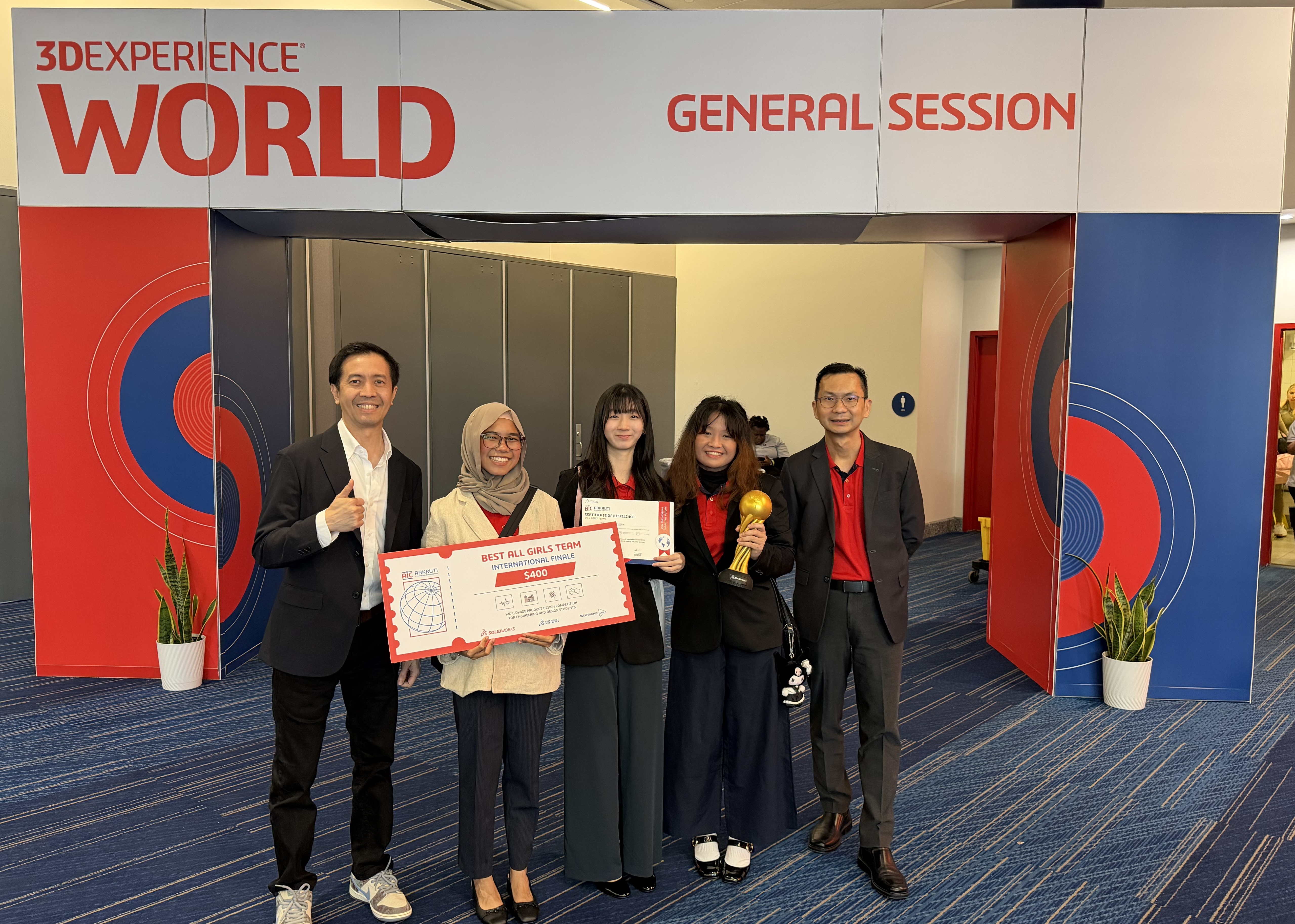
At the George R. Brown Convention Centre in Houston, Texas, USA, the SIT team celebrates their win outside the general session exposition hall. From left: Mr Mark Cano (Ashley’s father), Nur Tahirah Afiqah, Cynthia Phua, Ashley Cano, and Associate Professor Steven Tay. (Photo: Nur Tahirah Afiqah)
Student Ashley Cano stood before a panel of four judges, steadying her nerves before the presentation began. Beside her, her team members were preparing to demonstrate their project.
The Year 2 students from SIT-Newcastle University’s Mechanical Design and Manufacturing Engineering (MDME) degree programme had advanced to the final round of the 2025 AAKRUTI Innovation Competition in Houston, Texas, in February 2026. While the team comprised four members, only three were able to travel to the United States for the competition.
Organised by software corporation Dassault Systèmes, the annual AAKRUTI Innovation Competition encourages students to develop impactful solutions based on real-life problems.
For the final round, the team presented TalkingTiles, a communication and rehabilitation tool designed for people with aphasia – a language disorder that affects a person’s ability to speak, read or write. While patients can formulate thoughts and sentences internally, expressing them fluently can be difficult.
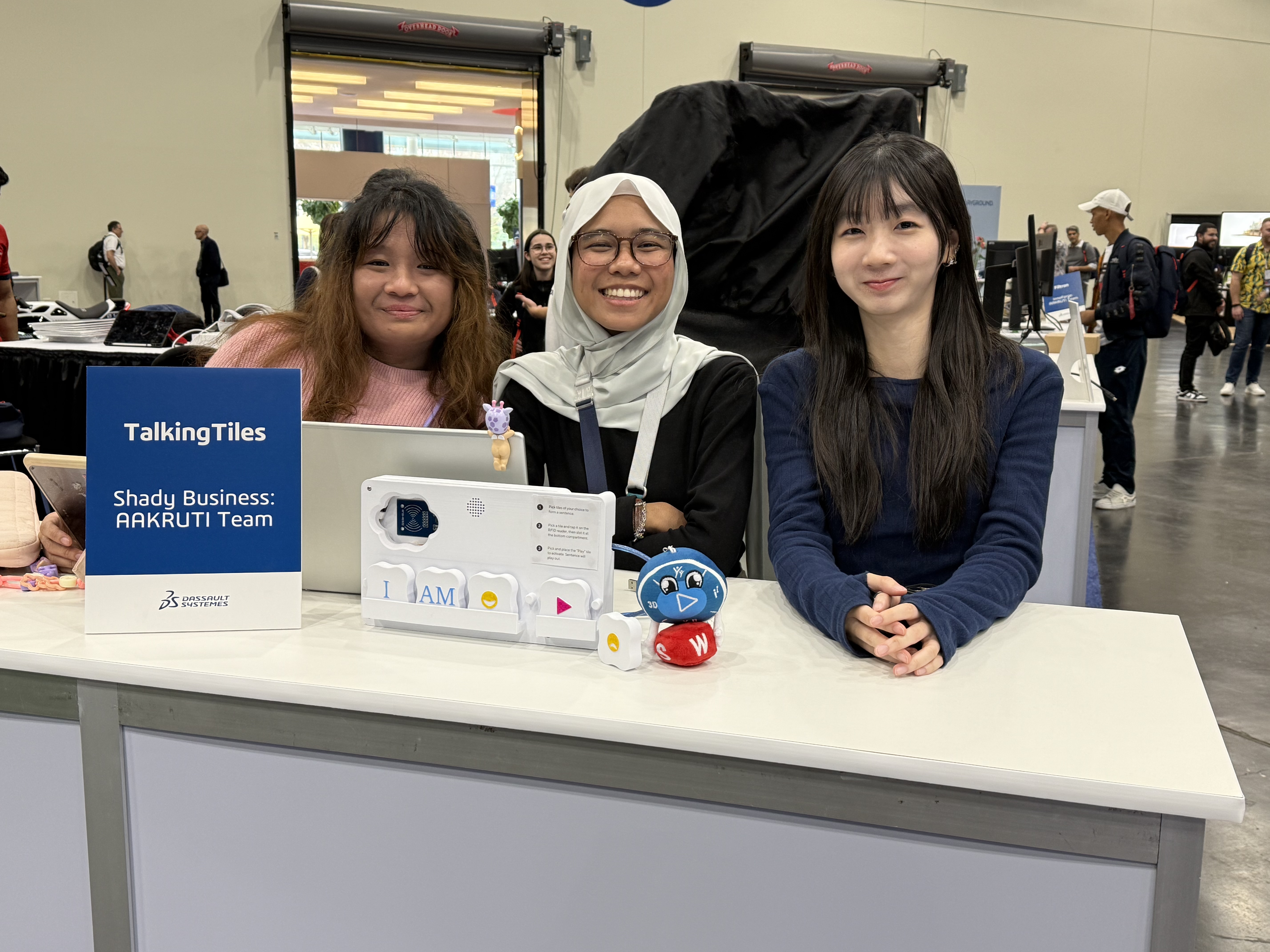
At the George R. Brown Convention Centre in Houston, Texas, the team showcases TalkingTiles during Demo Day, where finalists presented their prototypes to convention attendees. From left: Ashley Cano, Nur Tahirah Afiqah, and Cynthia Phua. (Photo: Nur Tahirah Afiqah)
Comprising a set of 25 square tiles and a plastic board, TalkingTiles helps aphasia sufferers communicate by translating sentences they form into speech. Users construct sentences by piecing together 3D-printed tiles programmed with words like “I”, “am”, and “happy”, then scan these tiles using a sensor on the board. With a final tap of an activation tile, the board articulates aloud the sentence that was formed.
Beyond enabling communication, the tool also supports rehabilitation. Patients can repeat the spoken sentences, helping them practise and gradually regain speech. As users progress, customised tiles can be created to form more complex expressions.
“Our idea was to create an independent tool that allows users to communicate more confidently, while also supporting gradual improvement in their speech over time. Ultimately, our goal is to empower them to regain confidence and recover by themselves,” said Ashley.
For their efforts, the team won the Best All-Girls Team title at the competition.
Solving a Problem Close to Home
TalkingTiles was inspired by team leader Nur Tahirah Afiqah’s experience caring for her grandfather, who developed aphasia following a stroke, just as the girls entered the competition.
Existing solutions for language disorders like aphasia, known as Augmentative and Alternative Communication (AAC) tools, are designed to help patients replace or supplement speech.
But most AAC tools are applications or online platforms, which posed a struggle for Tahirah’s 90-year-old grandfather. He was not adept with technology, and she saw the need for an offline alternative. This sparked the development of TalkingTiles as a tactile alternative for easier navigation.
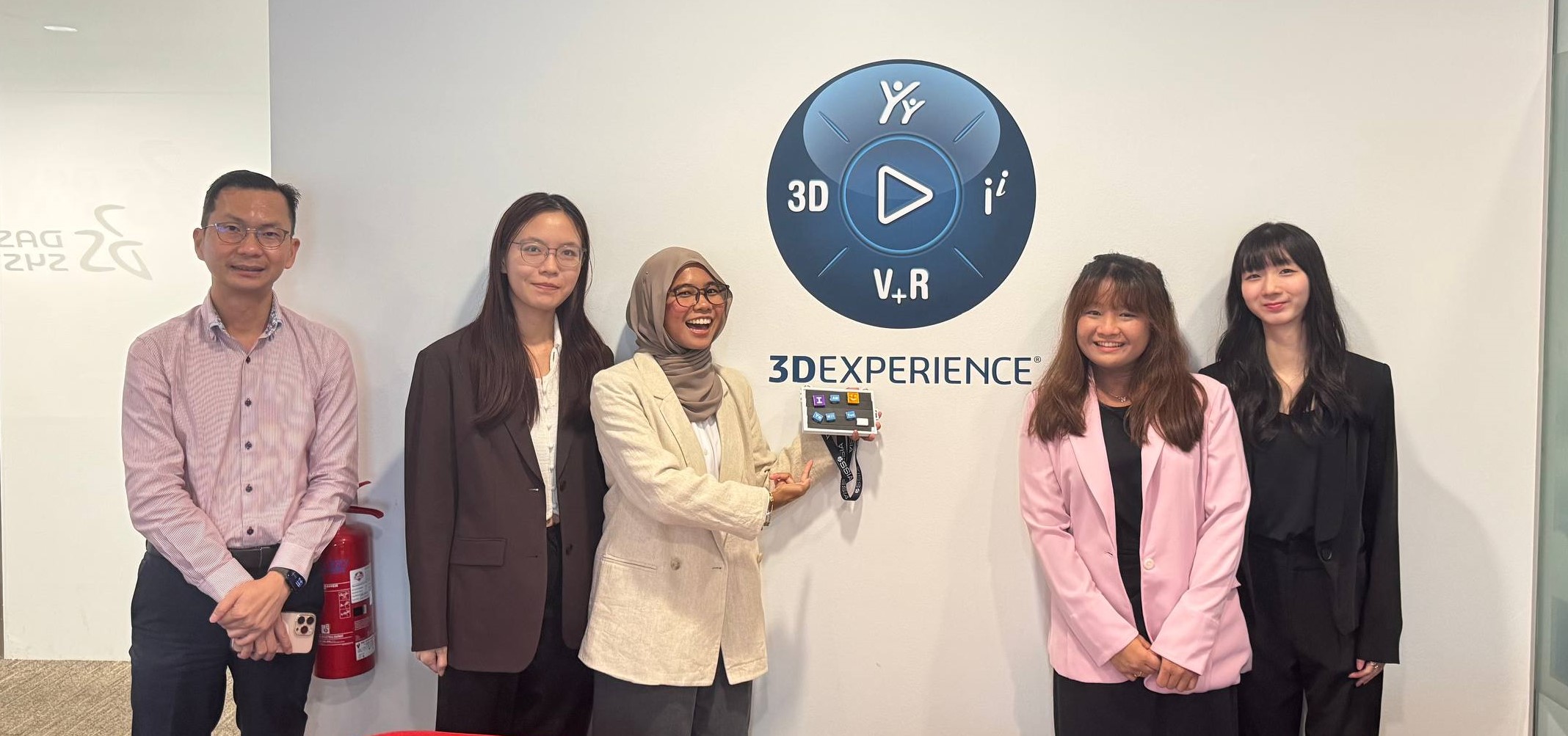
Taken at Dassault Systèmes’ headquarters in Singapore, where the team awaited the results after presenting their project to the panellists during the Singapore finale. From left: A/Prof Steven Tay, Gu Juanyu, Nur Tahirah Afiqah, Ashley Cano, and Cynthia Phua. Tahirah is holding the team’s first low-fidelity prototype of TalkingTiles, developed before the integration of electronics and final design refinements. (Photo: Nur Tahirah Afiqah)
Tahirah designed the board and the tiles, while her team members, Ashley, Cynthia Phua and Gu Juanyu, handled the programming, coding and 3D printing. Aside from being offline, TalkingTiles overcomes another barrier posed by AAC tools on the market — cost.
“Many AAC tools are very expensive, ranging from $500 to $1,000. TalkingTiles will be on the cheaper side, about $70,” said Tahirah. The team’s solution directly addressed a challenge that Tahirah’s family experienced first-hand - helping elderly patients communicate through a tool that is accessible and affordable.
Facing Hiccups Head-on
To bring her vision to life, Tahirah’s team had to overcome several bumps in the road, like learning how to solder and wire components together. They were guided by their mentors, Associate Professor Steven Tay from SIT’s Engineering Cluster, and Assistant Professor Choong Zijie from Newcastle University, both based at SIT’s Punggol Campus.
As part of the design process, Tahirah had to learn how to render a 3D model of the board using 3D modelling software SolidWorks. Whenever she had difficulties with the software, she would consult A/Prof Tay.
“My role was to guide them in the right direction, particularly in terms of design and how to approach the competition,” said A/Prof Tay. “I am very glad they did not give up, continued to believe in themselves, and ultimately succeeded in winning a prize at the grand finale.”
Meanwhile, Asst. Prof Choong taught the team how to solder and wire. They had to wrestle with inconsistencies between what they saw on the screen and the printed 3D model. It took several tries, but the girls produced an accurate prototype just in time for the final round, all while juggling their schoolwork.
Beyond technical guidance, the team also benefited from strong academic and interdisciplinary support. They expressed their gratitude to MDME Programme Leader, Assistant Professor Kiew Choon Meng, whose insights helped refine their prototype, and whose support eased their transition back to academic life after the competition.
They also acknowledged Associate Professor Valerie Lim from SIT’s Speech and Language Therapy degree programme. Her expertise deepened the team’s understanding of aphasia, helping them optimise the functionality of TalkingTiles to better meet users’ needs.
Before arriving in Houston, however, they hit another roadblock while in transit at Dubai: the board had stopped working. Thankfully, it was a simple fix. The battery had run out, and replacing the cell got the board running again.
Extending TalkingTiles’ battery life is one of the planned improvements, as is making the board less bulky and more portable. Currently, the board is slightly smaller than a 13-inch MacBook Air and about as thick as two books. They hope to continue developing TalkingTiles and perhaps launch it for commercial sale someday.
While her grandfather did not get a chance to use their prototype before passing away, Tahirah says that developing TalkingTiles gave her hope that stroke patients could rebuild their communication skills.
“We believe that communication is the heart of being human. If our product does reach the market one day, I hope it helps people with aphasia find their voice and confidence once again,” said Ashley.