










![[FA] SIT One SITizen Alumni Initiative_Web banner_1244px x 688px.jpg](/sites/default/files/2024-12/%5BFA%5D%20%20SIT%20One%20SITizen%20Alumni%20Initiative_Web%20banner_1244px%20x%20688px.jpg)
Cenior SITizen’s AI-powered app triumphed at the hackathon by making it easy for households to cut energy consumption.
The hall was packed. Hundreds of participants hunched over laptops, the low hum of keyboards and hushed conversations filling the air. It was the final stretch of HackOMania 2026, a 24-hour hackathon that brings together students, developers and professionals across Singapore to build real-world tech solutions under pressure. For five sleep-deprived participants from the Singapore Institute of Technology (SIT) running on caffeine and conviction, their success hinged on a smart air purifier that one of them had rushed home to fetch.
Organised by tech community GeeksHacking, HackOMania is an annual flagship hackathon where teams compete in sprint-style challenges to solve pressing societal problems using technology. The 2026 edition, themed “AI for Good”, challenged participants to apply artificial intelligence in practical ways, developing solutions with meaningful impact across areas such as emergency response and energy sustainability.
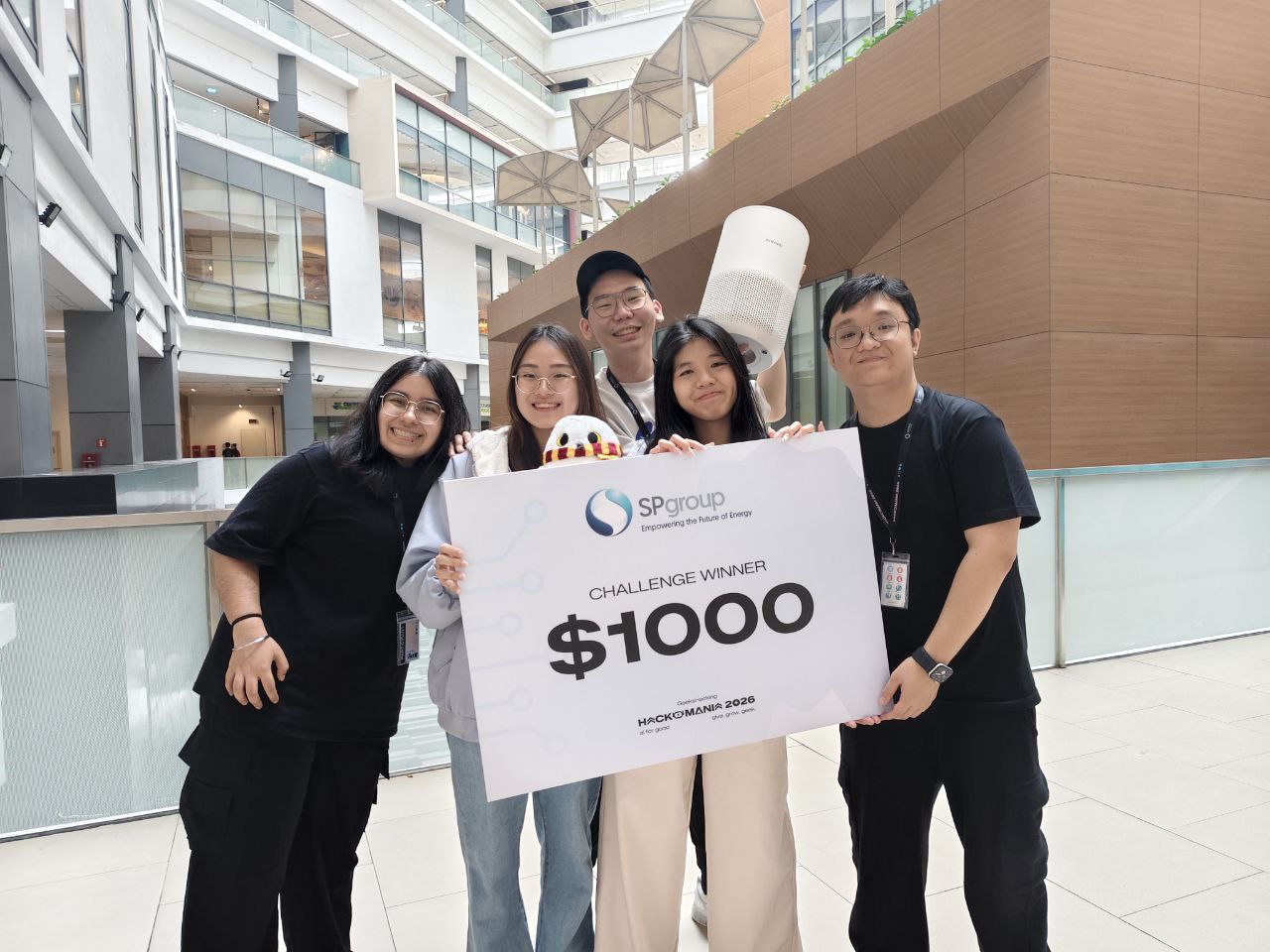
“Fortunately, it worked,” said Lin Zhenming, 24, laughing at the memory. Zhenming and Jasbir Kaur, 25, both Applied Computing (Fintech) students, joined Computing Science student Fan Xinyu, 23, Information Security student Khoo Xiaozhen, 24, and SIT employee Shaun Liew, 26, to form a team that went on to win the Grand Prize in the SP Group track at HackOMania 2026. Mr Liew works at SIT’s NVIDIA AI Centre as an AI researcher, while his four teammates are all undergraduates in their final year.
The team’s winning solution, Saivers, is an AI-powered energy coach mobile app that connects to smart home appliances and delivers personalised, actionable recommendations to help households reduce energy consumption with one click. The road to victory, however, was not so straightforward.
Little Effort, Big Results
The group’s name Cenior SITizen is a wordplay on “senior citizens” and a nod to the four students’ graduating status. They had come together through their shared identity as SITizen Ambassadors, student leaders who represent the University at events, fostering campus-community spirit. As for Mr Liew, he had taken part in several hackathons with Zhenming.
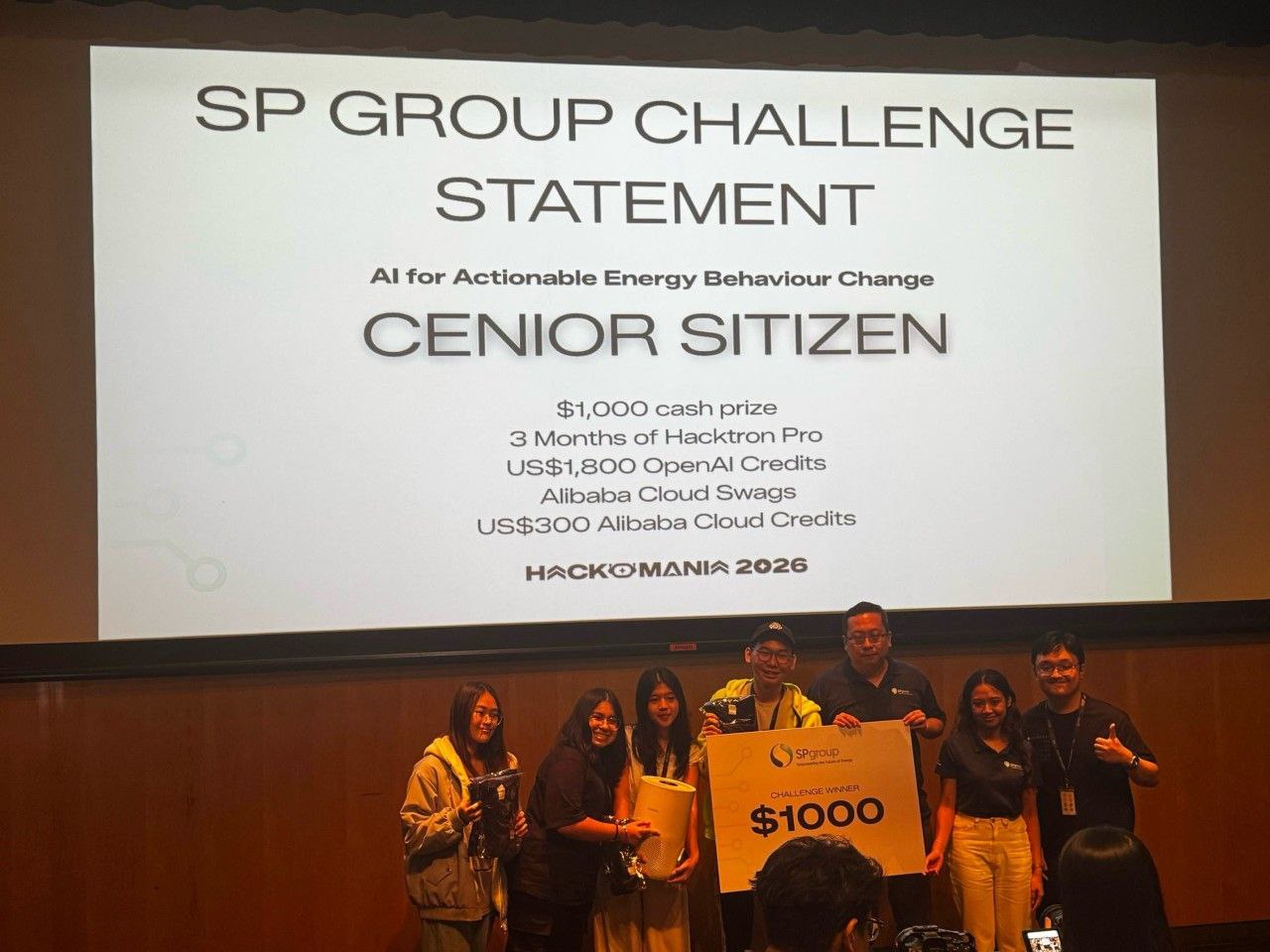
For HackOMania 2026, Cenior SITizen participated in one of the competition’s four challenge tracks, pitching to judges looking for working prototypes with real-world impact. In their track, the team took on a challenge posed by SP Group: “AI for Actionable Energy Behaviour Change.”
The challenge called on teams to use AI to analyse electricity consumption data and help users build sustainable energy habits. When they pitched their initial idea of a gamified energy-saving platform to their SP Group mentor, the reaction was sobering.
“She sounded a bit disappointed,” recalled Xinyu. Many teams had landed on similar gamification ideas, making it difficult to stand out.
That moment became a turning point. Instead of refining the same concept, the team stepped back and reframed the problem, asking: “What makes people change their behaviour?”
“We realised that the more effort required, the less likely people are to change their habits,” she added. The answer, they decided, was to make energy saving as effortless as pressing a button.
The Smart Idea
That insight shaped the team’s approach. If behaviour change depended on ease, their solution had to remove friction at every step. It was not enough to tell users what to do. The app needed to provide clear, specific recommendations that users could act on with minimal effort.
However, turning this into a working solution revealed a key constraint. SP Group’s existing data captures only total electricity consumption at the main meter. While this provides a comprehensive view of overall household usage, it does not show which individual appliances consume the most energy.
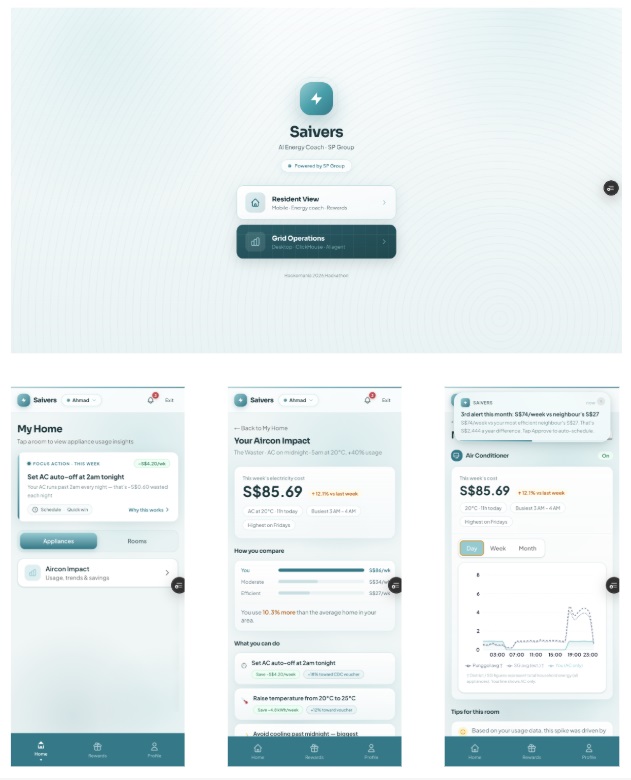
Saivers was designed to address this gap, integrating with smart home appliances to collect granular, appliance-level data. The AI then analyses usage patterns and suggests specific actions – like switching off the air conditioner two hours before waking up – which users can approve with a single tap, whereupon the app automatically configures the smart device.
“Instead of you waking up to switch an appliance off, the app does it in the background,” explained Zhenming. “By reducing the effort from users, we make it easier for people to adopt energy-saving habits consistently.”
To stand out against other teams racing against the clock, Cenior SITizen knew they needed a proof of concept. They demonstrated their idea in real-time to the judges by integrating the Saivers app with a Xiaomi smart air purifier – the very device that prompted a last-minute dash home.
For Xinyu, this move required her to tap on skills she had developed through an Internet of Things (loT) module at SIT, where she gained experience integrating diverse IoT devices and systems together. That hands-on exposure gave her the confidence to incorporate a live IoT setup into the team’s prototype during the hackathon. “If I had not done it before, I don’t think I would have had the confidence to implement the IoT integration,” she said
Another winning factor, said Jasbir, who pivoted from a business background in polytechnic to SIT’s Applied Computing (Fintech) course, was the team’s ability to nail down its target market, instead of attempting to appeal to everyone.
“We focused on a segment of the market that was growing – savvy owners of smart appliances,” she said, adding that Saivers provided these users with actionable insights beyond just displaying data on a dashboard.
More than a Win
For each of the team members, the win marks a personal triumph.
Xiaozhen, who typically competes in cybersecurity competitions, found that HackOMania presented a different kind of challenge. Instead of identifying vulnerabilities, the team had to define a real-world problem, design a solution, and build a working prototype within a compressed timeframe.
For Xinyu, an in-person hackathon debutante, the victory was proof that she could apply her IoT coursework to a tangible solution under pressure. “I’m so glad I stepped out of my comfort zone,” she said.
Zhenming, a self-professed hackathon evangelist who has competed in 26 hackathons, viewed each attempt as a chance to learn and refine his approach. His past experiences taught him how to pitch with conviction and adapt quickly under pressure – valuable lessons he carried into HackOMania.
“When we were pitching Saivers to the judges, I thought: ‘We have built something we truly believe in, something we would use ourselves.’ With that confidence, we went in with a champion aura.”
Summing up his team’s win, Mr Liew shared an observation: “You don’t need 100 wow factors. You just need one idea that’s very impressive and solves the problem.”
Whether Saivers finds its way beyond the hackathon floor remains to be seen. But in the spirit of Hackomania, where ideas are tested, refined and brought to life in just 24 hours, the Cenior SITizen team has already proven what matters most: the ability to turn insight into impact.