











![[FA] SIT One SITizen Alumni Initiative_Web banner_1244px x 688px.jpg](/sites/default/files/2024-12/%5BFA%5D%20%20SIT%20One%20SITizen%20Alumni%20Initiative_Web%20banner_1244px%20x%20688px.jpg)
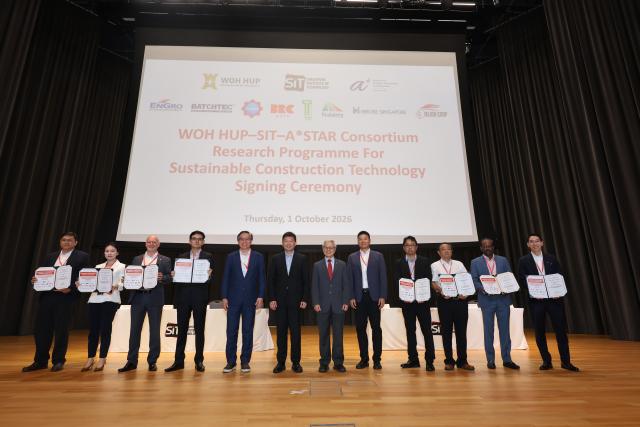
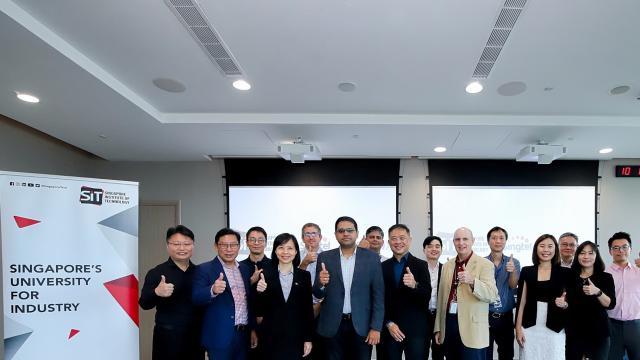
The Woh Hup–SIT–A*STAR Consortium for Sustainable Construction Technology, a research programme with an overall investment of S$30.4 million, comprising funding and in-kind contributions from SIT, A*STAR and industry partners was launched today. This initiative, supported under Singapore’s Research, Innovation and Enterprise 2025 (RIE2025) plan, aims to accelerate the development, validation and deployment of next-generation sustainable construction technologies. Announced at the Construction Technology Innovation Laboratory’s (CTIL) Annual Technical Seminar held at the Singapore Institute of Technology (SIT), the consortium was formalised through a signing witnessed by Minister for National Development Mr Chee Hong Tat.
The three-year research programme brings together SIT, A*STAR, Woh Hup (Private) Limited and seven other industry partners to develop practical solutions that reduce embodied carbon, improve construction productivity and strengthen the resilience of Singapore's built environment sector. By drawing on expertise across the full value chain, the consortium aims to shorten the pathway from research to deployment on actual construction projects. (More information on the industry partners & programme is available in Annex A)
Co-developing solutions and talent for the built environment
The consortium is structured around industry-identified challenges and real-world deployment opportunities. Industry partners will contribute project sites, operational expertise and validation environments to test and refine technologies under actual construction conditions, helping to accelerate adoption across the sector.
The research programme is organised into seven research projects that address some of the built environment sector's most pressing challenges. Among the projects are efforts to scale up ultra-low embodied carbon concrete production for wider industry adoption and develop AI-powered design tools that help engineers optimise structural designs for lower embodied carbon, cost and material use.
The programme will also explore new approaches to greener construction materials and innovative structural systems that can be tested and deployed on actual construction projects. One of the seven projects will scale up SIT's award-winning ultra-low embodied carbon concrete technology, which was developed under CTIL’s Phase 1 launch. The existing technology has already demonstrated up to 65 per cent reduction in embodied carbon. The next phase under this new research programme will focus on further development, validation and test bedding with industry partners. (Further information on the seven research projects is available in Annex A.)
By the end of the programme in 2029, the consortium targets up to 40 per cent reduction in embodied carbon in urban development applications using the relevant technologies compared with conventional construction approaches. It also aims to create new business opportunities and deliver operational cost savings for industry partners.
Beyond research, talent development is an integral component of the programme. It will support the training of undergraduate and postgraduate students and engage research staff in applied research conducted in close collaboration with industry partners. By embedding students and researchers within industry-led projects, the programme will provide opportunities to work on emerging technologies with direct relevance to the transformation of the built environment sector, helping to strengthen Singapore's future pipeline of engineering and sustainability talent. The programme also supports capability development of industry professionals through specialised training, industry attachments and technical seminars.
“The built environment sector is facing increasing pressure to reduce embodied carbon while improving productivity and resource efficiency. The challenge is not simply to develop new technologies, but to ensure they can be adopted at scale and create meaningful impact for industry. Through this programme, we will develop and validate technologies that address these challenges, from lower-carbon materials and innovative structural systems to AI-enabled design tools and circular construction solutions," said Professor Chiew Sing Ping, Head, Construction Technology Innovation Laboratory (CTIL), SIT. "By working closely with industry partners throughout the research process, we can accelerate the translation of these innovations into practice while developing the talent needed to support the sector's transformation."
“Addressing sustainability challenges in the built environment requires innovation across advanced materials, engineering and AI-enabled optimisation. Through this consortium, A*STAR is working closely with SIT, Woh Hup, and industry partners to develop and validate practical solutions that can reduce embodied carbon, improve resource efficiency and strengthen construction productivity. By bringing together complementary capabilities in materials science, engineering and AI-enabled design and optimisation, alongside industry expertise, we look forward to accelerating the translation of these innovations into real-world applications that create meaningful impact for the sector,” said Professor Lim Keng Hui, Assistant Chief Executive, Science and Engineering Research Council, A*STAR.
“Woh Hup has always believed that meaningful innovation comes from bringing research and industry closer together. Our partnership with SIT, A*STAR and industry partners gives us the opportunity to co-develop solutions that are not only innovative, but also practical and scalable for the construction industry. As we work towards a lower-carbon built environment, we are committed to contributing our experience, capabilities and project sites to help turn promising technologies into real-world applications that can make a lasting impact.” said Mr Yong De-Rhong, Executive Director, Woh Hup (Private) Limited.
Building on five years of industry collaboration
The new research programme marks the next chapter for CTIL, SIT’s flagship platform for applied research in sustainable construction technologies. It also reflects the growing confidence of industry and research partners in CTIL's ability to translate research into deployable solutions that address national priorities in sustainability and construction innovation. Since CTIL was established in 2021 to help bridge the gap between research and industry adoption, the Centre has worked closely with construction companies to identify industry challenges, develop practical solutions and evaluate new technologies under actual operating conditions. The Centre recently opened its facility at SIT Punggol Campus. As a co-creation and innovation hub, the space brings together researchers, students and industry partners to develop, test and showcase solutions for the built environment sector. (Details of CTIL can be found in Annex B)
During its first phase from 2021 to 2026, CTIL completed 13 applied research projects with 26 industry partners. Five technologies have already progressed to deployment on actual construction projects, demonstrating the value of developing innovations alongside industry from the outset. In 2024, CTIL received recognition at the Institution of Engineers Singapore's Prestigious Engineering Achievement Award for the ultra-low carbon concrete production system. (Additional details of the technologies are available in Annex C)
Beyond technology development, CTIL also supports industry capability building through technical publications and design guides. At the seminar, the Centre launched Design of Headed Anchorage Bars in Reinforced Concrete Structures, a new technical reference developed with industry partners to help engineers apply the latest design approaches for reinforced concrete structures. (More information on the new book is available in Annex D)
For more information, visit www.SingaporeTech.edu.sg
Annex A – The Woh Hup—SIT—A*STAR Consortium for Sustainable Construction Technology
The Woh Hup–SIT–A*STAR Consortium for Sustainable Construction Technology is a three-year research programme representing an overall investment of S$30.4 million, and is supported under RIE2025. It runs from 1 April 2026 to 31 March 2029.
Led by the Singapore Institute of Technology (SIT) in partnership with A*STAR and Woh Hup, the consortium aims to develop commercially viable innovations that help the built environment sector reduce embodied carbon, improve productivity and strengthen resource efficiency. The programme adopts a translational research approach, with technologies progressing from laboratory development to pilot production and deployment on live construction projects.
The programme comprises seven research projects organised across three research areas.
| Research Areas | Description |
| Sustainable construction materials | This research area focuses on developing greener construction materials and strengthening the industry's supply chain through technologies that:
|
| Innovative substructural systems | Research under this area addresses long-standing construction challenges by developing:
|
| Low carbon structures and reusability | The programme will develop next-generation low-carbon structural systems for green urban buildings and digital solutions for smart reusability management of structural steel, enabling more efficient lifecycle management and contributing to a more circular construction economy. |
| Research Project | Focus | Industry Outcome |
| 1 | Transform demolition waste into materials for land reclamation | Reduce reliance on imported fill materials and support circular construction |
| 2 | Scale up ultra-low carbon concrete production | Produce cost-effective low embodied carbon in concrete through automated CO₂ activation |
| 3 | Digital verification and traceability for reinforcing steel | Improve quality assurance and supply chain traceability |
| 4 | Lightweight and long-span earth-retaining and stabilising structures | Improve productivity and safety in deep excavations |
| 5 | Composite steel fibre reinforced concrete slab system for deep foundations | More durable, lower-carbon foundation construction with reduced need for maintenance |
| 6 | AI-powered design and optimisation tool for steel-concrete composite flooring system | Cost-effective and lower-carbon structural systems for buildings |
| 7 | Smart reusability management platform for structural steel reuse | Enable circular use of structural steel and reduce waste |
Over the three-year programme, the consortium aims to:
- generate seven technology disclosures;
- develop pilot production systems and demonstration platforms;
- validate all technologies through test bedding on live construction projects;
- target an up to 40 per cent reduction in embodied carbon of urban development as compared with conventional construction approaches through selected technologies;
- create new business opportunities and operational cost savings for industry partners; and
- contribute to Singapore's net-zero ambitions by advancing commercially viable sustainable construction technologies.
Industry collaborators include Woh Hup, EnGro Corporation Limited, Batch Technologies Pte. Ltd., Cares Certification Pte. Ltd., Hirose (Singapore) Pte. Ltd., Hangzhou Kuyiqiang Advanced Material Technology Co. (through Zhongxin Advanced Materials Technology Pte. Ltd.), T T J Design and Engineering Pte. Ltd., and MLION Corporation Pte. Ltd.
Government agencies including the Building and Construction Authority (BCA), JTC Corporation and the Housing & Development Board (HDB) provide guidance and participate in the programme's steering committee.
Annex B – Construction Technology Innovation Laboratory (CTIL)
Established in 2021, the Construction Technology Innovation Laboratory (CTIL) is a collaboration between SIT and Woh Hup, one of Singapore’s largest privately-owned construction and civil engineering companies. The Centre provides a platform for Singapore-based construction companies and SIT researchers to carry out applied research and develop innovative technologies for building structures and sub-structures with societal and economic impact.
The Centre is committed to developing innovative and disruptive construction technologies through applied research, translating innovative technologies from laboratory to site and providing specialised training and supporting talent development.
CTIL focuses on translating research into technologies that can be deployed in real construction projects. Its work spans sustainable construction materials, structural and substructural engineering, construction digitalisation and automation, while supporting industry capability development through technical training, knowledge exchange and talent development.
Phase 1 of CTIL concluded in January 2026. During this period, the Centre:
- Completed 13 applied research projects with 26 industry partners.
- Secured S$5.95 million in funding from Woh Hup, government agencies and industry partners.
- Successfully translated five technologies into implementation on live construction projects.
- Completed relevant applied research projects with support from the BCA’s Built Environment Technology Alliance (BETA) Catalyst Funding Programme.
Beyond research, CTIL supports capability building across the built environment sector through technical seminars, industry workshops, design guides, publications and specialised professional development programmes. It also provides opportunities for undergraduate students, postgraduate researchers and research engineers to work on industry-led applied research projects, helping to develop future-ready engineering talent.
CTIL marked its next phase of development as a platform for industry-led innovation with the opening of its new facility at the SIT Punggol Campus. By providing a dedicated environment for engagement with industry, government agencies and research partners, the facility will support larger-scale collaborative initiatives, accelerate technology validation and strengthen the translation of research outcomes into industry adoption, supporting Singapore’s ambition to achieve net zero emissions by 2050. The facility will also support the development and demonstration of emerging technologies, including AI and digital twin solutions for sustainable construction.
Annex C – Examples of Technologies Developed under CTIL
CTIL develops practical technologies that support a more productive and sustainable built environment. The examples below illustrate how applied research is being translated into real-world construction projects through close collaboration with industry partners during CTIL’s first phase of launch. These technologies are either being implemented or will be adopted in ongoing Woh Hup projects.
| Technology | Description |
| Ultra-low carbon concrete | CTIL developed a cost-effective aqueous carbon sequestration and utilisation system that produces ultra-low carbon ready-mixed concrete. The technology uses carbon dioxide-enriched water during concrete production, enabling up to 80 per cent replacement of conventional cement with blast furnace slag while maintaining comparable performance. This reduces embodied carbon by up to 65 per cent. |
| HISTEEL | HISTEEL is a high-performance steel kingpost system designed to improve productivity during deep excavation works. The lightweight structural system increases working space, reduces material usage and improves site safety compared with conventional excavation support systems. |
| Headed Bars for Reinforced Concrete Structures | CTIL worked with industry partners to develop new design guidance supporting the adoption of headed bars in reinforced concrete structures. Headed bars improve constructability by reducing reinforcement congestion, improving concrete quality and increasing productivity on site. The research has contributed to industry guidance aligned with the latest Eurocode developments. |
| High Performance Composite Steel Beams | CTIL developed a high-performance pre-engineered steel-concrete composite beam system for industrial and commercial buildings. The system reduces embodied carbon while improving structural efficiency and lowering construction costs, supporting more sustainable building design. |
| Steel slag permeable concrete | Steel Slag Permeable Concrete (SSPC) is a low-carbon, multifunctional pavement developed by CTIL that valorises locally produced steel slag. The technology has been deployed at a Woh Hup project site for full-scale demonstration, where its performance in stormwater management, urban heat mitigation and long-term durability is being monitored. |
Annex D – About the Book: Design of Headed Anchorage Bars in Reinforced Concrete Structures
Building on the earlier Association of Consulting Engineers Singapore (ACES) design guide published in 2025, the team further developed and consolidated the design methodology for headed-bar reinforcement into a comprehensive design book. The work brings together the mechanics of force transfer, product qualification and testing, anchorage verification, detailing requirements and construction control, with practical procedures and worked examples for engineers.
The book provides an evidence-based reference for the safe and efficient use of headed bars in complex and heavily reinforced concrete structures. By translating research and design principles into practical engineering guidance, it supports wider industry adoption while improving constructability, workmanship and confidence in headed-bar applications.
The work has also facilitated the use of headed bars in three local projects, helping to reduce reinforcement congestion, simplify cage assembly and improve concrete placement and compaction. These applications demonstrate tangible improvements in construction quality and productivity.