








SIT alumnus Tan Ren Kai spent his IWSP finding bottlenecks on a factory floor. Today, as part of a team honoured with the President’s Technology Award 2026, he is helping digitalise how Singapore measures marine fuel.
“Bunkering is very archaic,” says Tan Ren Kai. When he joined the Agency for Science, Technology and Research (A*STAR)’s National Metrology Centre, he found that many shipyards were still calculating fuel quantities with pen and paper. That left room for error, and for fraud. In 2022, two bunker clerks in Singapore were jailed for stealing marine fuel worth about S$237,000.
The SIT Mechanical Design and Manufacturing Engineering graduate and his teammates set out to change that. Their work became the foundation of a mandatory mass flow metering framework introduced by the Maritime and Port Authority of Singapore, which cut fuel-related disputes by up to 70 per cent.
This year, it earned them the President’s Technology Award 2026, one of Singapore’s highest honours for technological innovation.
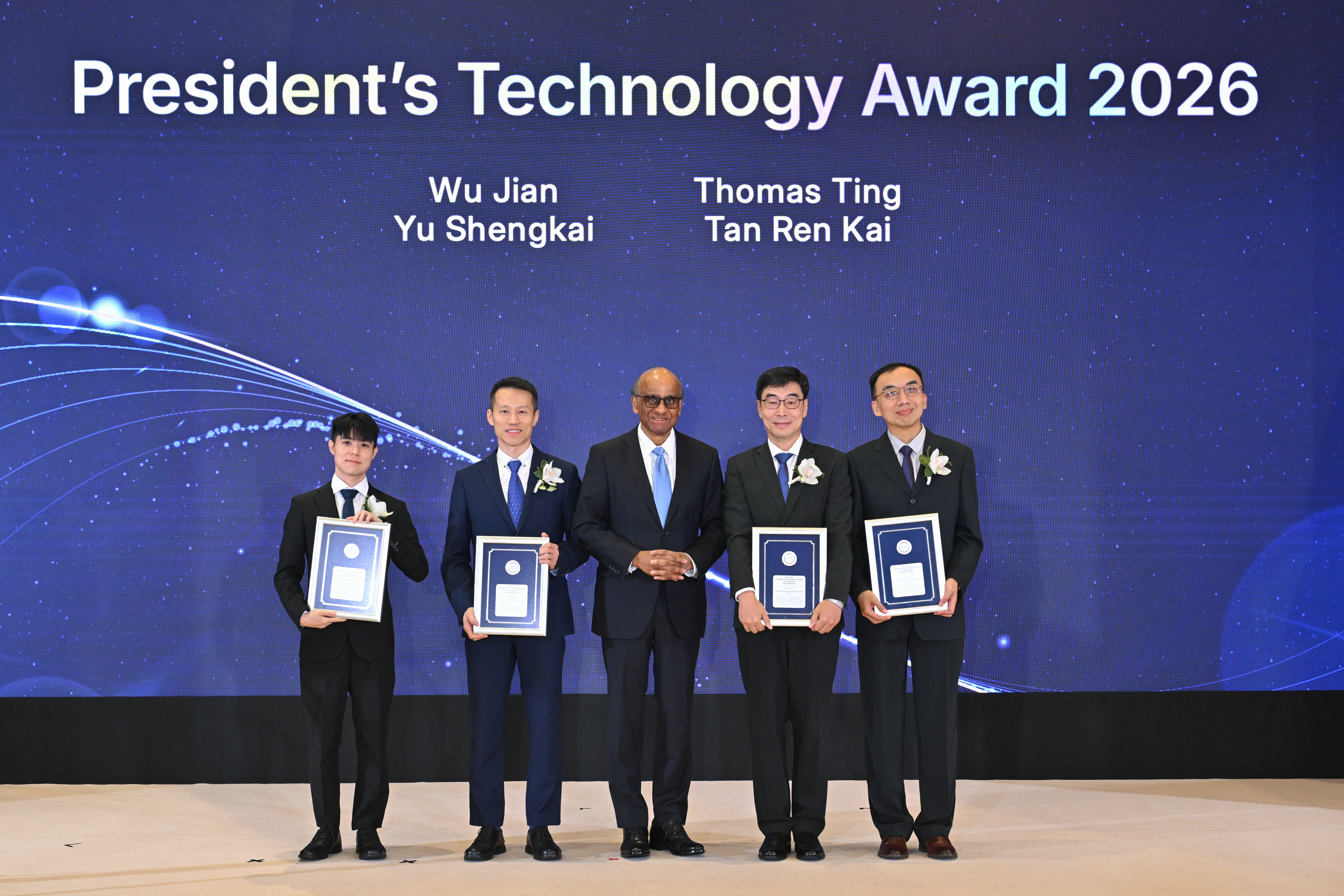
Tan Ren Kai (left most), with his team from the A*STAR National Metrology Centre, pictured with President Tharman Shanmugaratnam.
Bringing Precision to Bunkering
Bunkering, the process of supplying fuel to ships, is an essential part of Singapore's maritime industry, and accurate measurement is critical. Discrepancies can lead to costly disputes between ship operators and fuel suppliers.
At A*STAR National Metrology Centre, which focuses on conducting research to improve the science of accurate measurements, Ren Kai joined a four-member team as its research engineer to study how to improve transparency and efficiency in bunkering operations through digitalisation. The team’s task was to replace pen-and-paper calculations with a system both sides could trust.
The mass flow metering framework has since gained international adoption across ports in China, the Netherlands, and the United Arab Emirates. Ren Kai and his team have since gone on to develop technologies that support Singapore’s transition towards digital bunkering, which is expected to save the bunkering industry close to 40,000 man-days annually.
From Assembly Line to Data Line
Ren Kai’s path to A*STAR began years earlier, on a factory floor. During his Integrated Work Study Programme (IWSP) at Univac, Ren Kai’s task was to identify bottlenecks along a manufacturing line.
He first deployed virtual sensors to gather data on production timings. “I was trying to link and collect information on how long each station took,” he said of his IWSP experience.
To process his findings, Ren Kai picked up the coding language of Python, a skill which would prove invaluable in his later work. The precious data allowed him to locate the bottlenecks.
With the problem identified, he installed visual indicators at key points along the assembly line to guide workers to adjust their pace and improve productivity.
His digitalisation project not only impressed Univac and his SIT lecturers, it caught A*STAR’s attention. They offered him a job after graduation, taking the major step towards the eventual President’s Technology Award.
Those skills came into play when the team faced difficulties in achieving a uniform standard for the digitalisation process across different bunker ship classes. Ren Kai drew on his understanding of communication protocols, which he used previously to transfer data between systems.
“I used (communication protocols) to transfer data from the assembly lines (at Univac) to the cloud… It’s the same for bunkering,” he said.
His familiarity with Python was also key to his role in the A*STAR team. As the research and systems engineer of the team, Ren Kai worked with both software and hardware components, and his earlier experience in the field proved invaluable.
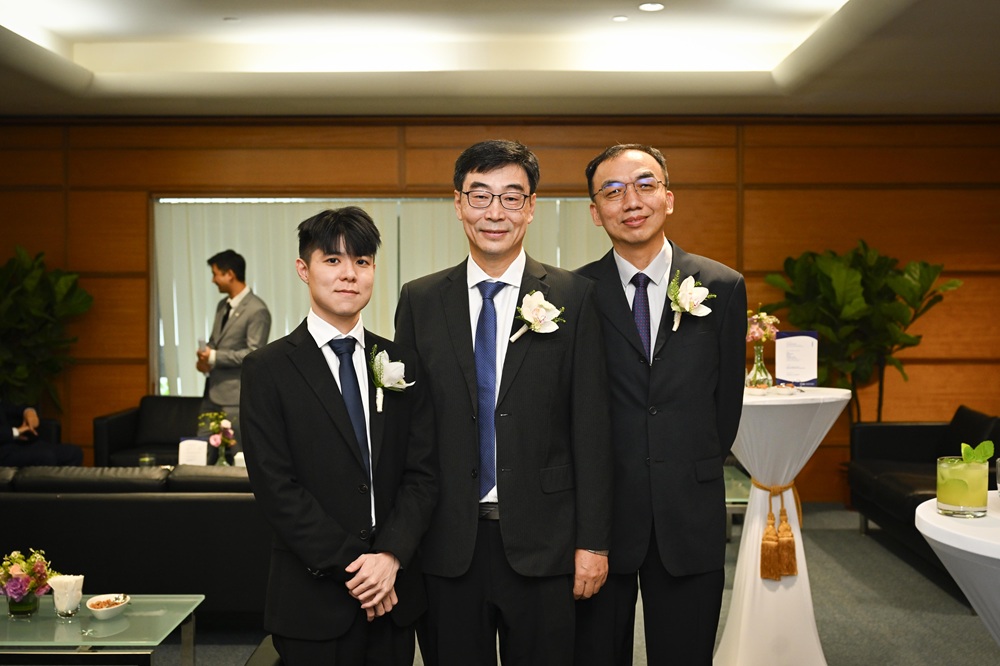
Tan Ren Kai with his colleagues from left to right: Wu Jian and Yu Shengkai.
Be a Sponge
Reflecting on the accomplishment, Ren Kai is proud of the contributions he and his team have made to the maritime industry.
“A lot of countries are very interested in adopting this digital bunkering framework,” he said, sharing his takeaways from a recent international bunkering meeting. He hopes that his work will improve the industry worldwide.
Despite receiving one of Singapore's highest honours for technological innovation, Ren Kai remains committed to learning and improving.
“I try to be a sponge,” he said, stressing the importance of staying humble, and that he is aware that he still has much to learn.
“I try to take in as much information as possible and pretend I don’t know anything. If you think you know something well, then you might stop learning!”