










The four-member student team secured a top three finish, while two SIT research engineers worked behind the scenes to ensure every team had a fair shot.
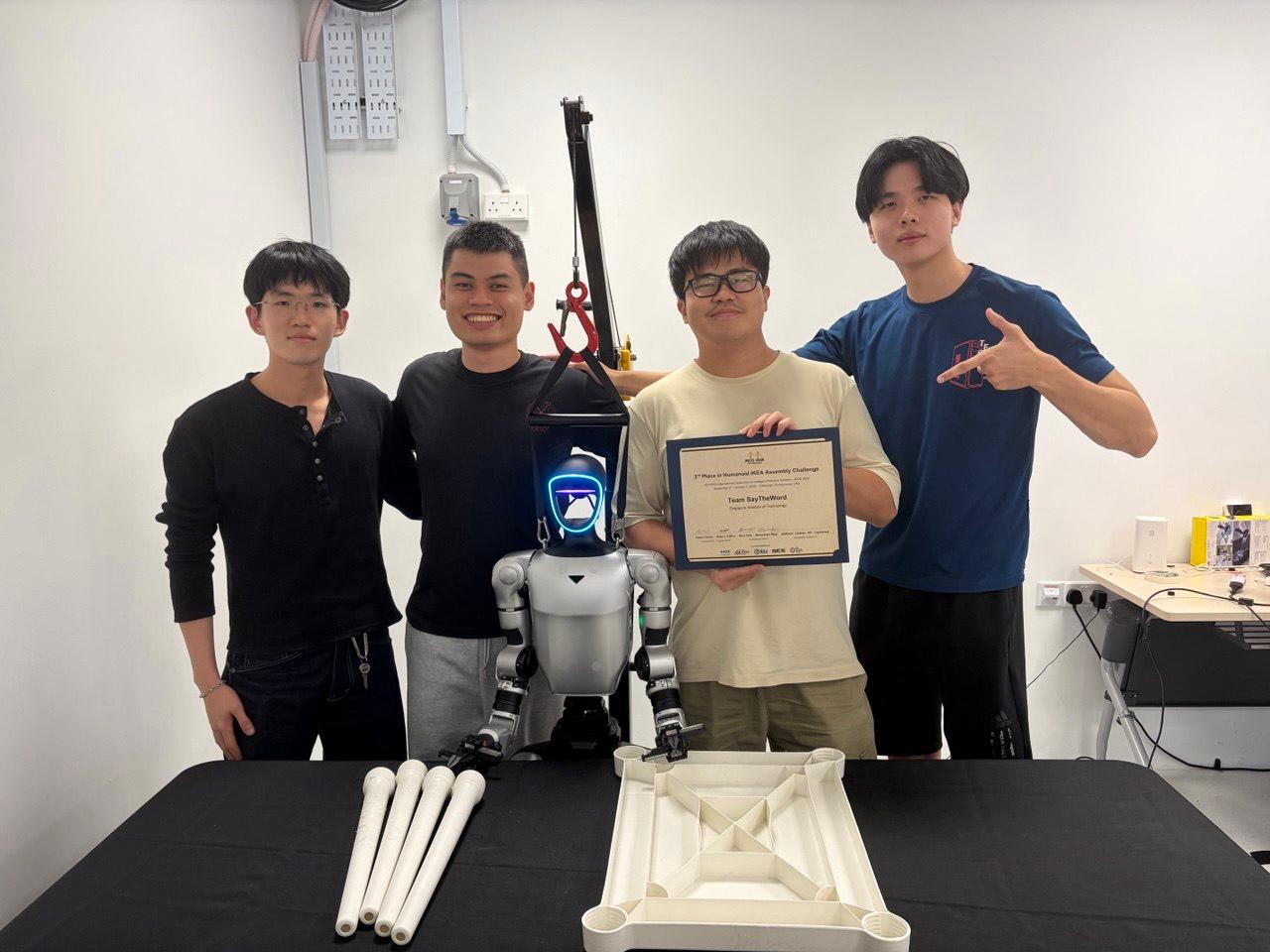
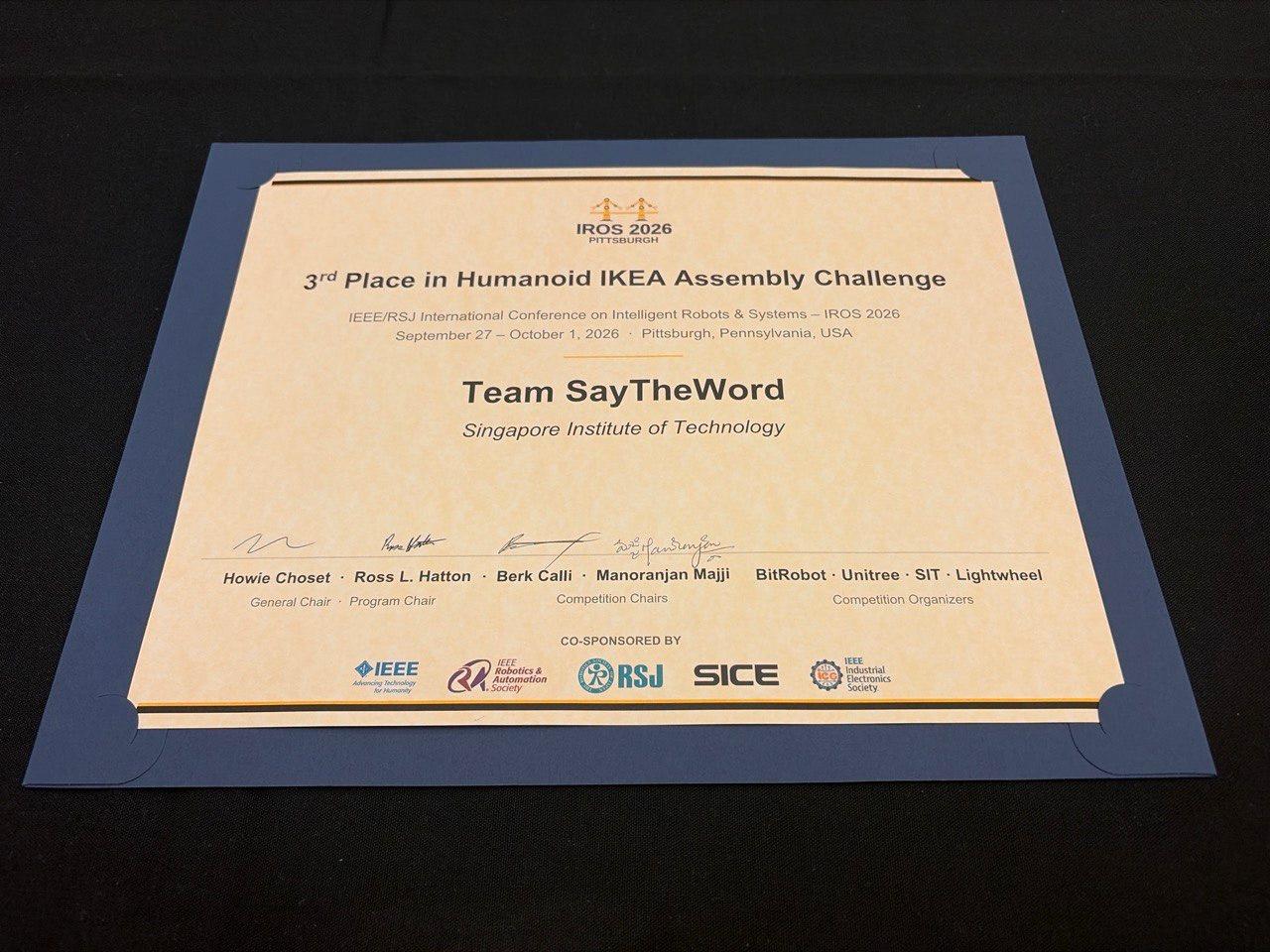
Thousands of kilometres from their robot, four Singapore Institute of Technology (SIT) students sent commands over a laggy remote connection and watched a humanoid try to build an IKEA table in Pittsburgh, Pennsylvania. They finished third among nine finalist teams, holding their own against corporate players and postgraduate competitors.
They were not the only people from SIT at the challenge. On the competition floor, two research engineers from SIT’s Centre for Intelligent Robotics were grading the robots and making sure the contest stayed fair.
Held in the United States from 27 September to 1 October 2026, the Humanoid IKEA Furniture Assembly Challenge was co-organised by SIT’s Centre for Intelligent Robotics, Google DeepMind, Unitree, Lightwheel and Frodobots. Competitors relied on their Artificial Intelligence (AI) models to guide the robots’ actions. Among them was SIT’s student team, who called themselves Team “SayTheWord”. They were the only team representing Singapore.
Grading the robots’ performance were technical evaluators, including two SIT research engineers, Muhammad Fazrey Bin Zainal and Muhammad Muslinmin Bin Mohd Saleh, who had flown halfway around the world to be on the competition floor.
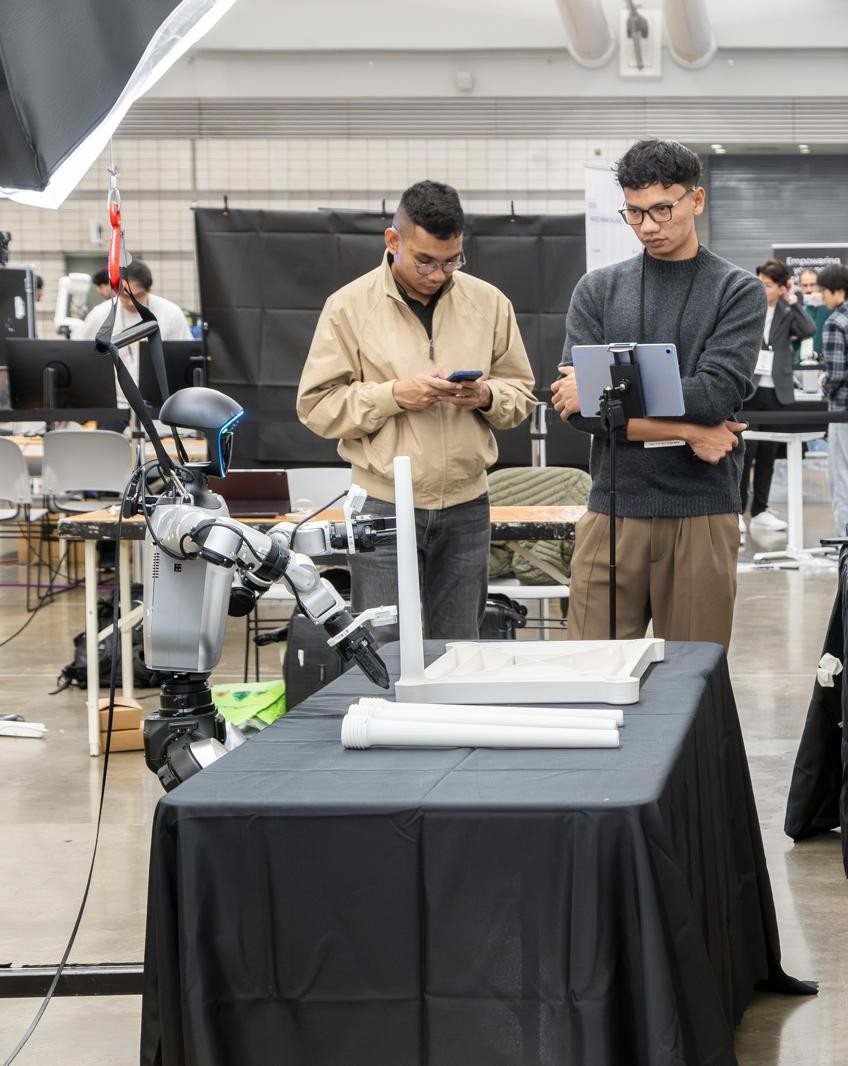
It would be no simple feat to win the challenge, which was part of the prestigious IEEE/RSJ International Conference on Intelligent Robots and Systems (IROS), one of the world’s premier robotics conferences. To make matters even more difficult, many some teams — including SIT’s — were controlling the robot remotely.
Fazrey and Muslinmin had to figure out a way to keep the competition fair, especially with 30 teams from around the world participating. “Everything that can go wrong will go wrong,” quipped Fazrey.
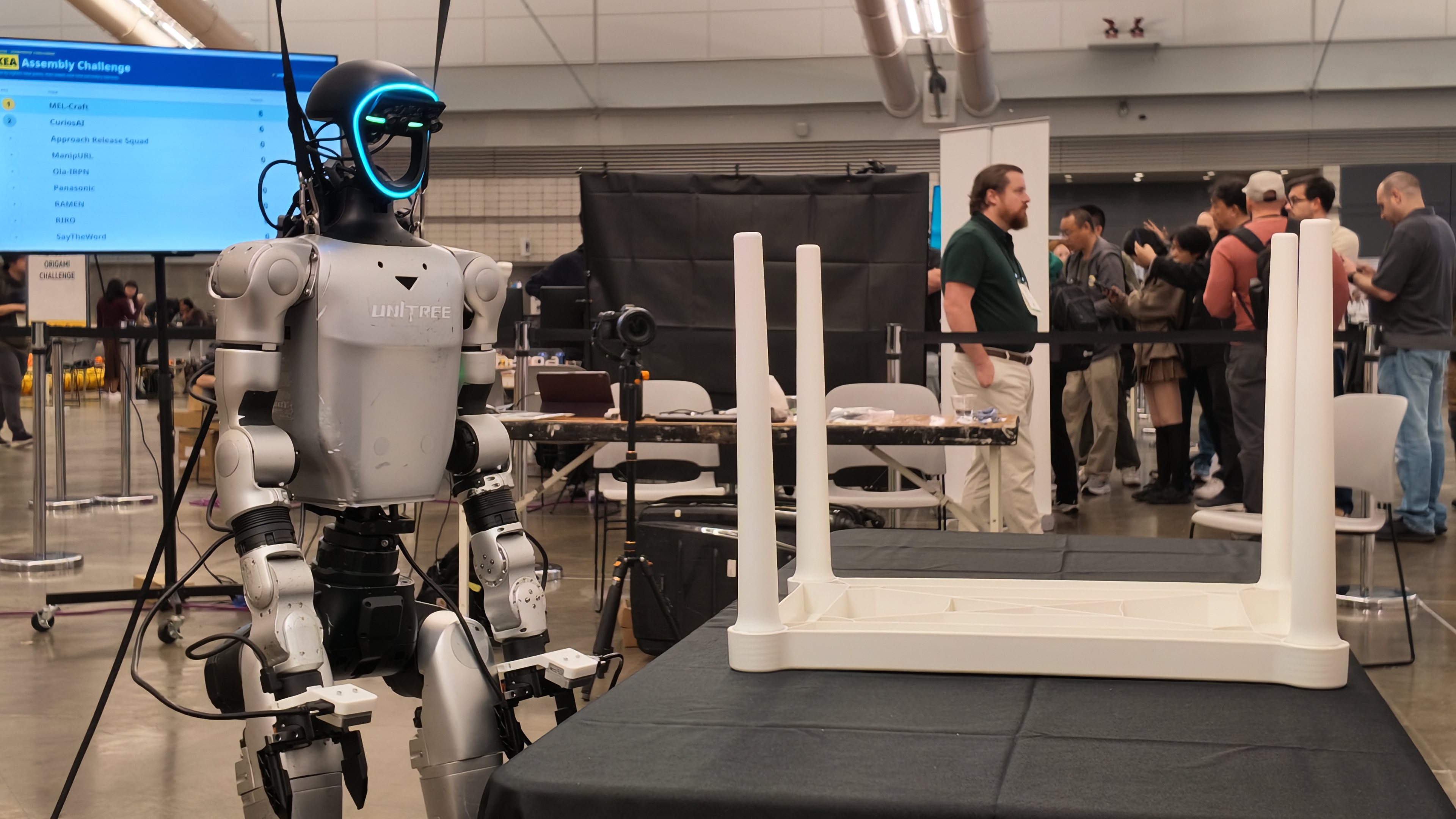
At the Humanoid IKEA Furniture Assembly Challenge, which was co-organised by SIT’s Centre for Intelligent Robotics, teams had to develop AI models capable of guiding a humanoid robot through the complex task of building a table.
Learning Embodied AI from Scratch
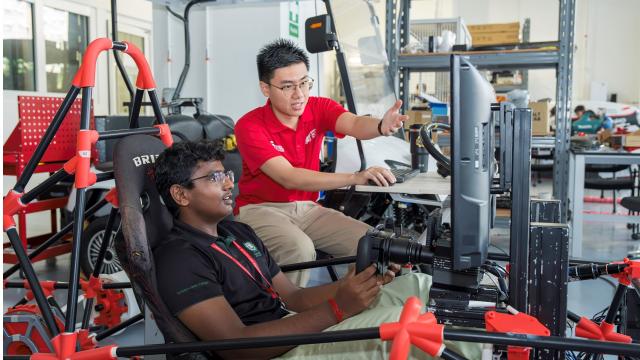
Although the SIT student team was optimistic in the months before the competition, they quickly met with a sobering reality. Embodied AI, which involves integrating AI into physical systems, was a nascent field. The students struggled to understand how it worked, much less build a functional embodied AI model.
“When we looked online, there wasn't much for us to refer to… We needed to dig around and find out for ourselves,” said Neo Zhen Ye, a third-year Robotics Systems undergraduate at SIT.
With the guidance of Associate Professor Lim Chun Yee, Programme Leader of the Bachelor of Engineering with Honours in Robotics Systems, they deepened their understanding of embodied AI through lectures and industry sharings.
The experience of some team members also came in handy. Caleb Gan, a recent Mechatronics Systems graduate from SIT, had once used embodied AI for his capstone project, which involved training a set of robotic arms to wipe stains from different angles of a toilet bowl. While less complex than the IKEA challenge, his capstone project gave him critical real-world insights. “Previously, I always thought like an engineer. But when it comes to embodied AI, you have to think like a data scientist,” he said.
In other words, he had to shift his focus from manual trial-and-error to systematic data collection. Each training session was meticulously planned, with variables tracked to a tee. The team learnt from his experience by using Microsoft Excel to organise and process their collected data, ensuring it was clean and useful when training the AI model.
Meanwhile, Fazrey and Muslinmin were facing their own struggles. As evaluators, their task was not only to grade teams during the competition but also to ensure that the preparation process was equitable. That meant one thing: providing all teams with access to robots, wherever they were located in the world.
For months before the main event, the duo served as the vital link between code and hardware by liaising with overseas teams who wanted to test their models on the robots hosted in SIT. But they discovered that these robots did not exactly match the ones that would be used during the competition.
To solve this problem, they worked with the manufacturer to align the robots’ hardware and software. “We tried to make a twin of the robot in SIT,” said Fazrey. Not only that, they also set up a remote server and private network, which helped teams run their code seamlessly.
Competition Day: Lag, Glitches and Long Waits
On competition day, the SIT student team faced formidable opponents, including SoftBank and Mitsubishi, and master’s and PhD students from other universities.
Still, they were confident. “We were expecting to win,” said Caleb. The team had seen videos of rival teams attempting the task and felt they could do better.
But operating the robot remotely came with unexpected challenges. The distance between Singapore and Pittsburgh introduced slight communication delays, making it difficult to control the robot in real time.
They also had to adapt their AI model to the computer system used at the venue, which had less processing power than the system used in Singapore.
“It was like using a phone to type an essay,” explained Kieran Neo, a third-year Robotics Systems undergraduate of the remote setup. “It was laggy… the entire model ran slowly.”
While the SIT team struggled with technical glitches, Fazrey and Muslinmin were dealing with a different set of challenges – ensuring the competition remained fair to participants despite hiccups. One was a shortage of robots: with only a limited number available, teams had to take turns.
“When one team gets delayed (by technical glitches), the next team has to wait,” Fazrey recalled. To prevent any misunderstandings, he called an impromptu meeting with the competitors during one such delay. “I gathered a representative from each team for a face-to-face chat… and offered the waiting teams a chance to reschedule.”
What’s Next for Embodied AI?
The challenge gave the SIT team a valuable platform to apply their knowledge in real life. “It was a very good opportunity to learn how to build and understand these systems,” said Caleb, adding: “We got to see our model actually run!”
“I don't think it's smart enough to be super useful right now,” said Geremy Lee Yi Liang, a third-year Robotics Systems undergraduate.
For Muslinmin, being a technical evaluator taught him to be flexible. “Things are very iterative in this space, so being set on one model early on isn’t a good idea,” he said. “What if you become an expert in the current best model, but it’s no longer the best in a year’s time?”
But while technology can shift rapidly, some fundamentals remain the same. For him, the ultimate goal of embodied AI should be to improve people’s lives.
“Whatever technology we come across, (we must consider) how to make the world around us better,” he said. “It's not about replacing people but helping them.”