









![[FA] SIT One SITizen Alumni Initiative_Web banner_1244px x 688px.jpg](/sites/default/files/2024-12/%5BFA%5D%20%20SIT%20One%20SITizen%20Alumni%20Initiative_Web%20banner_1244px%20x%20688px.jpg)
Living with two chronic conditions that require her to use a wheelchair on difficult days, Pamela Tan went on to complete her master’s at SIT and came away with new insights into the emotional and physical challenges facing young liver transplant patients.
Pamela Tan has learned to plan around uncertainty.
She lives with small fibre neuropathy and postural orthostatic tachycardia syndrome (POTS), two interconnected conditions with unpredictable symptoms. During an episode, her heart rate spikes, her blood pressure drops, and her vision turns black and white. Since her diagnosis around 2022, Pamela could not stand or walk for long durations at work, relying on a motorised wheelchair to move around the wards.
It was a reality that gave her pause when she considered pursuing a master’s degree. The clinical hours alone — 440 in total — would test anyone. For Pamela, they would require careful management of her energy, her schedule, and her health.
She enrolled anyway.
Over the course of SIT’s Master of Health Sciences (Organ Transplant Nursing), consistent rehabilitation helped Pamela progress from the wheelchair to a walking stick. At 45, she graduated as one of the more senior members of her cohort and one of the most quietly determined.
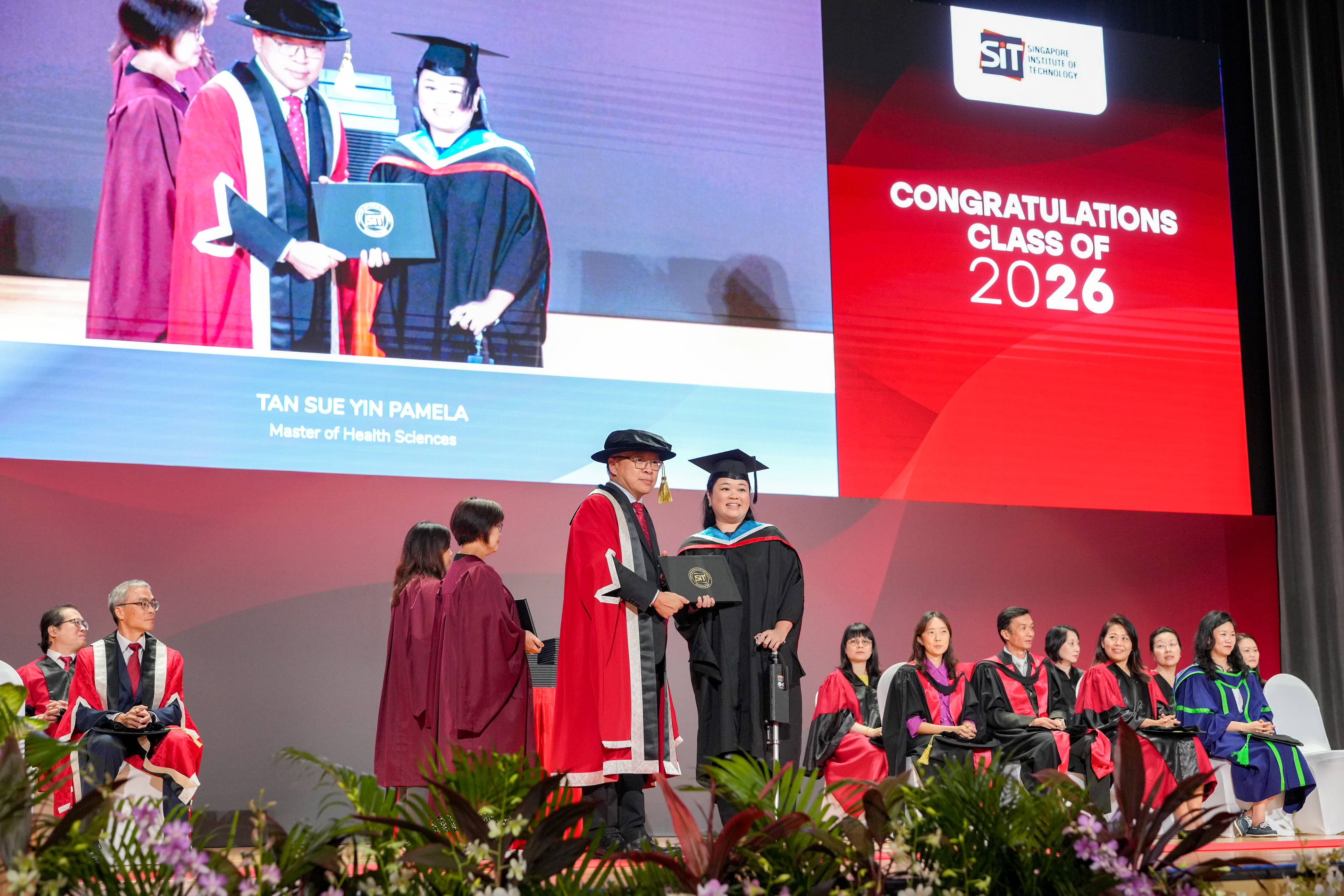
A proud moment for Pamela as she crosses the Convocation stage. (Photo Credit: Keng Photography)
Answering a Long-Awaited Call
The decision to pursue the degree had been building for fifteen years.
Pamela works at the Division of Paediatric Gastroenterology, Hepatology and Nutrition at the Khoo Teck Puat – National University Children’s Medical Institute, National University Hospital, Singapore’s only public paediatric transplant centre. This makes her one of the very few specialty nurses in the country caring for children undergoing liver transplantation, a responsibility she does not take lightly.
It is a highly specialised field. For fifteen years, she had been searching for a programme that matched it. SIT’s Master of Health Sciences programme offers five specialisation tracks, including one in Organ Transplant Nursing – exactly what she needed to deepen her clinical expertise.
Designed for practising clinicians, it allowed Pamela to undertake clinical training at her own workplace. “The theory I studied in the evening was something I could bring to the bedside the next morning,” she said.
The programme’s focus on adult organ transplantation was particularly relevant to Pamela, who also helps patients transition from paediatric to adult care, “I know what to expect and the best practices. I wanted a qualification that deepened my practice.”
“Tell Us What You Can and Cannot Do”
Pamela braced for rejection after submitting her application to SIT. Instead, Associate Professor Edward Poon and Associate Professor Muhammad Rahizan Zainuldin reached out to ask for a meeting.
“They did not treat my condition as an administrative problem to be processed. They treated it as something to plan around together,” she recalled.
Small adjustments made a real difference. Lessons conducted online allowed Pamela to attend from home or her workplace. She was allowed to deliver presentations seated, and A/Prof Poon checked in on her during her first week of clinical attachment. Coursemates also rallied around her, helping with tasks like opening doors and handling lunch trays.
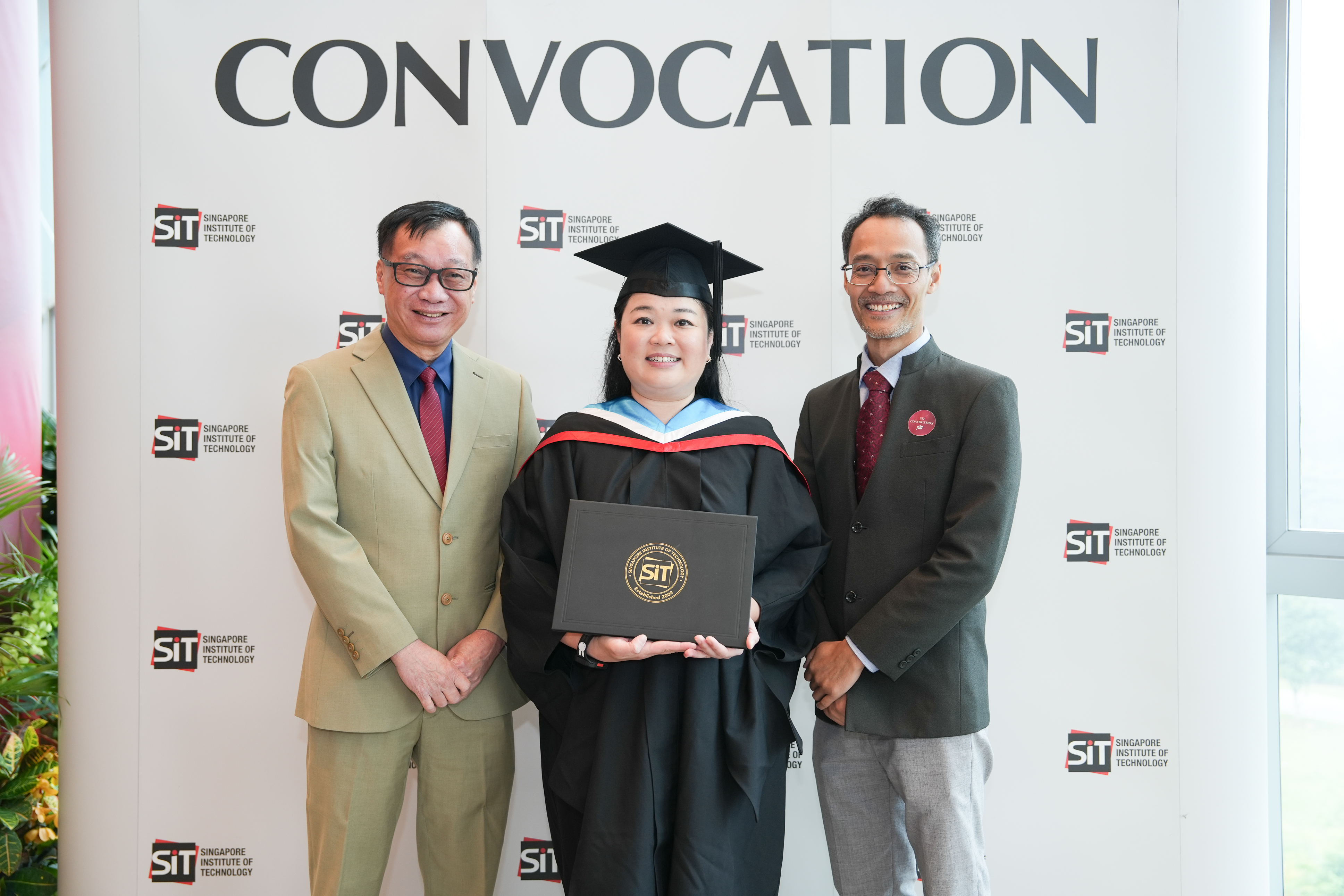
Pamela with A/Prof Edward Poon (left) and A/Prof Muhammad Rahizan Zainuldin (right), who worked with her to plan around her condition from the start of her studies. (Photo Credit: Keng Photography)
Managing her health alongside work and studies still required careful planning. To prevent blackouts, Pamela lugged two litres of isotonic drink to the campus each time and was driven to and from classes throughout the programme. Weekends were set aside to rest and recover for the week ahead.
Making Her Degree Count
Pamela’s perseverance paid off in insights that have made her a better clinician.
Many came from her master’s research, which examined transition readiness among adolescent and young adult recipients of paediatric liver transplants at her hospital. It is a challenge faced by transplant centres worldwide. Young patients who thrive under paediatric care can begin to lose their transplanted livers after moving to adult services, where they must manage their own medication and appointments without their parents' supervision.
Pamela’s research uncovered opportunities to strengthen psychological support for patients and caregivers alike.
"Growing up with a transplant means medication for life and missing out on things that teenagers are naturally curious about, like hanging out with friends and going to crowded parties," Pamela said.
Because transplant medication suppresses the immune system, crowded places carry infection risks for these young patients. So, care should go beyond making sure patients keep to their medication and appointments, to supporting them emotionally as they navigate these trade-offs, she added.
The coursework also highlighted the importance of rehabilitation for patients who lose strength and muscle mass during extended rest. “If we don’t make them strong, the post-transplant recovery will take longer and be more difficult,” she added.
As a nurse clinician who designs her patients’ care journey, Pamela has since increased the involvement of physiotherapists and occupational therapists in patients’ care plans.
Her approach to patient conversations has evolved too. Beyond discussing medication and test results, she asks patients how things are at school and at home. Recently, these questions helped her identify a primary school pupil who was being bullied. She alerted the parents and a medical social worker, who contacted the school counsellor for help.
“For a long time, medical teams focused on test results and numbers, when we should also be helping patients adapt to a less common lifestyle,” said Pamela, who will be presenting her research at the NUHS Nursing Seminar this month.
Two years on, Pamela has shown that age and health need not stand in the way of growth. She hopes other nurses will feel the same freedom to keep learning. "If you have the motivation and the resilience, never give up," she said. "There is always more we can learn to give our patients better care."