







For the top six teams of this year's National Youth Tech Championship (NYTC), the competition was only the beginning. A follow-on robotics workshop at SIT, supported by industry, shows how an early spark in technology can turn into confidence to solve real-world problems.
An engineering vehicle approaches a line-up of animal plushies. Its task: identify the monkey and trigger a response. No one is steering. The vehicle decides for itself, leaning on the AI model trained by the secondary school students who had built it.
Months earlier, these students took part in the National Youth Tech Championship (NYTC) 2026 – the largest AI tech competition for secondary school students in Singapore, jointly organised by the Infocomm Media Development Authority (IMDA) and Google, in partnership with SIT.
For most competitions, that would be the end of the line. Trophies handed out, photos taken, and the momentum that carried through the competition slowly fades.
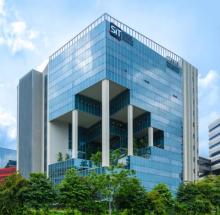
But for the students who had emerged as the top six teams at NYTC, that momentum was carried forward. Over two days, the winning teams from Bedok Green Secondary School, Nanyang Girls’ High School, Temasek Junior College (Secondary), Xinmin Secondary School, Yusof Ishak Secondary School and Zhonghua Secondary School made their way to SIT Punggol Campus for the Beyond NYTC: Advanced Robotics & Autonomous Systems Workshop.

Two days, six schools, one big step beyond NYTC.
While NYTC provided a platform for students to develop and showcase their skills in AI, coding and robotics, Beyond NYTC gave them an opportunity to take those foundations further — into engineering design, systems integration and autonomous decision-making.
Seeing What’s Possible, then Building It
Behind the seemingly playful monkey challenge lies a complex engineering process involving cameras, sensors, motors, programming, data collection and artificial intelligence. To prepare for it, participants were exposed to the breadth of robotics and engineering work at SIT.
Through demonstrations and interactions with SIT faculty and students, they encountered projects spanning different environments and applications, including embodied AI and humanoid robotics, Formula student race car, RobotX autonomous systems and Team MAKO’s underwater robotics. Several of these projects were student-led, giving participants a glimpse of where a project or co-curricular activity can lead.

Learning from those a few steps ahead: a SITizen guides a participant through SIT’s Formula race car.
They subsequently moved from observing to building.
Working with Raspberry Pi, Python, cameras, sensors, motors and servos, the mixed-school teams learnt to program an engineering vehicle, testing and refining their solutions until they worked — experiencing first-hand a process familiar to engineers: a working solution often emerges through repeated experimentation, rather than from getting everything right the first time.
A Uniquely Punggol Challenge
The learning culminated in a challenge grounded in the students’ surroundings.
Inspired by occasional monkey incursions in Punggol, the teams were tasked with training their AI models to recognise a monkey plushie among other animal plushies. Their robots then had to respond based on what they detected.

RoboCop? Just a participant using a roboarm to give a tap.
What appeared simple on the surface required students to bring together the different skills they had developed during NYTC and the workshop — from collecting and training datasets to programming, sensor integration and testing the complete robotic system.
More importantly, the challenge gave students an opportunity to consider how engineering and technology can be applied to situations beyond the classroom or competition arena.
“At SIT, we believe that nurturing future innovators begins with giving young people meaningful opportunities to explore, experiment and solve problems. When students encounter STEM through authentic challenges and learn alongside our faculty, students, alumni and peers, they can begin to see both the relevance of technology and their own potential to shape it,” said Mr Seah Keok Choon, Director, Community Engagement, SIT.
For SIT, creating such experiences is part of its broader commitment to nurturing interest in STEM from an early age. “Our role is to create these pathways and connect education, industry and community in ways that make learning matter,” he added.
Building a Pathway Beyond the Competition
These pathways are built with the support of industry partners.
‘Beyond NYTC’ was supported by Tokyo Electron Singapore, whose sponsorship enabled the two-day extension of the students’ NYTC learning journey. Mr Alex Ngor, Vice President, Engineering Management, Tokyo Electron Singapore, attended the workshop as a guest and engaged with the participants, giving them a glimpse of how the skills they were learning are applied in industry.

Mr Alex Ngor from Tokyo Electron Singapore shows participants where their new skills can take them.
“Tokyo Electron believes in inspiring tomorrow—partnering closely with our tertiary and school communities to empower young innovators through robotics, autonomous and emerging technologies,” said Mr Ngor.
For students, these partnerships add up to a learning journey that no single organisation could offer alone. IMDA provides a national platform through NYTC for students to develop and showcase capabilities in AI, coding and robotics. SIT extends this learning through its faculty expertise, facilities, student and alumni involvement, and exposure to authentic engineering projects. Industry partners such as Tokyo Electron Singapore contribute support and perspectives that help students to engage more deeply with STEM.
“The development of future digital talent requires a collective effort across government, educational institutions and industry. Initiatives like NYTC and programmes that build on it, such as ‘Beyond NYTC’, demonstrate how an ecosystem can come together to provide students with authentic learning experiences that inspire curiosity, build confidence and deepen their understanding of emerging technologies. We are pleased that SIT and industry partners are coming together to create opportunities that empower students to become the innovators and problem-solvers of tomorrow.” Mr Simon Lee, Director, Digital Literacy and Wellness at IMDA.
For the participants, however, the value of the two days extended beyond completing a robotics challenge. They experienced what it means to take an idea, turn it into a system, test it against reality and refine it when it does not work as expected.
And perhaps most importantly, they began to see themselves not just as participants in a technology competition, but as young innovators who do more than consume technology — ones who know how to harness it, put it to work and shape solutions for their communities.