








Carbon Negative Steel Slag Permeable Concrete for Green Urban Infrastructure

Small placeholder avatar image
Sing Ping CHIEW    
Professor

Read More 

Small placeholder avatar image
Chew Beng SOH    
Associate Professor

Read More 

Small placeholder avatar image
Zhao Ming Shan    
Associate Professor

Read More 

Small placeholder avatar image
Choon Meng KIEW    
Assistant Professor

Read More 

Small placeholder avatar image
Chow Goon Ng    
Senior Professional Officer

Read More 

Small placeholder avatar image
Chua Yuan Shen, Raphael    
Research Engineer
Small placeholder avatar image
Zhang Yuhui    
Research Engineer
Research Objective:

Steelmaking generates over 400 million tonnes of slag annually worldwide, with tens of thousands of tonnes of electric arc furnace (EAF) slag produced in Singapore each year. Unlike blast furnace slag, EAF slag has low hydraulic reactivity, limiting its structural applications. This research develops Sustainable Steel Slag Porous Concrete (SSPC) to transform this underutilised industrial by-product into a multifunctional construction material for green and climate-resilient urban infrastructure, addressing stormwater management, urban heat mitigation, and waste valorisation simultaneously.

Screenshot 2025-09-24 094813.png

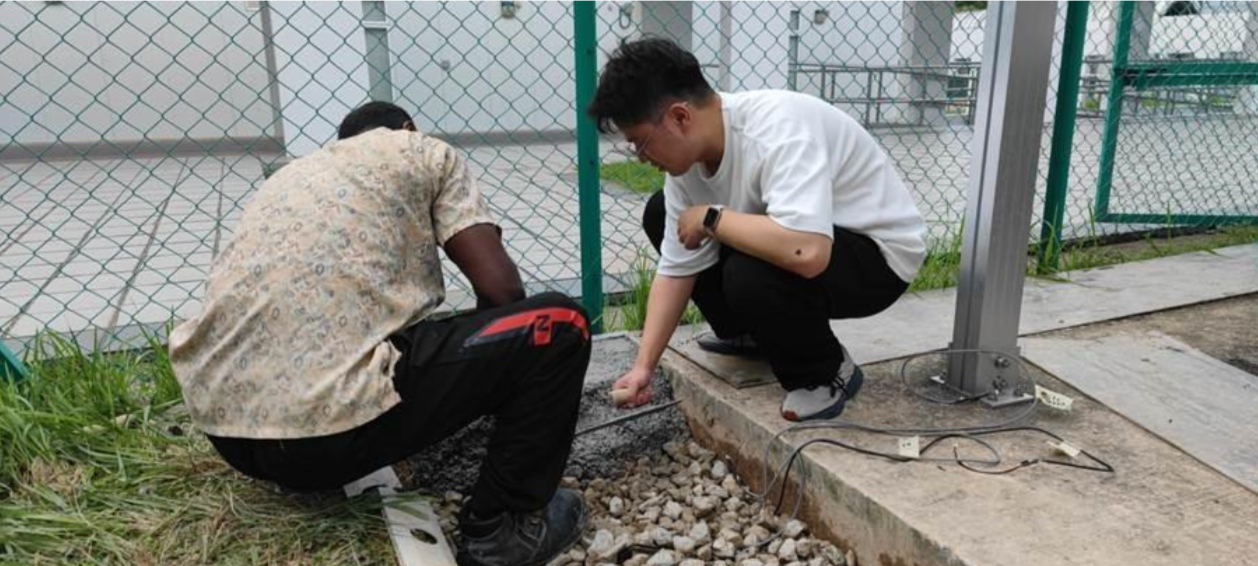
Yuhui (on the right) casting full-scale permeable footpath during test bedding. (Photo: Zhang Yuhui)

Applied Research Methods

Led by DEng candidate Zhang Yuhui under the supervision of Associate Professor Zhao Ming Shan and industry supervisor Mr Natarajan Saravanan from NatSteel Holdings, the research integrates laboratory optimisation with real-world validation. Laboratory studies optimised mix designs to achieve permeability and compressive strength benchmarks comparable to conventional porous concrete. A full-scale outdoor testbed with embedded temperature and moisture sensors monitored pavement performance over three months. Comprehensive environmental safety assessments, including extended leaching tests in freshwater, seawater, and pH-adjusted solutions, validated negligible trace metal release with chromium levels consistently below international safety thresholds.

Results & Impact

Yuhui’s innovative work on SSPC has established a promising pathway for valorising industrial by-products in sustainable pavements. His research highlights how EAF steel slag, once considered low-value waste, can be transformed into a safe, multifunctional, and carbon-negative construction material. 

The project has attracted strong academic and industry interest, aligning closely with Singapore’s ambitions for ecological, resilient, and resource-efficient urban infrastructure. By reducing reliance on imported aggregates, lowering embodied carbon, and offering multifunctional urban benefits, SSPC has the potential to make a significant impact on climate-smart city development.
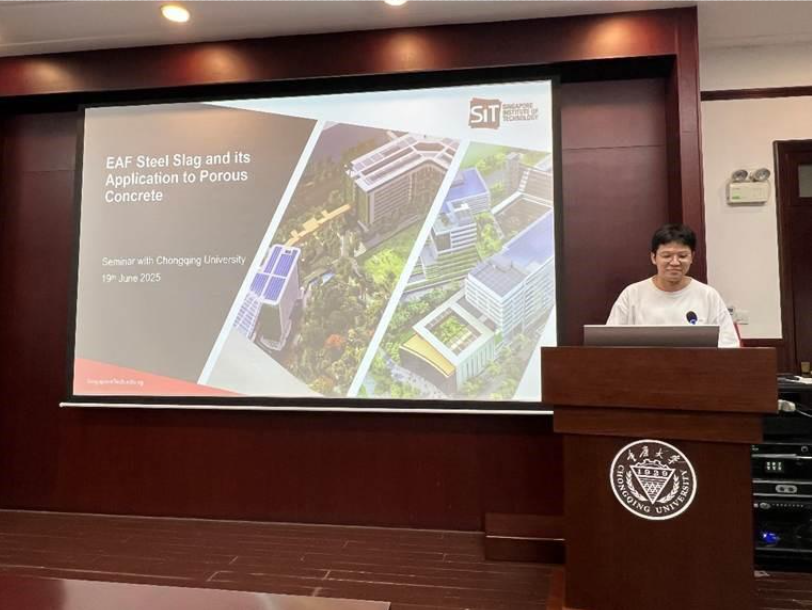
Screenshot 2025-09-24 103121.png

Yuhui presenting his research and protypes at the 2025 Chongqing University G-Seminar. (Photo: Zhang Yuhui)

Ongoing Development

Yuhui continues advancing SSPC technology through his DEng programme, focusing on scaling laboratory innovations to widespread urban infrastructure applications. The collaboration with NatSteel Holdings and other industry stakeholders aims to demonstrate commercial viability and regulatory compliance, positioning SSPC as a key component in Singapore's transition toward ecological, resilient, and resource-efficient urban infrastructure that addresses multiple climate challenges through integrated solutions. 

Reflecting on his research, Yuhui shares: 

“Steel slag is often seen as a problem, but I see it as an opportunity. By converting this abundant by-product into a multifunctional concrete for pavements, we are solving multiple urban challenges at once—flooding, heat, and waste. What excites me most is that this is not just theory. The testbed shows it works in real conditions, and it has the potential to make Singapore’s infrastructure greener and more sustainable.”