














Programme Overview
Qualification
Master of Science in Safety and Risk (MSc Safety and Risk)
Provider
Singapore Institute of Technology
Duration
2 years
Total credits
60
Application period
Varies by module. See each module page for dates.
Next intake
Campus location
SIT Punggol Campus
The Master of Science in Safety and Risk is a 60-credit postgraduate programme for professionals who manage safety and risk in complex, high-risk environments. It brings risk science, safety systems and human factors into one framework, so you can make defensible, risk-informed decisions across assets, systems and stakeholders.
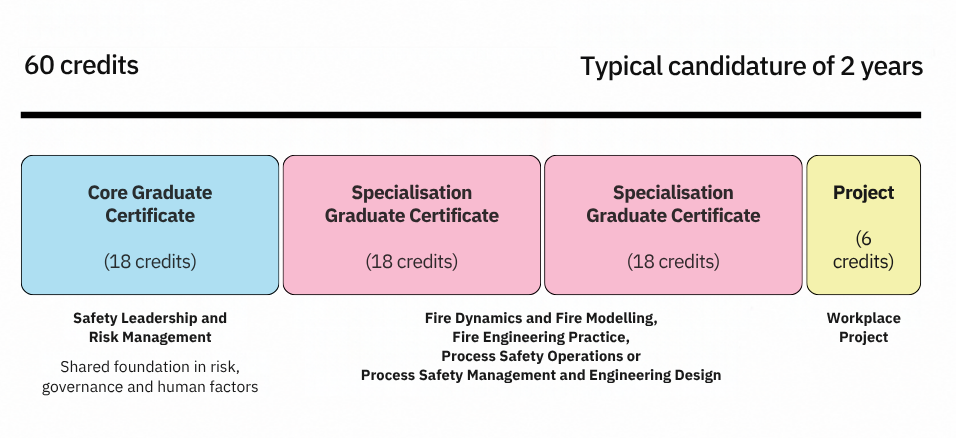
The programme is built from stackable Graduate Certificates. Every learner completes the core Graduate Certificate in Safety Leadership and Risk Management (18 credits), two specialisation Graduate Certificates (36 credits), and completes with a 6-credit project set in a workplace context. Choose a specialisation in Fire Safety Engineering or Process Safety, or combine any two of the four Graduate Certificates.
Learners begin with individual modules within a Graduate Certificate, and each Graduate Certificate is a standalone credential. Completed Graduate Certificates then stack towards the master’s.
The MSc Safety and Risk is designed for working professionals in engineering, safety, risk and operations.
One Framework for Risk, Systems and People
Risk science, safety systems and human factors are taught together as one framework. You learn to assess hazards in complex systems, govern safety, and lead the people and technology involved, including data and AI tools.
Depth in the Domain You Work In
Specialise in Fire Safety Engineering or Process Safety, or combine certificates from both. Each specialisation builds on the shared core, so technical depth sits within a consistent approach to risk.
Learning Applied at Work
Each core module ends in a project drawn from your own workplace, and the programme closes with a 6-credit workplace project. You apply what you study to real problems in your organisation.
A Pathway Paced Around Your Job
Every Graduate Certificate is a standalone credential, and fees and funding apply module by module. You may start with one and stack towards the master’s as your schedule and sponsorship allow.
Who It Is For
ENGINEERS
Mid-career engineering professionals working in aviation, maritime, manufacturing or transport and moving into complex risk governance.
SAFETY PROFESSIONALS
Technology-driven safety practitioners building skills in AI, data analytics, cyber-physical safety and automated environments.
RISK MANAGERS
Corporate risk and operations managers overseeing enterprise, digital and operational risks across sectors.
Programme Structure
The MSc Safety and Risk is built from Graduate Certificates. Each Graduate Certificate is an 18-credit, coherent bite-size set of learning, made up of three to eight modules. Each credit-bearing module earns a Certificate of Attainment, and learners complete the full set of modules to earn the Graduate Certificate.
The 60 credits are accumulated through three components: a core Graduate Certificate (18 credits), two specialisation Graduate Certificates (36 credits) and a project (6 credits).
Sample Pathways
Programme Educational Objectives
Our programme’s educational objectives are:
- To advance the capabilities of engineering, safety, risk and operations professionals in applying advanced engineering knowledge, quantitative risk assessment, modelling and analytical techniques to complex and emerging safety and risk challenges across multidisciplinary domains.
- To develop professionals’ ability to lead and manage safety and risk initiatives, working effectively in multidisciplinary teams and integrating engineering judgement with project management and organisational objectives.
- To develop professionals who demonstrate high standards of professional ethics, effective communication and a strong commitment to regulatory compliance, sustainability and societal responsibilities in safety and risk practice.
- To enable professionals to engage in research, innovation and continuous professional development, using digital technologies and emerging methodologies to advance safety and risk practices in a rapidly evolving landscape.
At the end of the programme, our graduates will be able to:
- Apply advanced risk assessment methodologies and analytical tools to identify, model and evaluate hazards in complex socio-technical systems, enabling sound, risk-informed decision-making under uncertainty.
- Design, evaluate and optimise safety systems and risk control strategies, integrating engineering principles, operational realities and regulatory requirements to achieve resilient and high-reliability outcomes.
- Critically evaluate and implement safety governance frameworks, regulatory systems and assurance processes, demonstrating ethical, accountable and standards-aligned professional practice.
- Integrate human factors, safety culture and organisational behaviour to enhance system performance, while leading and influencing stakeholders to strengthen resilience in high-risk environments.
- Use emerging technologies and data-driven approaches (e.g., AI, digitalisation) to address evolving risks, and conduct applied research or inquiry to support continuous improvement and industry advancement.
Note: SIT reserves the rights to change, modify, or remove the contents of the website at any time for any reason at our sole discretion without notice.
Specialisation
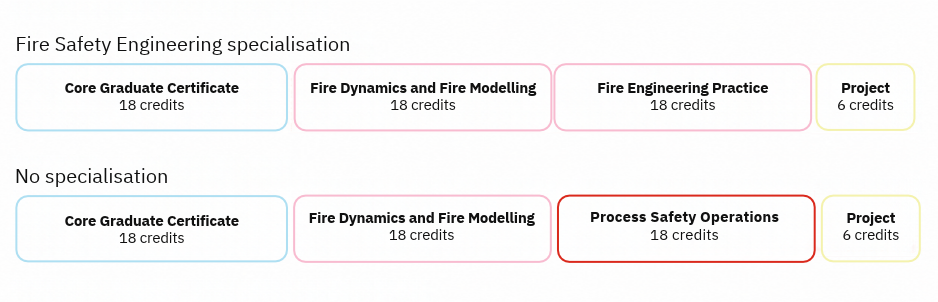
Learners have the option of graduating with a specialisation in either Fire Safety Engineering or Process Safety.
To graduate with a specialisation, learners must complete the core Graduate Certificate in Safety Leadership and Risk Management (18 credits) and both specialisation Graduate Certificates (36 credits) under their chosen specialisation.
To graduate without a specialisation, learners may complete the core Graduate Certificate and any two of the four specialisation Graduate Certificates below.
Select a Graduate Certificate to view its modules and apply for them.
Core
Graduate Certificate in Safety Leadership and Risk Management Details to follow
Fire Safety Engineering
Graduate Certificate in Fire Dynamics and Fire Modelling Co-developed with the Singapore Civil Defence Force (SCDF)Graduate Certificate in Fire Engineering Practice
Process Safety
How to Start
To begin, apply to the modules you choose within a Graduate Certificate, then stack the credits earned towards the degree. Direct admission into the degree programme is currently unavailable.
1
Choose your modules
Anytime
Browse the Graduate Certificates and pick the modules that fit your goal. Details on schedule, fees and funding are on the module pages.
2
Apply Online
Per module run
Apply through the module page on SITLEARN, SIT’s lifelong learning division.
3
Earn a Certificate of Attainment
Per module
Attend at least 75% of the module and pass its credit-bearing assessment.
4
Earn a Graduate Certificate
After all its modules
Complete every module in a Graduate Certificate to receive it.
5
Stack towards the master’s
At your own pace
Build to 60 credits with the core Graduate Certificate, two specialisation Graduate Certificates and the project.
Funding for stacked modules is subject to a cap, See details in Fees and Finances.
Curriculum Structure
All classes are conducted in person on weekdays at SIT Punggol Campus. Learners take the Graduate Certificates and modules whenever the modules are held. The following illustration shows how the master’s degree could be earned within the normal candidature of 2 years.
| Year | Trimester 1 | Trimester 2 | Trimester 3 | |
|---|---|---|---|---|
| Normal Candidature | 1 | - | Modules (12 credits) | Modules (12 credits) |
| Project (6 credits) | ||||
| 2 | ||||
| Modules (12 credits) | Modules (12 credits) | Modules (6 credits) | ||
Note: Illustrative pacing, in credits. Learners may pace their studies differently.
Eligibility
- Applicants must hold a bachelor’s degree in science, engineering or a relevant discipline.
- Professional qualifications from local or overseas registration bodies, such as PE or CEng, may be considered.
- An interview may be required if applicants do not have the requisite qualifications but have strong, relevant industry practice and experience.
Applicants who do not meet these criteria are considered case by case, in line with SIT’s prevailing admissions policy.
Fees and Finances
Eligible modules in this programme receive up to 90% course fee funding from the Skills and Workforce Development Agency (SWDA), depending on your eligibility.
Fees, funding rates and eligibility criteria are shown on individual module page. Terms and conditions apply.
Note that funding support is capped at 30 of the 60 credits (50% of the programme) for modules stacked towards the MSc in Safety and Risk.
For more details on funding and eligibility:
Fees and Finances
Frequently Asked Questions
-
Do I have to commit to the full master's degree programme straight away?
No. Each Graduate Certificate is a standalone credential, so you can complete one, earn the credential and decide later whether to stack it.
-
Do I have to choose a specialisation?
Learners complete a 6-credit Project module in an area related to safety and risk or your chosen specialisation, preferably applicable to your workplace. This project aims to bring together what you have learned to deliver a solution to a real-world problem.
Details on how to enrol in the project will follow.
-
What is the project?
Learners complete a 6-credit Project module in an area related to safety and risk or your chosen specialisation, preferably applicable to your workplace. This project aims to bring together what you have learned to deliver a solution to a real-world problem.
Details on how to enrol in the project will follow.
-
How do I enrol?
Learners apply to modules through the individual module pages, complete them to earn Graduate Certificates, then stack towards the master's degree.
Details on direct enrollment into the master's will follow.
-
Can I choose electives from other programmes?
No. All 60 credits are earned through the core Graduate Certificate, two specialisation Graduate Certificates and the project.
-
How long does it take to complete the programme?
The normal candidature is 2 years for 60 credits. Modules are held on scheduled dates, and you choose which to take and when.
-
What funding support is available?
Eligible modules receive up to 90% course fee funding from the Skills and Workforce Development Agency (SWDA), depending on your eligibility.
The fee before and after funding are detailed on individual module page. Terms and conditions apply.
For modules stacked towards the master’s, funding support is capped at 30 of the 60 credits (50% of the programme).