








![[FA] SIT One SITizen Alumni Initiative_Web banner_1244px x 688px.jpg](/openhouse2025/sit-teaching-and-learning-academy/centre-professional-communication/sit-teaching-and-learning-academy/openhouse/directory/sites/default/files/2024-12/%5BFA%5D%20%20SIT%20One%20SITizen%20Alumni%20Initiative_Web%20banner_1244px%20x%20688px.jpg)
Three SIT undergraduates and one research engineer from the university’s ICT and Engineering clusters have clinched an Excellence Award in the 2025 International Innovation Competition on Structural Health Monitoring for Railway Systems, standing out among postgraduate and PhD-level teams from around the world.
Keeping a railway system safe goes far beyond trains running on time. Beneath the carriages, tracks, pillars and other supporting structures work silently around the clock, enduring constant vibration, heavy loads and the effects of weather.
In a city like Singapore, where millions of journeys depend on rail reliability every day, monitoring the “health” of these structures is essential.
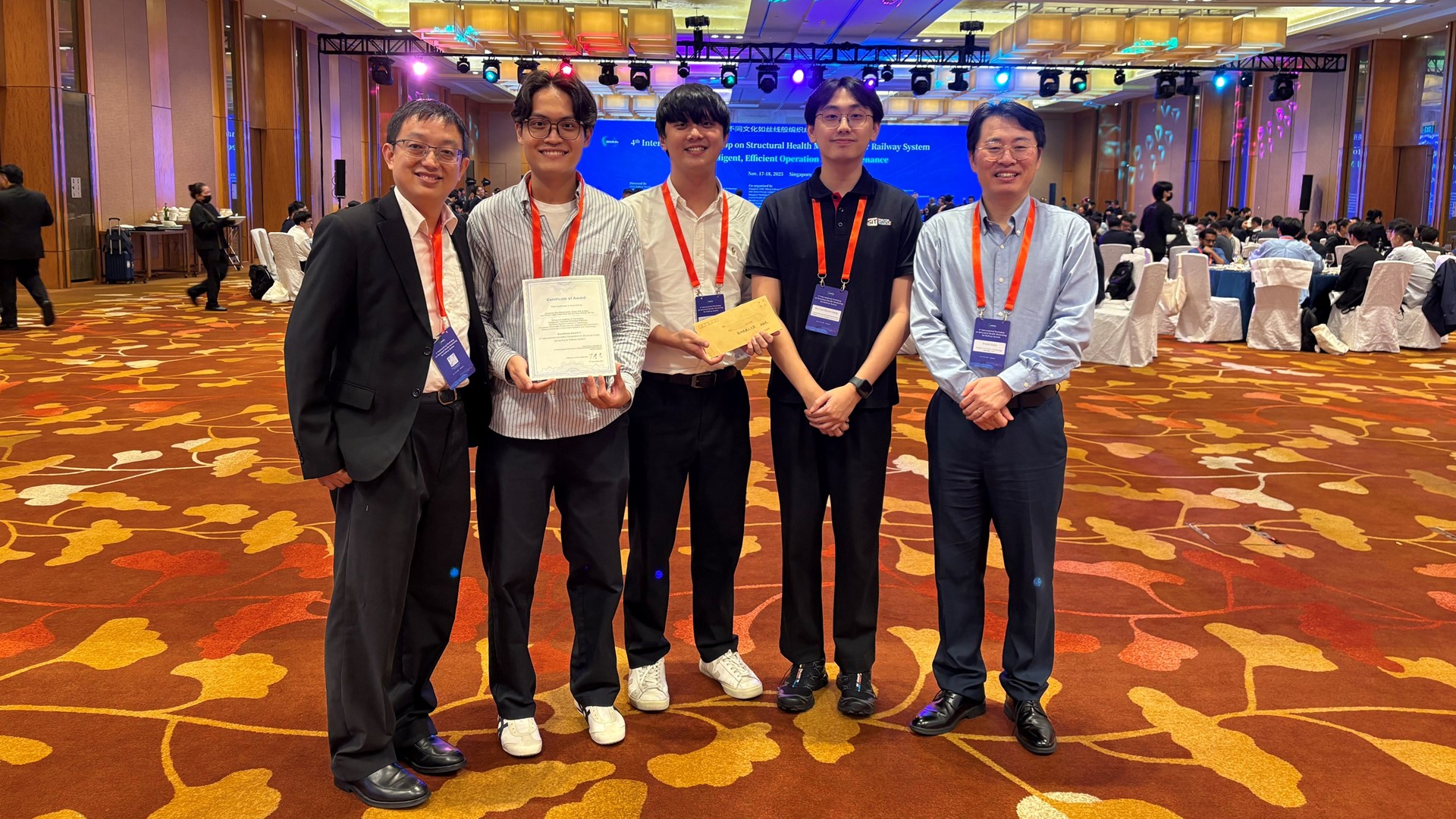
From left to right: A/Prof Zhou Yi, Joey Chua Jun Yu, Aaron Poh Xi Wen, Research Engineer Lee Choon Liang, and A/Prof Frank Guan (Not in picture: Johannes Gan Dombrowski).
On The Rails to Safer, Smarter Systems
As rail infrastructure ages, engineers increasingly rely on sensors and data analytics to detect subtle changes before they become critical issues. These include detecting minute cracks, abnormal vibrations, unusual movement in tunnels or viaducts and temperature-related stress. Early detection prevents minor defects from escalating into faults that disrupt services or compromise commuter safety.
Competitions such as the International Innovation Competition on Health Monitoring of Railway Structures help accelerate advances in this field. Organised by major rail manufacturers and operators, including CRRC Qingdao Sifang Co. Ltd., SMRT Corporation Ltd., SBS Transit and the State Key Laboratory of High-speed Maglev Transportation Technology, the initiative aims to drive technological breakthroughs, foster global collaboration and nurture future railway engineers and innovators. Ultimately, it supports the development of safer, smarter, and more sustainable railway systems.
Engineering Momentum Through Industry-aligned Learning
As part of SIT’s commitment to industry-aligned education and applied research, the university fielded a team in the 2nd edition of the competition, which was held from May to November 2025.
Competing in the “Impact Monitoring of Composite Material Structures” track, the SIT team comprised Year 4 students Joey Chua Jun Yu from the Computer Science in Real-Time Interactive Simulation programme, Aaron Poh Xi Wen and Johannes Gan Dombrowski from the Electronics and Data Engineering programme, alongside SIT research engineer Lee Choon Liang.
They faced stiff competition from overseas teams comprising full-time PhD students and postgraduate researchers. Despite this, the SIT undergraduates managed to balance this five-month project alongside their academic coursework and full-time industry attachments.
Describing their approach, Joey shared, “Each of us would research existing methods – from convolutional neural networks (CNN) to acoustic emissions to capture signals for sound waves. We tested each method before coming together weekly to compare our findings.”
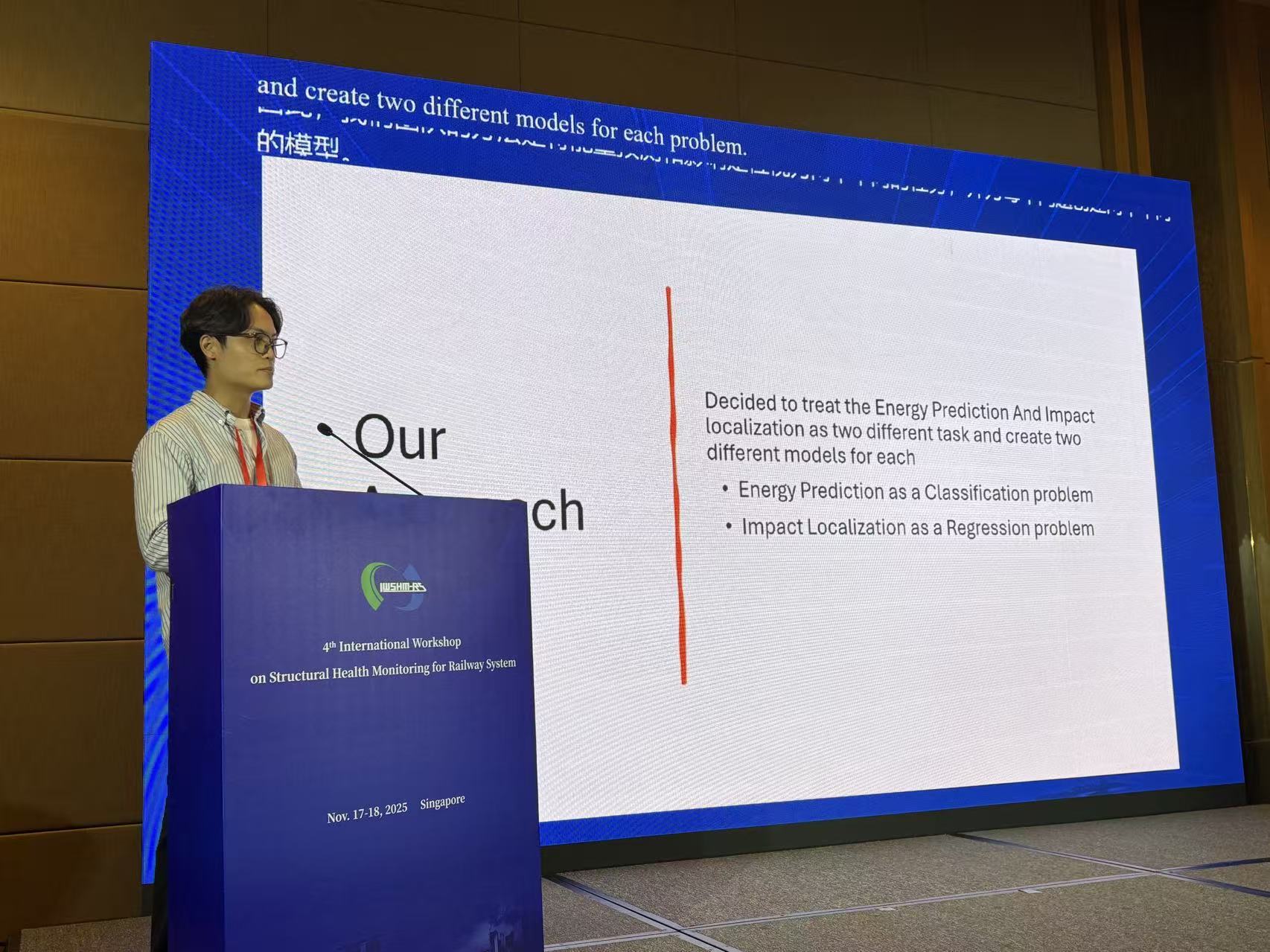
Information and Communications Technology SITizen, Joey Chua, presenting the team’s findings to the panel.
Added Johannes, “This competition was a great learning experience in signal processing and in extracting meaningful information from limited data. We spent a lot of time studying research methodologies and figuring out how to apply them effectively - which paid off!”
Switching Tracks Towards Innovative Solutions
Under the guidance of SIT Associate Professors Zhou Yi, Zhou Junhong and Frank Guan, all established engineering and ICT experts, the team emerged as one of 18 winning groups worldwide.
Explaining the team’s innovation, A/Prof Guan said, “We developed a physics-informed, AI-powered model combined with a novel triangulation method that uses multiple wave sources from IoT sensor signals. This delivered more accurate defect localisation compared to all the other methods we tested.”
Aaron elaborated, “Our experiments showed that traditional methods provided a defect location accuracy of around 40mm, whereas ours achieved 17mm — an improvement of 2.35 times.”
Highlighting the broader impact of this breakthrough, A/Prof Zhou Junhong added, “This forms an important aspect of smart maintenance, where potential faults can be identified and rectified before they even occur.”
A Learning Journey That Goes the Distance
While the award is a significant achievement for SIT, the competition offered something even more meaningful for the students: an opportunity to apply their knowledge beyond the classroom, collaborate with external researchers, and deepen their understanding of real-world engineering challenges.
For Joey, the experience was transformative. “I joined the competition with no expectations. Balancing our full-time internships while working on the project was tiring, but our win came as a pleasant surprise. More importantly, I learnt a lot just working on the project.”
Aaron, who did his Integrated Work Study Programme (IWSP) at SMRT and saw first-hand how structural monitoring tools are used in practice, reflected on the journey: “Despite the huge time commitment, I only felt the significance of our achievement at the award ceremony, when PhD and postdoc researchers were surprised to find out that we were undergrads.”
The students’ growth did not go unnoticed by their mentors. As Prof Zhou observed, “Through this competition, we can see that our students have the capability to self-learn, independently undertake research and discover new methods on their own.”
For Johannes, the takeaway went beyond the win, “SIT has always taught me to look for learning opportunities outside of the classroom. Although the scope of this project exceeded what I was taught in my modules, the key takeaway is about developing the right attitude – being willing to learn independently and to keep persevering when the going gets tough.