







![[FA] SIT One SITizen Alumni Initiative_Web banner_1244px x 688px.jpg](/sites/default/files/2024-12/%5BFA%5D%20%20SIT%20One%20SITizen%20Alumni%20Initiative_Web%20banner_1244px%20x%20688px.jpg)
NAMIC Hub@SIT is bringing local stories to life for visually impaired children through 3D-printed tactile braille books.
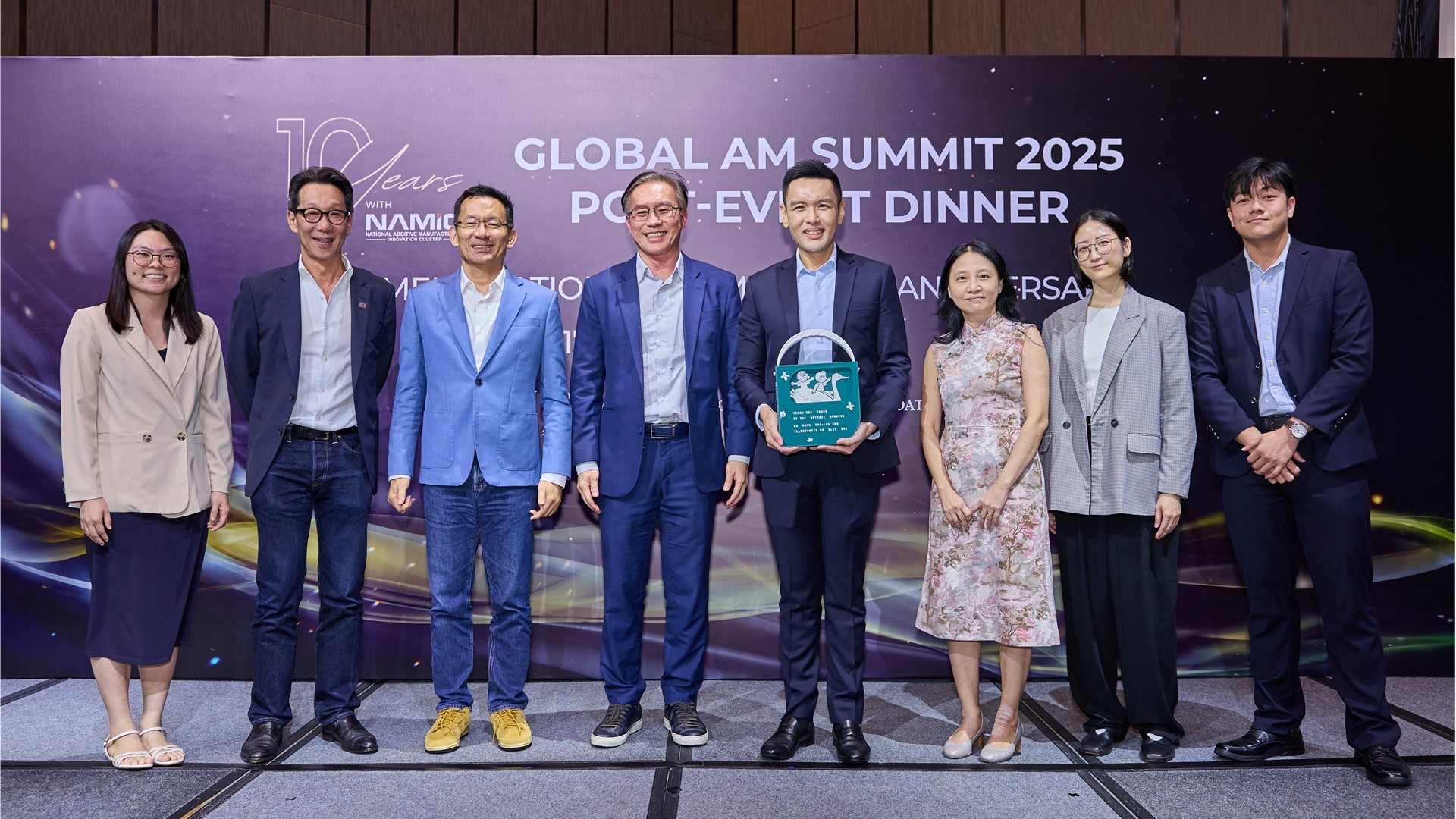
Presentation of Singapore's first 3D-printed braille book to iC2 PrepHouse at NAMIC’s Global AM Summit 2025 Post-event Dinner. The 3D-printed Tactile Braille Story Book project is part of NAMIC Singapore's 10th anniversary CSR initiative, with the printing supported by the various NAMIC hubs for this cause. Left to right: Ms Michelle Ng (NAMIC), Dr Lim Jui (SGInnovate), Mr Beh Kian Teik (A*STAR), Dr Ho Chaw Sing (NAMIC), Mr Edwin Lim (iC2 PrepHouse), Ms Jenny Ho (MOE), Ms Foler Goh (Tusitala), Mr Hui Yijian (NAMIC Hub@SIT). (Photo: NAMIC Singapore )
At iC2 PrepHouse, a charity for visually impaired youth, the classic children’s book The Very Hungry Caterpillar by Eric Carle looks a little different. The titular caterpillar protrudes from the page, made out of colourful felt and the familiar green material of a Scotch-Brite sponge, while small braille characters are manually embossed on every page.
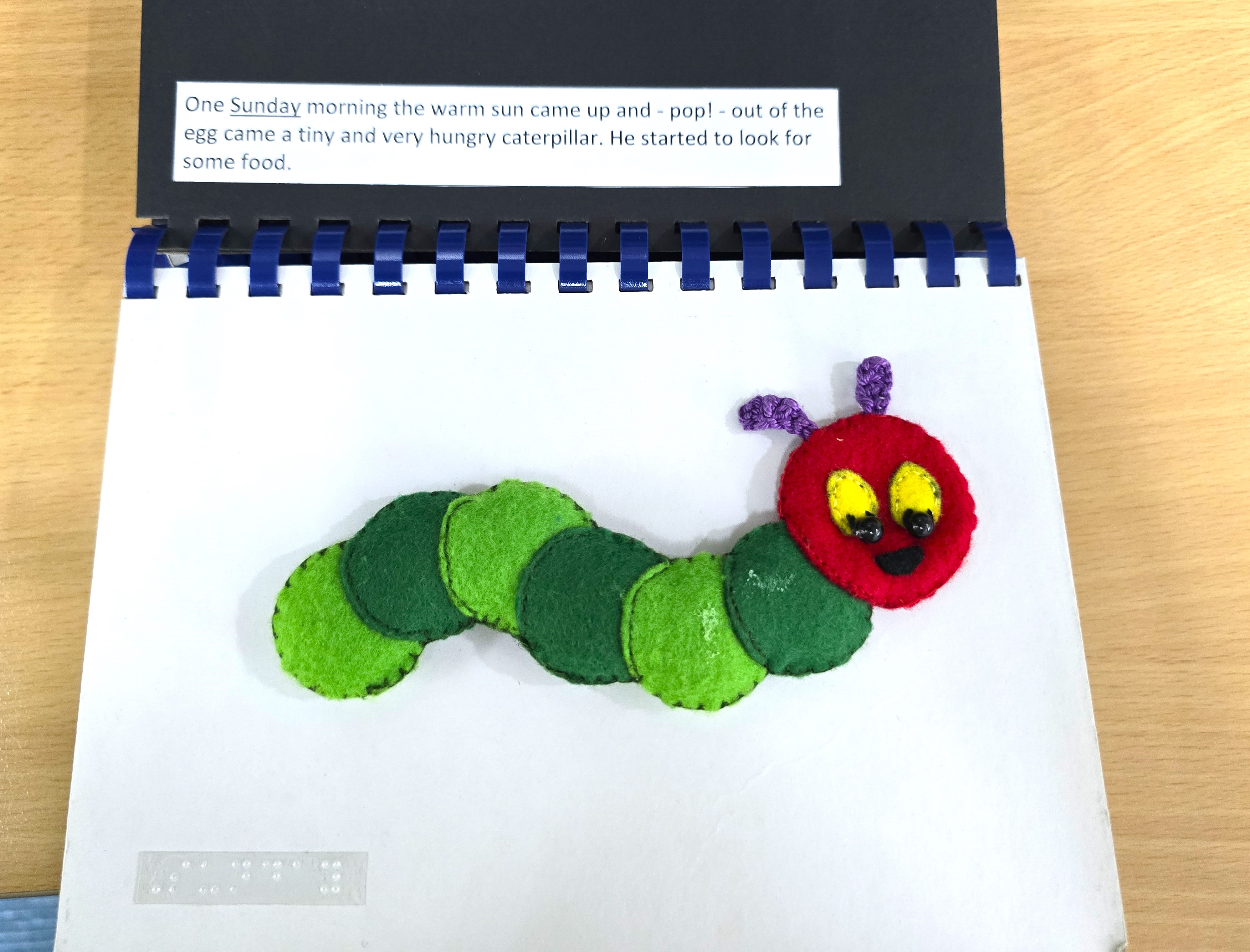
The caterpillar in The Very Hungry Caterpillar tactile picture book was handcrafted by iC2 PrepHouse teachers. Photo: iC2 PrepHouse)
These tactile picture books are a labour of love by the charity’s teachers, who painstakingly created each one from scratch. It’s a beautiful effort, but a time-consuming one: it takes two weeks to a month to custom-make a tactile book.
The magic of 3D printing changes the story, where the same process can be done in just two to five days — and at a higher volume.
In 2024, iC2 PrepHouse teamed up with digital storytelling studio Tusitala and the National Additive Manufacturing Innovation Cluster (NAMIC) Hub@SIT to develop a 3D-printed tactile braille book prototype for visually impaired children. The collaboration, supported by the Good Design Research Grant, aimed to combine storytelling, design, and additive manufacturing to make early braille literacy more accessible and engaging for children with visual impairments.
iC2 PrepHouse provided the braille expertise, Tusitala oversaw the storytelling and user experience, while NAMIC Hub@SIT, helmed by Additive Manufacturing (AM) Design Engineer Hui Yijian, took charge of the 3D printing production process — from developing the tactile components and modular braille plates, to optimising materials and print settings for durability and readability.
The result of the year-long journey was a 3D-printed version of local children’s book Timmy & Tammy: At the Botanic Gardens, complete with tactile elements and interchangeable braille plates to cater to different levels of braille literacy. The project is also a part of NAMIC’s 10th anniversary corporate social responsibility initiative, celebrating how empathy-driven innovation can contribute to a more inclusive society.
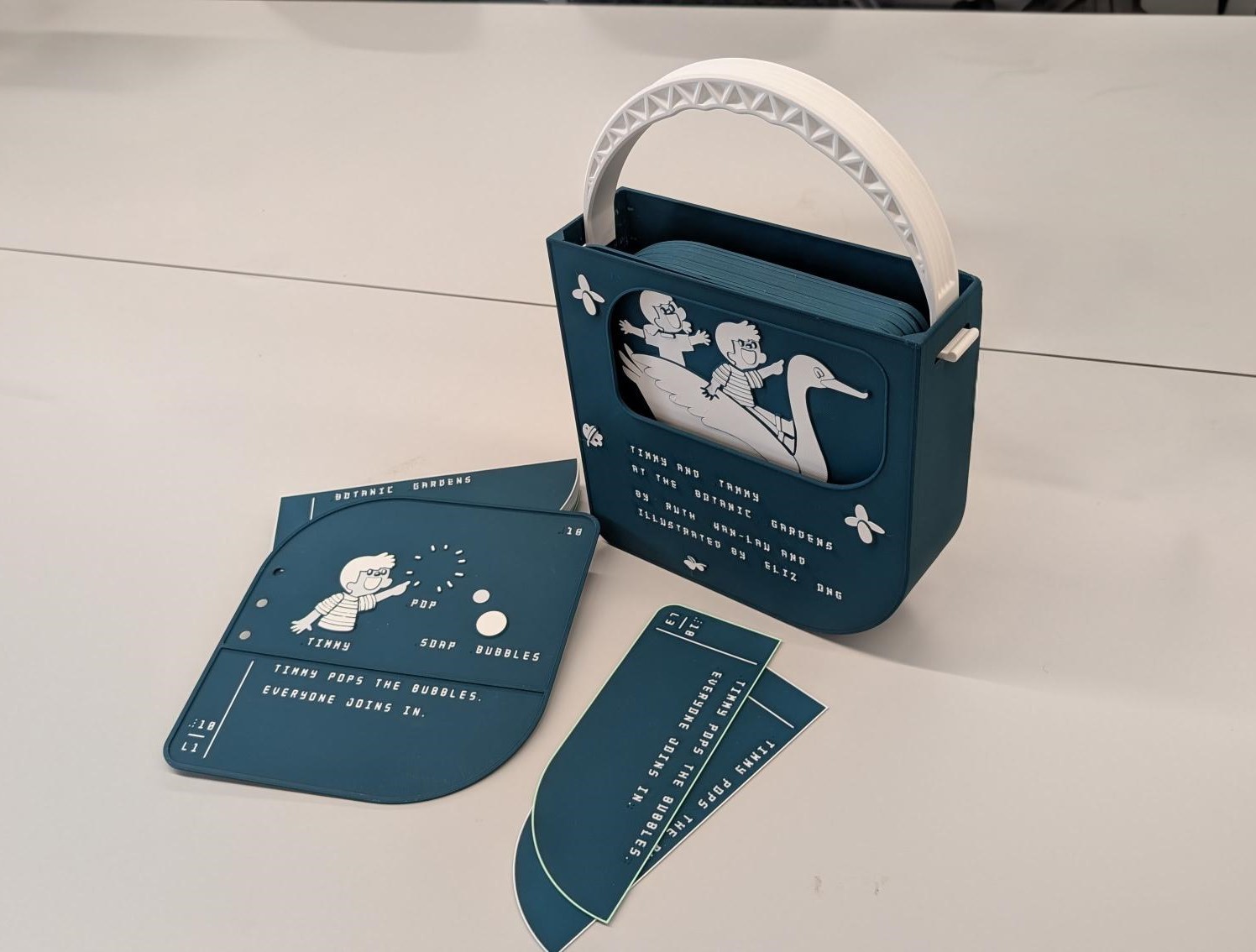
The 3D-printed braille book features interchangeable braille plates to cater to different literacy levels. (Photo: Tusitala)
Made in Singapore
There is a dearth of accessible braille picture books in Singapore, much less tactile ones. Importing them is expensive, and alternatives like audiobooks lack the tactile element, which is the primary way visually impaired children learn.
This is why tactile elements were at the front and centre of the trio’s project, without compromising braille readability. But first: which book to choose? For the team, it was important to adapt a local story that felt familiar and relevant to readers.
“This is so that their worldview is shaped first by their own surroundings, rather than of other places,” explained Yijian, who added that the story also needed to have identifiable characters and shapes.
One early contender was a book about the different types of noodles in Singapore, which was later rejected as it would have made more sense to have children touch the real objects.
The team settled on Timmy & Tammy: At the Botanic Gardens by homegrown author Ruth Wan, which featured a good mix of local wildlife. Then there came the question of how much detail to include and how much space to leave in between visuals without cluttering the page.
Finalising the design of the book during the engineering stage, including converting 2D visuals into 3D-printable files, took four to five months. The team went through numerous iterations to strike a balance between recognisable detail and clear readability. Overly fine details, such as the scales and feathers of animals, were simplified to focus on key features. Monitor lizards, for instance, were distinguishable by their outline and three raised lines on their body, while Timmy’s striped shirt differentiates him from his sister Tammy. Of course, the accompanying braille dots also had to be precise and legible.
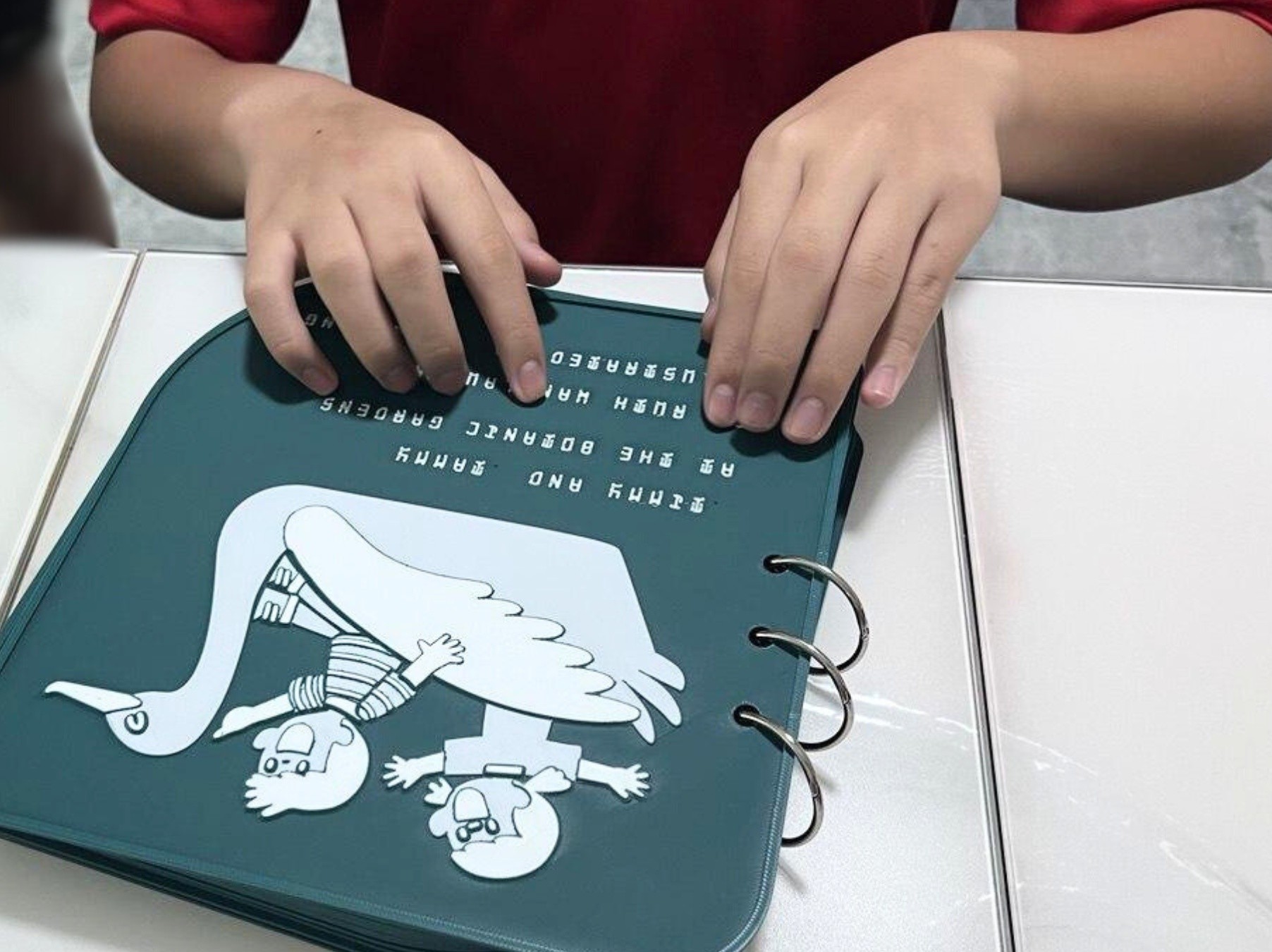
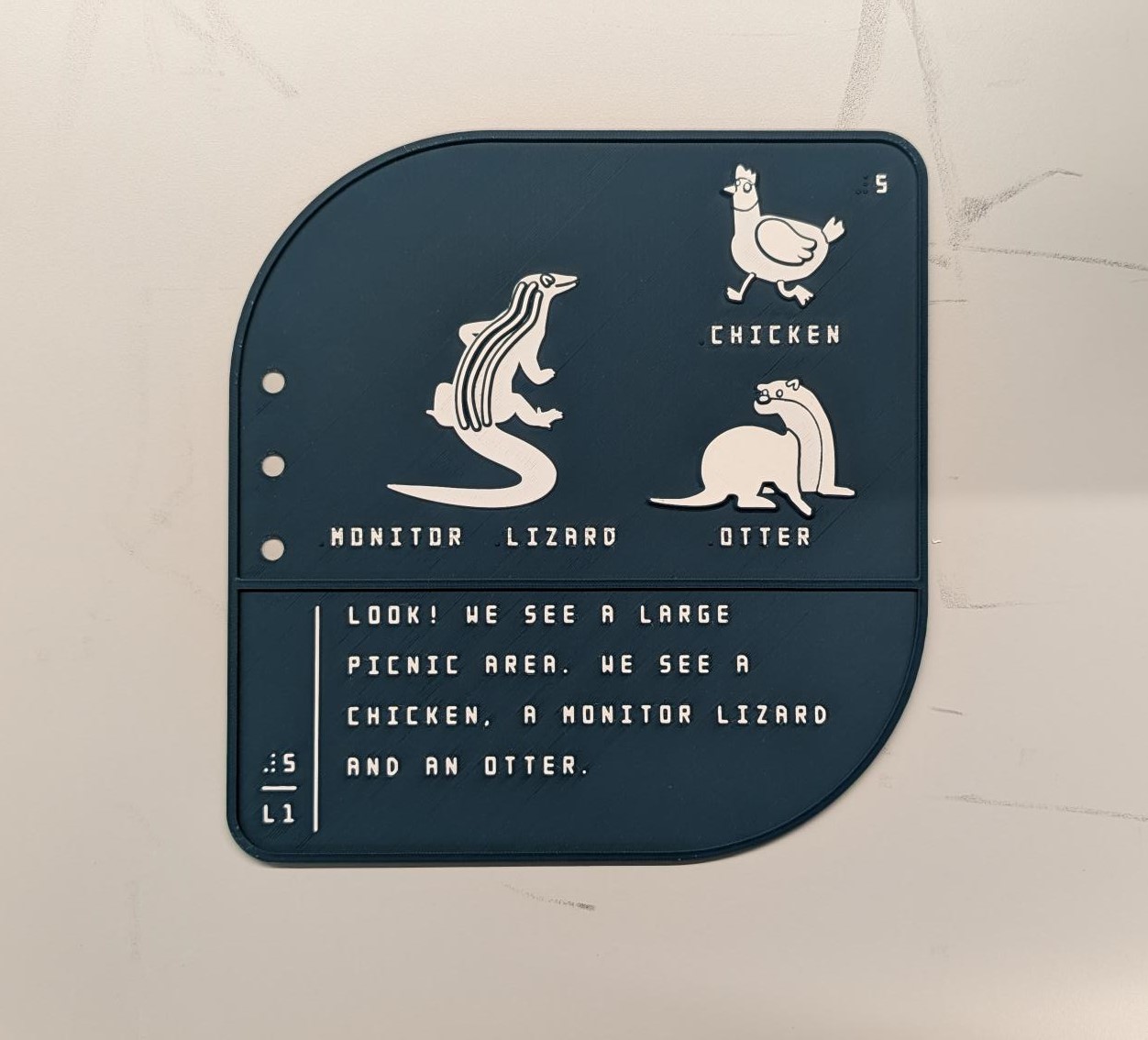
Pages from the 3D-printed version of local children’s book Timmy & Tammy: At the Botanic Gardens. Timmy and Tammy with a swan (top), and the various animals (bottom). (Photo: Tusitala)
To ensure longevity and adaptability, the book features interchangeable braille plates to match children at their literacy level and progress with them. For example, a child who is just starting out with braille might begin with just single words (“swan”), before moving on to simple sentences (“there is a swan”), and finally more complex ones (“there is a swan in the garden”) — all by snapping the respective plates onto the page, which has a passive locking mechanism, allowing educators to reuse and customise the same book for different learners.
“As children increase their braille literacy, they also build their imagination of the story. What we hope is that children can use the book for at least one to two years,” said Yijian.
Expanding the Right to Read
The response was encouraging. Not only were the children captivated by the 3D-printed book with dark-green leaf-shaped pages, parents also quickly recognised its value.
“One piece of feedback that really resonated with me came from a parent. They mentioned how a page featuring the bubble-popping concept made it much easier to explain the idea through touch,” said Yijian, referring to the textured ridges arranged in a circle that represented a popped bubble.
“The 3D-printed tactile braille book has greatly enhanced our students’ engagement and understanding. It is durable and its well-designed tactile elements help children experience stories more fully and build confidence in reading. Working with NAMIC Hub@SIT was a smooth and collaborative process, and their expertise was crucial in turning this meaningful learning tool into reality,” shared Ms Natasha De Silva, Associate Vision Teacher at iC2 PrepHouse.
The next step is to expand adoption beyond iC2 PrepHouse, and have more people create their own braille books. Ideally, anyone would be able to replicate the design process to create their own braille books, especially now that 3D printing is readily available.
In the meantime, Yijian has made it his goal to optimise certain 3D printing parameters to improve print speed without compromising quality, which could shave 20 per cent off the production time. He has also created a 3D-printed book cover that doubles as a carrier for the interchangeable pages and braille plates.
“I'm very interested in continuing to convert more books into 3D tactile braille versions for visually impaired children. This would give educators a wider selection of books and hopefully pique children's interest in learning,” said Yijian.