![[FA] SIT One SITizen Alumni Initiative_Web banner_1244px x 688px.jpg](/sites/default/files/2024-12/%5BFA%5D%20%20SIT%20One%20SITizen%20Alumni%20Initiative_Web%20banner_1244px%20x%20688px.jpg)
Applied Research
Co-designing solutions with industry partners
Areas of Expertise
Business Transformation and Societal Impact
Applied research in this area helps organisations navigate change while staying responsive to evolving societal needs - producing practical, evidence-based solutions that strengthen operations and create lasting value.
The SIT BCD cluster bridges research and practice across business practices, service excellence, responsible governance, and organisational capability development. Deeply embedded in industry, our work draws on real-world data, sector benchmarks, and stakeholder insights to generate actionable knowledge.
Research outcomes translate directly into practice through capability development frameworks, performance metrics, operational improvement strategies, and evidence-based policy recommendations – enabling organisations to optimise operations, lead responsibly, and build workforces that deliver both business results and societal impact.
Research Initiatives
S.A.I.L. - Accelerating Singapore’s Industry 5.0 Transformation.
Assistant Professor Thomas Goh partnered with the Singapore Manufacturing Federation and Lenovo to design and implement the SAIL (Sense, Align, Innovate, Lead) programme – an industry transformation Initiative that guides Singapore manufacturers from Industry 4.0 to 5.0. Through human–machine collaboration, sustainable production, and data-driven decision-making, SAIL offers tailored MAKE and LEARN tracks, seven-pillar audits, pilot projects, and recognition mechanisms, fostering ecosystem collaboration and building scalable case studies for national-level transformation. Read more here.
How Employee Brand Perception Shapes Service Excellence
Associate Professor Michael Kruesi examines how hotel frontline employees’ brand perceptions – from understanding to commitment to behaviour – progressively influence service quality, customer satisfaction and organisational performance. The research proposes a staged internal branding mechanism, showing how employee cognition, identification, and engagement jointly drive desirable service. The findings offer actionable guidance for strengthening internal branding, leadership communication, and employee engagement. Read more here.
The Impact of Short-Term Vacation Rentals on the Hotel Industry
Assistant Professor Soh Jun Tae analyses data across multiple short-term rental platforms, finding that growth in vacation rentals generally hurts hotel performance — particularly for lower-end hotels. Interestingly, when price gaps between rentals and hotels widen, the negative impact eases. The research extends the conversation beyond Airbnb, giving hotel operators a sharper view of competitive dynamics and practical strategies to adjust pricing, service offerings, and marketing to protect occupancy across market segments. Read more here.
Food Services Productivity
Associate Professor Lee Kuan-Huei contributed to the Food Services Productivity Report 2024/2025, providing the F&B sector with practical benchmarks across sales per man‑hour, sales per square foot, and manpower ratios. The report reveals significant performance gaps across the industry, with top-performing outlets achieving markedly higher productivity through streamlined operations, technology adoption, and efficient manpower deployment, offering guidance for industry improvement. Read more here.
The Impact of Workforce Reductions on Firm Performance
Assistant Professor Soh Jun Tae’s research finds that workforce reductions generally hurt tourism and hospitality firms, but the impact depends heavily on the business model. Asset‑light firms can be better positioned to mitigate the effects compared to full‑service firms, with dynamic capabilities playing a key role in how staff reductions translate into financial outcomes. This implies that workforce adjustments need to be tailored to how a business is built. Read more here.
Business Innovation & Technology Integration
Applied research in this area is built on close collaboration with industry partners to develop and test innovative solutions that tackle real operational challenges, boost productivity, and strengthen long-term competitive advantage. Grounded in real-world industry insights and sector benchmarks, our research produces knowledge that is immediately actionable — translated into operational frameworks, process redesign tools, performance improvement strategies, and evidence-based recommendations that help organisations innovate with confidence and integrate technology that actually works.
Research Initiatives
Robotic Process Automation in accounting firms
Associate Professor Chu Mui Kim documents four real-world audit scenarios from Big 4 and mid-tier firms, prototyping and implementing RPA solutions to automate repetitive, rule-based audit tasks. The research demonstrates clear benefits — greater efficiency, fewer errors, and higher-value work for auditors. It also addresses adoption challenges and governance considerations, offering accounting firms a practical roadmap for deploying automation that improves service quality and competitiveness. Read more here.
Artificial Intelligence for the Accountancy Industry
Associate Professor Koh Sze Kee, Associate Professor Desi Arisandi, Assistant Phoebe Gao and Senior Lecturer Benjamin Goh, partnered with the Institute of Singapore Chartered Accountants to assess AI readiness, sentiment and challenges across the accountancy sector. The findings are significant – it found that AI could augment 60 –100% of critical tasks across assurance, financial, and management accounting. The research champions a human‑centred approach where AI supports professionals rather than replaces them, highlighting clear opportunities for upskilling and technology adoption to enhance the profession’s strategic value. Read more here.
Data Analytics Adoption Among Singapore SMEs
Associate Professor Koh Sze Kee, Associate Professor Desi Arisandi, and Assistant Professor Lee Hwee Hoon partnered with RSM Singapore and the Institute of Singapore Chartered Accountants to survey 575 Singapore SMEs on data analytics adoption. The findings are striking — around 69% have yet to embrace analytics, held back by scepticism, limited resources, infrastructure gaps, and a lack of skilled staff. A follow-up study further found that data quality and systems are key enablers, while poor understanding and security concerns remain barriers. The message is clear: businesses that use analytics effectively get better results. Read more here.
Hand and Leg Straps – Rehabilitation Made Accessible
Associate Professor Agnes Xue developed hand and leg straps now distributed at ActiveSG gyms and adopted by the Singapore National Stroke Association to support stroke survivors’ rehabilitation. Simple, user-centric and effective, the product improves accessibility, encourages coordinated movement and demonstrates how thoughtful design can strengthen therapy outcomes and community‑based recovery. Read more here.
Redesigning the Transition into Nursing Homes
Associate Professor Agnes Xue used a design thinking, phenomenological approach to understand what older adults in Singapore experience when transitioning into nursing homes. The study identified four distinct transition phases and personas — revealing how emotional responses, support mechanisms, and visitation frequency shape the experience. The findings offer a human-centred model for nursing home admission: one built on empathy-driven assessments, preparatory orientation, family engagement, and personalised psychosocial support that improves resident outcomes from day one. Read more here.
Sustainable Business Futures
Applied research in this area helps organisations build long-term value by embedding environmental, social, and governance (ESG) considerations into strategic decision-making — balancing profitability with responsible stewardship that benefits both business and society. Grounded in real-world data, sector benchmarks, and stakeholder insights, our research delivers actionable knowledge — translated into ESG integration frameworks, governance assessment tools, impact measurement metrics, and evidence-based policy guidance. The outcome: organisations equipped to lead responsibly, make better decisions, and create lasting value.
Research Initiatives
Eco-feedback technology in wildlife attractions
Associate Professor Michael Kruesi partnered with Mandai Wildlife Park to explore how real-time environmental feedback shapes visitor engagement and sustainable behaviours. The study analyses both visitor and operator perspectives, offering practical guidance for improving conservation education and designing more meaningful visitor experiences in tourism. Read more here.
Rethinking Sustainable Development: Economic Integration and Public Policy
Associate Professor Seck Tan re-examines sustainable development through the lens of economic integration and public policy — making the case that coordinated regional cooperation, institutional alignment, and evidence-based policymaking are essential to balance growth, equity, and environmental priorities. The research proposes frameworks linking macroeconomic governance, trade integration, and policy coherence to deliver long-term, inclusive development outcomes. For organisations, the implications are clear: align corporate strategy with regional sustainability policies, embed ESG into investment decisions, and collaborate across supply chains to support inclusive growth. Read more here.
What Motivates Individuals to Practice Online Safety
Associate Professor Jiow Hee Jhee collaborated with Kaspersky Lab to investigate what drives individuals to adopt cybersecurity practices. Drawing on Protection Motivation Theory, the research examines how risk perception, response efficacy, and self-efficacy shape behaviours — from secure connectivity to password protection. The findings provide evidence-based guidance for designing behaviour-focused cybersecurity training that builds risk awareness, confidence, and practical protective habits — strengthening workforce digital resilience and organisational security culture. Read more here.
Audience Co-experience and Social Media Engagement in Digital Communities
Assistant Professor Jisu Kim examines how shared experiences and audience identification shape social media engagement. The research finds that co-experience and emotional arousal significantly strengthen proactive, active, and reactive participation — offering media organisations practical insights to design community-centric content strategies that deepen interaction and sustain audience engagement over time. Read more here.
Cultivating New Taste
Assistant Professor Aaron Ng explores how independent coffeehouses and social media are reshaping coffee culture among Chinese millennials — linking aesthetic experiences, online communities, and social distinction. The research shows that "taste makers" create cultural value and belonging, driving specialty coffee demand well beyond functional consumption. A practical lens for café operators, brand marketers, and lifestyle businesses looking to build community-oriented experiences that resonate with evolving consumer identities. Read more here.
Our applied research is designed to create and capture real value for industry partners. To deepen strategic partnerships — spanning multidisciplinary research, talent development, and workforce training — SIT has established thematic centres to support industry where it matters most.
Design Factory@SIT
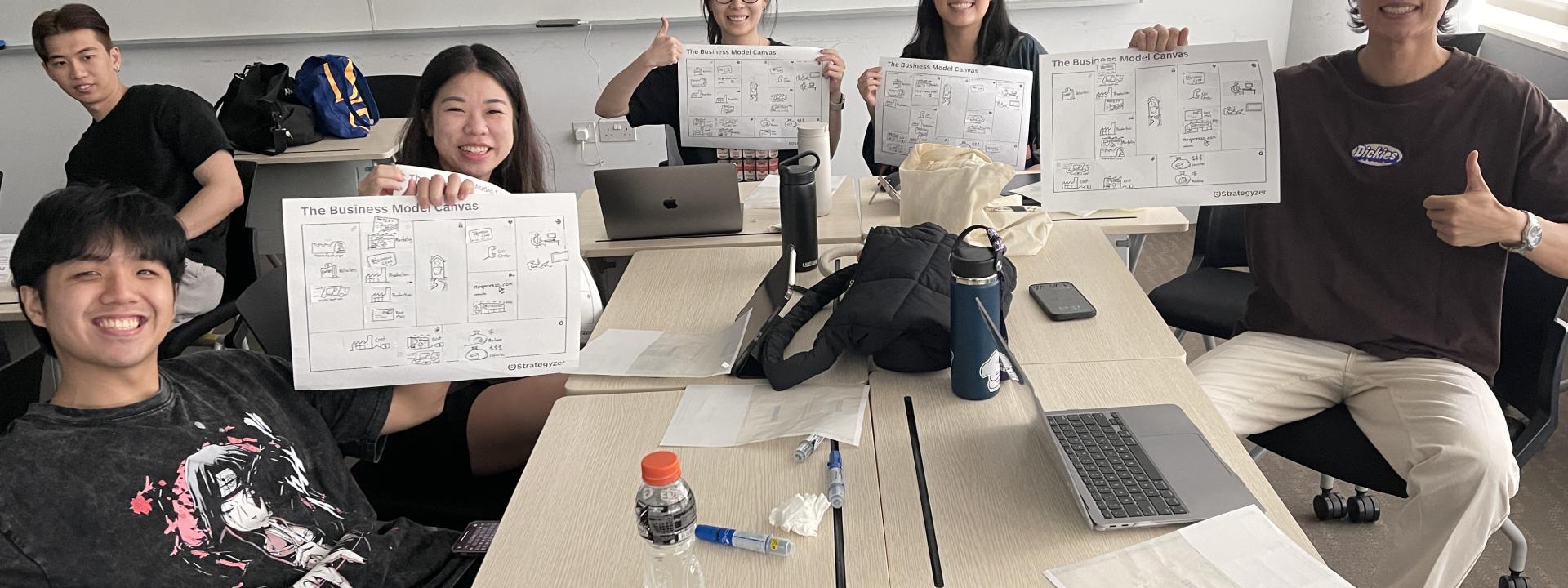
Design Factory@SIT (DF@SIT) takes a user-centric approach to collaborative innovation — partnering with industry to solve real challenges while creating authentic, interdisciplinary learning experiences for students. A space where industry needs and student potential come together.