
About Programme
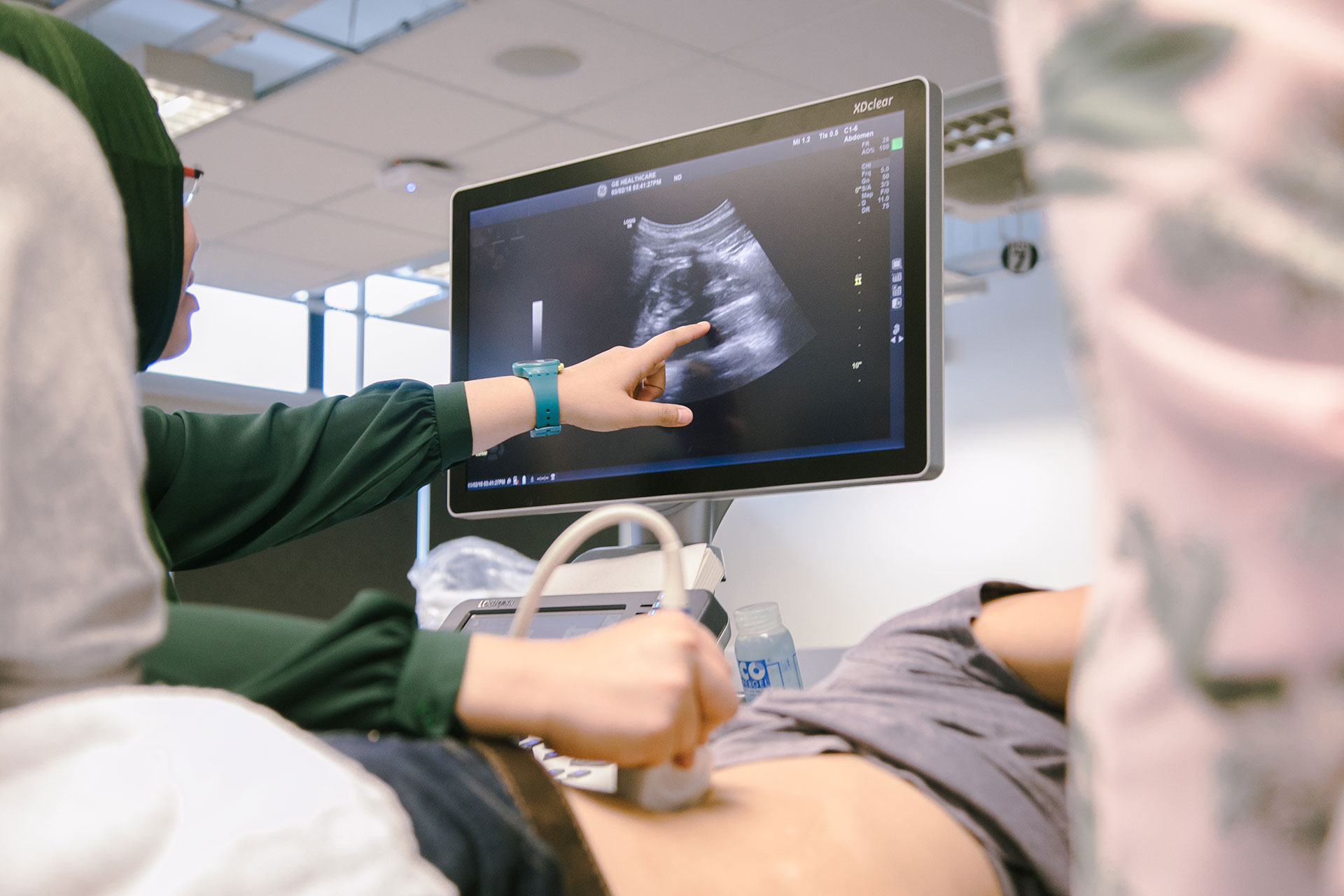
Ultrasound is a frontline diagnostic tool across a wide range of clinical contexts — from evaluating hepatobiliary and kidney disease, to monitoring maternal and foetal health throughout pregnancy. As Singapore’s healthcare system expands capacity to meet growing patient needs, there is increasing demand for sonographers and allied health professionals to deepen their formal clinical expertise and advance into broader scopes of practice.
This micro-credential was developed in direct response to industry demand and government healthcare policy priorities around upskilling the current healthcare workforce. It offers practising sonographers and radiographers a structured, part-time pathway to earn a recognised postgraduate qualification in medical sonography — without stepping away from clinical work.
This micro-credential is part of SIT’s Competency-based Stackable Micro-credential (CSM) Pathway leading to the Master of Health Sciences (MHSc). It comprises three modules delivered through a blended model of online lectures, case-based tutorials, and intensive hands-on practical sessions, with each module offered concurrently with supervised clinical practice in the learner’s own workplace. Upon completing all three modules and fulfilling the requirements, learners will be awarded a Graduate Certificate in Medical Sonography Principles and Practice (18 credits):
| Module Code | Module Title | Credits |
|---|---|---|
| DRG6101C | Ultrasound Physics and Instrumentation | 6 |
| DRG6102C | Abdominal Sonography | 6 |
| DRG6109C | Obstetric and Gynaecologic Sonography | 6 |
| Total | 18 | |
Skills you’ll gain
Competency-based Education
Health Sciences
Sonography
Who Should Attend
This micro-credential is suitable for practising sonographers, radiographers, and allied health professionals who perform or support diagnostic ultrasound examinations and wish to pursue a formal postgraduate qualification in medical sonography.
Minimum Entry Requirements
Relevant ultrasound-related experience with at least 1 year of working experience as an independent sonographer
Access to a medical ultrasound facility for clinical applications
Recognised Bachelor’s degree in any of the health sciences registrable with local regulatory bodies
Mandatory Supporting Documents
- Employment support letter (including applicant’s area of work)
- Degree transcript of highest relevant qualification
- Professional certification
Written Responses (100–150 words each)
- Your reasons for pursuing the module
- Why you selected SIT over other academic institutions
- What you hope to achieve upon completion of the module
Learning Outcomes
This micro-credential is predominantly delivered through a competency-based education (CBE) approach where learners acquire and demonstrate mastery of knowledge and skills that are directly relevant to job functions. This prepares them to be industry-ready where they can apply their newly acquired competencies to their work.
Upon successful completion of this micro-credential, learners will be able to:
Analyse, design, and evaluate neurological rehabilitation approaches by integrating clinical reasoning, research evidence, and service innovation strategies, demonstrating the ability to deliver and improve patient-centred care and functional outcomes in complex, real-world contexts.
Evaluate and optimise ultrasound imaging practice by ensuring high-quality diagnostic images and system performance using ultrasound physics, instrumentation knowledge, artefact recognition, quality assurance methods, and ALARA principles, demonstrating autonomous and safe technical judgement in clinical contexts.
Evaluate and integrate abdominal ultrasound findings by assessing normal anatomy and pathology using sonographic knowledge, scanning techniques, and clinical presentation data, demonstrating reflective clinical judgement, ethical decision-making, and effective communication within multi-professional practice.
Evaluate and integrate obstetric and gynaecologic ultrasound findings by assessing normal anatomy and pathology using sonographic knowledge, modality limitations, adaptive scanning techniques, and clinical presentation data, demonstrating reflective, accountable judgement and ethical, effective communication in multi-professional practice.

Coaching for Success
During the course, you will have access to a team of qualified success coaches who can work with you on learning strategies or to develop a personalised learning plan. Through the success coaches, you can gain access to a wide range of resources and support services, and be empowered with the necessary tools to navigate your learning journey successfully.
Teaching Team
Rita Phillips
Senior Lecturer, Medical Ultrasound, University of The West of England, Bristol UK (UWE), Advanced Practitioner, Ultrasound Department, Royal United Hospital Foundation Trust (RUH) Bath UK
View profile

Nicole Seah
Chief Radiographer, Fetal Assessment Centre
View profile

Amarjit Kaur
Senior Sonographer, Perth Radiological Clinic and Sir Charles Gairdner Hospital, Australia. Associate Faculty, Health and Social Sciences, Singapore Institute of Technology
View profile
Course Details
Modules
This micro-credential comprises three modules totalling 18 credits. Completion of each module awards a Certificate of Attainment.
| Module Code | Module Title | ABOUT MODULE | Credits | Annual Intake |
|---|---|---|---|---|
| DRG6101C | Ultrasound Physics and Instrumentation | Builds the technical foundation for safe and high-quality sonographic practice, covering ultrasound physics, instrumentation, artefact recognition, image optimisation, and quality assurance using ALARA principles. | 6 | Trimester 1 (September) |
DRG6102C
| Abdominal Sonography
| Develops competency in abdominal ultrasound examination, including assessment of the liver, gallbladder, biliary system, kidneys, spleen, pancreas, and major abdominal vessels, as well as advanced techniques such as FAST scans, elastography, and contrast-enhanced ultrasound.
| 6 | Trimester 2 (January) |
DRG6109C
| Obstetric and Gynaecologic Sonography
| Equips learners with the knowledge and scanning skills for obstetric and gynaecologic ultrasound across all trimesters, covering normal and abnormal anatomy, foetal well-being assessment, and Doppler studies.
| 6
| Trimester 1 (September) |
Total | 18 | |||
Certificate and Assessment
A Certificate of Attainment for each module will be issued to learners who:
- Attend at least 75% of the module
- Undertake and pass the credit-bearing assessment for that module
Participants who meet the attendance requirement but do not pass the assessment will receive a Certificate of Participation.
Upon passing all three modules totalling 18 credits within 8 months with a CGPA of ≥ 2.0, learners will be awarded the Graduate Certificate in Medical Sonography Principles and Practice, which can then be stacked towards the Master of Health Sciences (MHSc).
Fees, Subsidies & Course Applications
SkillsFuture funding of up to 90% is available for eligible Singapore Citizens and Permanent Residents for each module taken individually.
For learners stacking micro-credentials towards the full Master of Health Sciences, SkillsFuture funding is available for up to 30 credits (equivalent to 5 modules) across the degree programme.
Please refer to individual module pages for details on fees, applicable subsidies, course run and to proceed with applications:
DRG6101C Ultrasound Physics and Instrumentation (coming soon)
DRG6102C Abdominal Sonography (coming soon)
DRG6109C Obstetric and Gynaecologic Sonography (coming soon)
For Organisations
Interested in this course for your business or team?
Tailored to your organisation's specific training needs, we can help you design and develop custom courses to grow key talent and build specialist expertise to meet the future demands of work.
Course Runs
Learning Pathway

Earn a Graduate Certificate
The Graduate Certificate in Sustainability Principles and Practices is designed to equip professionals with the sustainability-related expertise to navigate industry demands, regulatory shifts, and sustainability challenges in the evolving landscape.
Explore More
New Engineering Micro-credentials Launching Soon!
Exciting news! We are introducing new micro-credentials in Electrical and Electronic Engineering & Infrastructure and Systems Engineering. Be among the first to know by registering your interest today! Register now →